


| Quantity: | |
|---|---|
Manual assembly machine is composed of three parts, pre-assembly station, riveting station and accessory assembly station. It is applied for two types of busbar: two piece type and four piece type. Main function of this machine is to fix the busbar conductor in convenience of riveting. All operation such as rotating, riveting and etc. will be done manually.


The Manual Assembly Machine supports operator-paced busbar assembly and jointing. Its published configuration combines a manual fixture with power tooling, mechanical or hydraulic clamping, and foot-pedal or push-button control. The original assembly platform uses pre-assembly, riveting and accessory-fitting stations for two-piece and four-piece busbars. This layout keeps the conductor supported while operators complete the required joining operations. |  Official Kiande Electric product image |
The current page uses KD-Manual-Assembly-Machine, while its narrative also names the KD-SDX/2(4)-6(4.5) platform. Confirm the ordered model and tooling scope. Conflicting cycle-time descriptions are not used as a performance guarantee.
| Parameter | Specification |
|---|---|
| Published Model / Identifier | KD-Manual-Assembly-Machine; KD-SDX/2(4)-6(4.5) platform in narrative |
| Function | Manual busbar assembly & jointing |
| Busbar Length Range | 300mm – 6000mm |
| Workstation Type | Manual fixture + power tooling |
| Clamping Method | Mechanical / hydraulic clamp |
| Torque Range | Configurable per joint spec |
| Control | Foot pedal / push-button |
| Power Supply | 380~415VAC 50~60Hz |
| Pneumatic Supply | 0.5 – 0.7 MPa |
| Working Mode | Operator-paced assembly |
Operator-Paced AssemblyOperators control the assembly sequence and timing rather than follow a fixed automatic cycle. | Clamping ChoiceMechanical and hydraulic clamp arrangements are listed on the current product page. | Powered Jointing ToolsThe workstation pairs a manual positioning fixture with power tooling. |
Joint-Specific TorqueThe published torque range is configurable according to the joint specification. | Length CoverageThe current specification table lists a busbar length range of 300mm–6000mm. | Control OptionsFoot-pedal and push-button actuation are available in the published configuration. |
FunctionsOperator-Paced Assembly — Operators control the assembly sequence and timing rather than follow a fixed automatic cycle. Clamping Choice — Mechanical and hydraulic clamp arrangements are listed on the current product page. Powered Jointing Tools — The workstation pairs a manual positioning fixture with power tooling. | Working Principle
|
Two-Piece BusbarsManual assembly of the two-piece busbar structure described on the original page. | Four-Piece StructuresFixture-supported joining for the four-piece busbar arrangement. | Accessory InstallationA dedicated workstation for fittings after the riveting operation. |
Specify the busbar cross-section and whether mechanical or hydraulic clamping is required.
Identify the fastener, joint torque and preferred actuation method.
Discuss the lengths and sequence of pre-assembly, joining and accessory stations.
Recommended acceptance checks for manual assembly machine:
Clamp FitCheck that the fixture holds the actual busbar without obstructing the joining position. | Joint SettingVerify the selected torque and tooling against the production drawing. | Operator AccessReview movement and access around a representative long section. |
Manual-Line ExperienceKiande lists manual busbar production equipment among its manufacturing and customization activities. | Joining and AccessoriesIts official product range covers both production equipment and busbar accessories. | Engineering DepartmentsThe company identifies engineering design, production and after-sales departments on its website. |
The three-stage arrangement separates preparation, riveting and accessory fitting.
Clamping and actuation choices can be discussed against the specific busbar joint.
The manufacturer also supplies semi-automatic and automatic lines for different production plans.
Related equipment for manual assembly planning: Semi-Automatic Assembly Line, Automatic Busbar Assembly Line, Manual Inspection Line.
Busbar trunking manufacture
Busway assembly operations
Electrical manufacturing
Suzhou Kiande Electric Co.,Ltd. develops equipment for electrical manufacturing. Its range includes manual assembly lines, inspection machines and busbar accessories. The company lists its headquarters in Suzhou and its manufacturing center in Zhenjiang. | 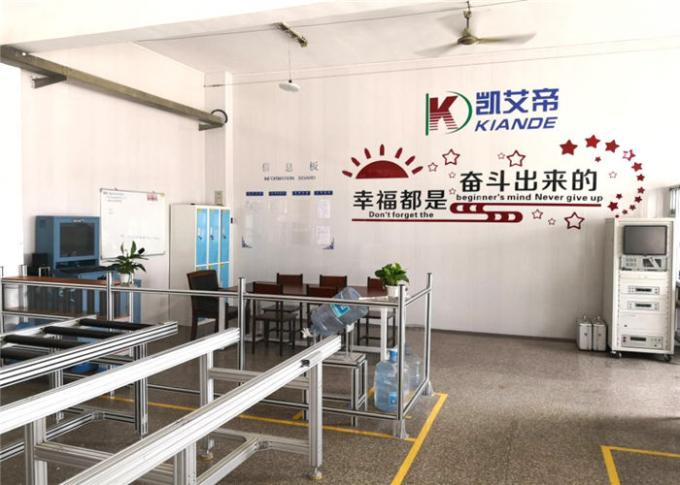 Factory scene published on Kiande’s official sister website |
Provide section dimensions, fastener details and the required manual operations.
Identify fixtures, power tooling and accessories in the itemized quotation.
Use representative parts to discuss clamp access and joining requirements.
Kiande’s official website displays an invention patent document for busduct processing equipment. This is a company technology document. It does not establish CE conformity or current ISO certification for every product configuration. |  Company-published invention patent document |
The current table lists 300mm–6000mm. The earlier platform description also identifies a 6000mm maximum; confirm the fixture arrangement for the shortest sections.
Its working mode is operator-paced assembly. The original KD-SDX/2(4)-6(4.5) platform describes manual riveting and manual rotation.
Both structures are described for the KD-SDX/2(4)-6(4.5) platform. Match the lifting fixtures and clamp arrangement to the intended structure.
The KD-Manual-Assembly-Machine table lists mechanical or hydraulic clamping. The final selection depends on the joint and busbar geometry.
The current table specifies 380~415VAC at 50~60Hz and a pneumatic supply of 0.5–0.7MPa.
No fixed cycle applies to every configuration. The current KD-Manual-Assembly-Machine table identifies an operator-paced mode, so tooling, section size and station use must be reviewed.


