


| Quantity: | |
|---|---|
Automatic assembly line is customized according to clients’ busbar type. It can achieve unmanned operation no matter the busbar is fixed by rivet or bolt. Currently the busbar type is mainly divided into two types: two-piece type and four-piece type.
By automatic assembly and fixing, the automatic assembly machine will help to reduce manpower and improve the product quality and working efficiency. The working principle is to recognize the busbar type and adjust all the parameters in the machine automatically by scanning the bar code. By module interconnection among PLC, network, touch screen and IPC etc., automatic assembly machine can also achieve information communication with ERP, automatic inspection machine and other related machines.


The KD-ZDX/NC-2(4)D-6(4.5) Automatic Busbar Assembly Line is customized to the busbar structure. The original description covers two-piece and four-piece types, with automatic assembly and fixing. Barcode scanning identifies the busbar type and adjusts machine parameters. The page describes communication through PLC, network, touchscreen and IPC modules, including interfaces with ERP and automatic inspection equipment. |  |
The source dimension includes H19000mm. This value is preserved as published and explicitly flagged for confirmation; it is not silently changed to H1900mm. Bolt-fixing scope must be confirmed separately from the automatic-riveting table.
| Parameter | Specification |
|---|---|
| Model | KD-ZDX/NC-2(4)D-6(4.5) |
| Max. Busbar Height | 350mm(Single layer) |
| Max. Busbar Length | 6000mm |
| Position Type | Unilateral position/ Middle position |
| Working Efficiency | Around 3000 mm/2 min |
| Control Axis | 5 Axis |
| Control System | Network control, Online maintenance (optional) |
| Riveting Station Nos | 4 sets (Four-piece type)/2 sets (Two-piece type) |
| Riveting Type | Automatic riveting |
| Power | 380~415VAC 50~60Hz 20kW |
| Equipment Dimension: | L25000mm*W2000mm*H19000mm |
Barcode-Based SetupScanning identifies the busbar type and adjusts the related machine parameters. | Five Control AxesFive control axes are specified in the source table. | Structure-Based RivetingFour stations are listed for four-piece busbars and two for two-piece busbars. |
Positioning ChoicesUnilateral and middle positioning are listed. | Network ControlNetwork control is specified, with online maintenance marked optional. | Automatic RivetingThe published riveting type is automatic riveting. |
FunctionsBarcode-Based Setup — Scanning identifies the busbar type and adjusts the related machine parameters. Five Control Axes — Five control axes are specified in the source table. Structure-Based Riveting — Four stations are listed for four-piece busbars and two for two-piece busbars. | Working Principle
|
Two-Piece Busbar LinesAutomatic assembly with the two-station riveting configuration. | Four-Piece Busbar LinesAssembly using the published four-station arrangement. | Networked Busway ProductionProduction requiring the communication interfaces described on the official page. |
Specify two-piece or four-piece busbars and whether the product requires rivets or bolts.
Select unilateral or middle positioning against the section and line layout.
Define ERP, inspection-machine and optional online-maintenance requirements.
Recommended acceptance checks for automatic busbar assembly line:
Barcode Recipe MatchCheck that scanning selects the correct type and machine settings. | Fastening ReviewInspect the assembled section under the agreed riveting or bolting configuration. | Interface CheckVerify the information exchanged with the connected production equipment. |
Automatic Assembly OfferingFully automatic production lines are named in Kiande’s official equipment range. | Related Inspection MachinesThe company also lists automatic and manual inspection equipment. | Production and Data BusinessIts company profile emphasizes intelligent production and data analysis. |
Riveting-station count and positioning can be reviewed against busbar structure.
Barcode recognition links product type to the machine settings.
The original page describes information exchange with related machinery and ERP.
Assembly-level alternatives and quality inspection equipment: Semi-Automatic Assembly Line, Manual Assembly Machine, Manual Inspection Line.
Automated busway manufacture
Busbar trunking assembly
Electrical factory automation
Kiande develops busbar production equipment with a stated focus on intelligent manufacturing and data analysis. Its official range includes automatic assembly, inspection and packing machinery. Headquarters are in Suzhou, and the manufacturing center is in Zhenjiang. | 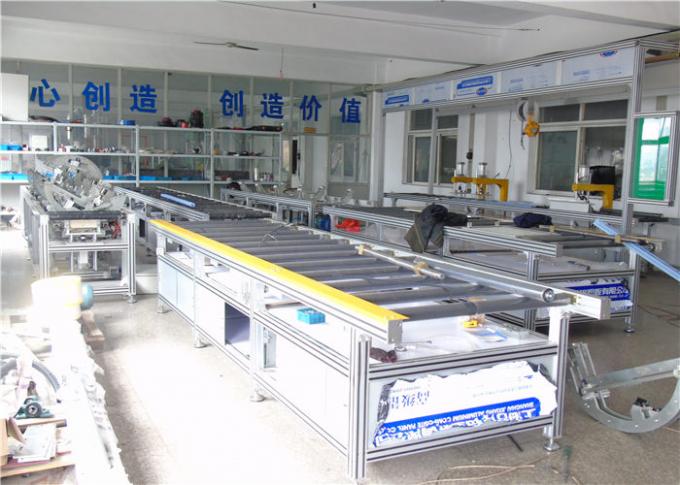 |
Provide structure, section dimensions and fastening requirements.
List barcode, ERP and inspection-machine communication requirements.
Review the model-specific footprint and station arrangement before site planning.
Kiande’s official website displays an invention patent document for busduct processing equipment. This is a company technology document. It does not establish CE conformity or current ISO certification for every product configuration. |  |
KD-ZDX/NC-2(4)D-6(4.5) lists both. Its table specifies two riveting stations for two-piece busbars and four for four-piece busbars.
The KD-ZDX/NC-2(4)D-6(4.5) description uses barcode scanning to recognize the type and adjust machine parameters.
The source lists a maximum length of 6000mm and a maximum single-layer height of 350mm.
The KD-ZDX/NC-2(4)D-6(4.5) description covers communication using PLC, network, touchscreen and IPC modules. Confirm the actual interface scope in the quotation.
The KD-ZDX/NC-2(4)D-6(4.5) table lists network control and identifies online maintenance as optional.
The table publishes L25000mm × W2000mm × H19000mm. The 19000mm height needs confirmation on an arrangement drawing; it has not been changed to an assumed value.
The KD-ZDX/NC-2(4)D-6(4.5) table gives around 3000mm/2min and 380~415VAC, 50~60Hz, 20kW. The production reference is not a universal cycle guarantee.
Besides that, automatic assembly machine has self-checking functions by self diagnosing each input and output signal to avoid failures. Furthermore, data statistics for machine’s OEE (comprehensive utilization rate) is helpful for future data analysis.
Currently the busbar type is mainly divided into two types: two-piece type and four-piece type.


