
Views: 0 Author: Site Editor Publish Time: 2026-09-20 Origin: Site


Setting up a busbar production line is a big decision. Demand for busbars is growing because of energy efficiency, renewable power, and electric cars. Your line must be both precise and fast. This guide covers the key machines, layout choices, and costs. You need a clear plan to avoid expensive mistakes. Adding automation helps keep quality steady. Top manufacturers offer custom setups. How much you invest affects how much you can grow later. Knowing your needs early prevents downtime. Think carefully about how many parts you will make and how work flows. A smartly designed line saves time and money for years. Use this guide to move forward step by step with confidence.
Plan your busbar line based on your current production and future growth goals.
Pick CNC machines for accuracy and automation to lower labor costs.
Plan a straight-line setup that includes safe areas and space for repairs.
Invest in automation for high-volume production to get your money back quickly.
Get your site ready and train your team so you avoid startup problems.
Before buying any equipment, you need a clear view of your market and your business goals. A busbar production line costs a lot, so your machine choices must match realistic demand forecasts. Start by studying your target customers: switchgear makers, electrical panel builders, or renewable energy integrators. Each group needs different tolerances, batch sizes, and material specs. You also need to check your facility's available floor space, power supply capacity, and material handling abilities. These factors directly affect which machines you can install and how you set them up.
Your planning phase starts with a full market analysis. Find out which busbar types your customers need, such as two-piece or four-piece designs, and decide whether you will work with copper, aluminum, or both. You must also review your current workforce's technical skills. Running CNC-controlled busbar manufacturing equipment requires trained staff who understand programming and quality control. Additionally, you need to set your quality standards and testing methods before production begins. Many manufacturers skip documentation needs, yet traceability becomes vital when you supply parts for critical power systems.
You should also think about regulatory compliance and safety rules. Your facility must meet local electrical codes and workplace safety regulations. Proper ventilation, emergency stops, and protective guards on machines are must-haves. Suzhou Kiande offers custom solutions that help you plan both capacity and layout during this early stage. Their engineers review your production goals and suggest equipment setups that fit your space and budget limits. This team approach prevents costly redesigns after installation.
Your production volume determines how much automation you need. A small shop making custom busbars for local contractors might run a single manual machine. A factory supplying busway systems to large distribution projects needs a fully automated line with little human involvement. Calculate your target output per shift, then work backward to find machine cycle times and staffing needs. For example, if you need 500 busbars per day and each machine handles one part every two minutes, you need roughly two machines running eight-hour shifts.
Your capacity goals also shape your investment plan. Higher production capacity demands more advanced equipment, which raises your initial cost. However, automation cuts long-term labor costs and improves consistency. You should estimate your break-even point based on expected order volumes and pricing. Consider future growth too. A modular production line lets you add stations as demand rises. Suzhou Kiande designs systems with scalability in mind, so you can start with essential processes and add more automation later without replacing core machinery.
Your busbar production line requires several categories of machinery that work together from raw material to finished product. The complete setup includes busbar fabrication machines for punching and bending, busduct housing processing equipment for cutting and profile sawing, busbar assembly equipment for fitting and riveting, and busduct inspection equipment for electrical testing. You also need slitting machines for raw material preparation, PET film forming machines for insulation coating, busbar cutting machines for length cutting, copper/aluminum bar processing machines for shaping, punching machines for connection points, riveting equipment for assembly, testing lines for quality verification, and packing equipment for final packaging. You can start with manual or semi-automatic versions of these machines, then upgrade as your order volumes stabilize.
The core of your operation centers on three critical operations: cutting, punching, and bending. Each operation demands precision because errors create fitting problems downstream. CNC busbar processing machines improve dimensional consistency across batch production, preventing length errors that cause assembly issues. CNC punching machines enhance hole position accuracy, ensuring reliable bolt installation and electrical connections. CNC bending machines deliver precise bending angles, preventing interference with breakers or cabinet structures. CNC control also enables faster parameter adjustment, reducing slow changeover times between different busbar specifications. Integrated processing machines improve workflow stability, lowering your rework rate significantly.
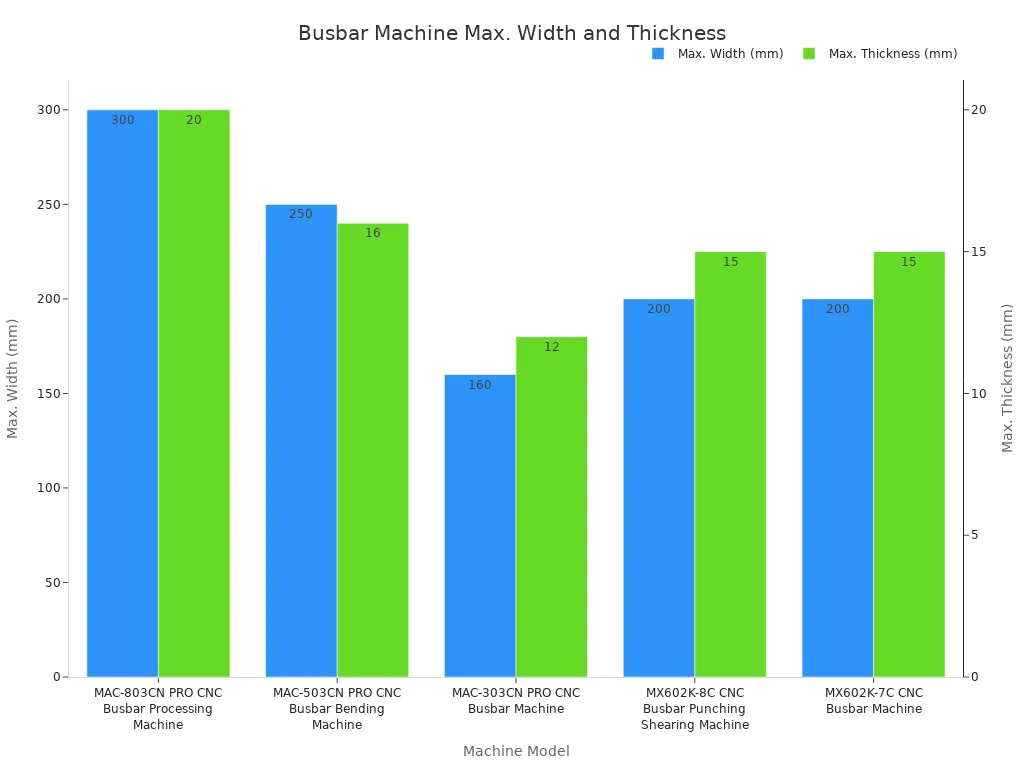
Different machine models handle varying material dimensions. The MAC-803CN PRO CNC busbar processing machine handles a maximum width of 300 mm and thickness of 20 mm. The MAC-503CN PRO CNC busbar bending machine manages 250 mm width and 16 mm thickness. The MAC-303CN PRO CNC busbar machine processes 160 mm width and 12 mm thickness. The MX602K-8C CNC busbar punching shearing machine and MX602K-7C CNC busbar machine both accommodate 200 mm width and 15 mm thickness. These specifications help you match equipment to your typical workpiece sizes.
The servo 3-in-1 busbar machine adds a servo stopper system to the punching, bending, and cutting units. Through PLC numerical control, it achieves automatic positioning, replacing manual calibration. This results in production efficiency that is 5 times that of traditional busbar machines.
Computer control systems can control tolerances on thousands of parts to within a fraction of a millimeter, ensuring correct fit and function while reducing waste. This precision matters especially for high-voltage applications where connection integrity is critical.
Suzhou Kiande offers advanced solutions that elevate your busbar manufacturing capabilities. Their busbar machines combine cutting, punching, and bending functions into one unit, eliminating the need to switch between separate machines. This multi-functional busbar machine reduces setup time and occupies less floor space than multiple dedicated machines. The busbar fabrication process becomes streamlined, allowing workers to focus on higher-value activities rather than repetitive manual tasks.
Kiande's busduct production line takes automation further by integrating the entire busbar fabrication process into a coordinated system. This line supports both two-piece and four-piece busbar configurations, offering flexibility for diverse manufacturing needs. The system features automatic assembly that reduces manual labor while increasing speed and consistency. Advanced barcode scanning technology identifies busbar types and automatically adjusts machine settings for optimal processing. ERP integration enables seamless data handling and smooth workflow, supporting digital traceability and audit readiness.
The production line connects individual processing units into one unified system, incorporating continuous material feeding, precision cutting, bending, punching, automatic riveting, insulation wrapping, online inspection, and finished packaging. This integration reduces human intervention throughout the entire production cycle. Automatic inspection machines conduct feeding, positioning, and multi-dimensional quality verification, ensuring traceable manufacturing processes and uniform product quality. Kiande designs its machinery for unmanned or lightly manned workshops, aligning with the smart factory concept. Their equipment serves both low-voltage switchgear applications and high and low voltage switchgear manufacturing, making it versatile switchgear manufacturing equipment. Whether you produce copper busbar manufacturing components or aluminum busbar production runs, Kiande's solutions adapt to your material requirements. Their busbar processing machines deliver the precision and reliability that modern electrical systems demand, helping you achieve consistent quality across every production batch.
Your floor plan controls how easily materials move from raw stock to finished parts. A smart layout cuts handling time, stops bottlenecks, and keeps workers safe. Begin by mapping the full workflow: material entry, storage, cutting, punching, bending, assembly, testing, and packing. Put these stations in order so each piece moves forward without going back. This straight flow reduces wasted motion and keeps your busbar production running well.
Plan your floor around straight-line material flow. Put raw material storage at one end and finished goods at the other. Place each busbar machine along this path in the order workers use it. This setup stops cross-traffic and lowers the risk of harm to half-finished parts. You also need clear paths for forklifts and hand carts. Keep these lanes at least one meter wide so movement stays safe without bothering active work areas.
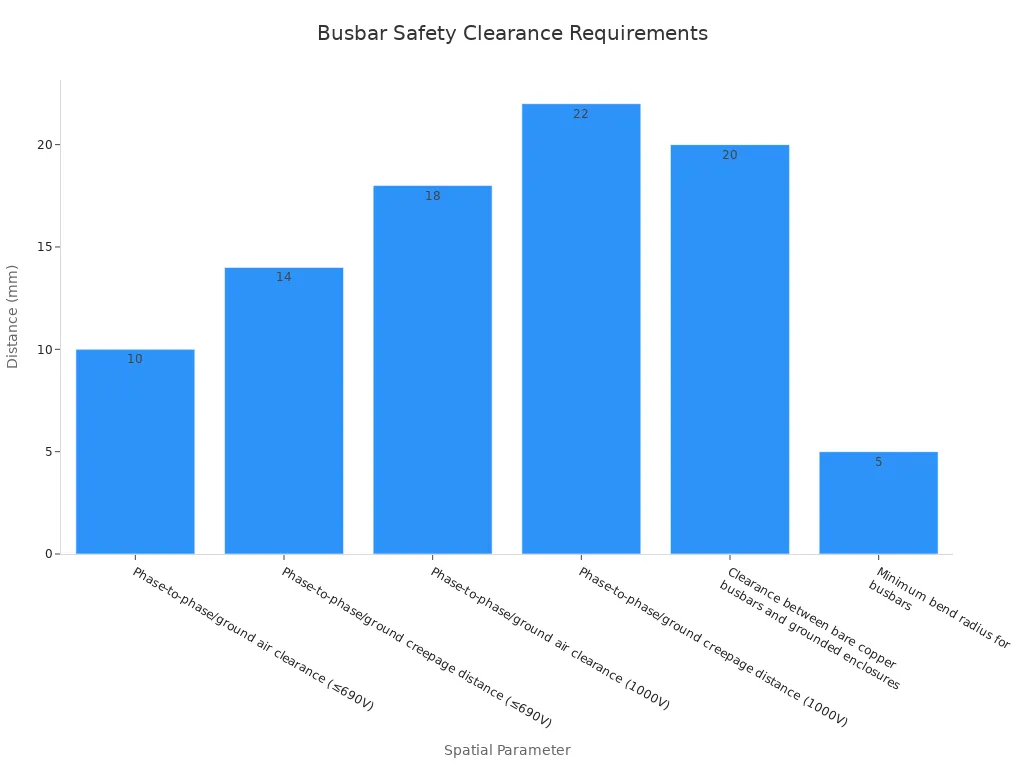
Safety zones need equal focus during layout planning. Electrical clearance rules directly affect how you place equipment and storage racks. For systems rated up to 690V, keep at least 10mm air gap and 14mm creepage distance between phase conductors and ground. Higher voltage systems at 1000V need 18mm air gap and 22mm creepage distance. Bare copper busbars must stay at least 20mm away from grounded enclosures. Support insulators should sit 300mm to 500mm apart along the busbar length. These spacing rules prevent arc flash dangers and help your finished products pass safety checks.
Your layout must also leave room for machine repairs. Keep enough space behind each busbar machine for technicians to reach motors, hydraulic systems, and control panels. This access cuts downtime when fixes are needed. Plan utility connections for power, compressed air, and hydraulic lines before pouring concrete floors. Adding these services after equipment placement costs much more.
Automated material handling boosts your production efficiency. Suzhou Kiande's Busbar Storage Loading System automates the storage, selection, and feeding of raw copper and aluminum bars. Operators enter material specs and amounts through a touch screen. The system then pulls the right bars and sends them straight to your processing equipment. This automation removes manual material handling and lowers labor costs.
The storage system tracks inventory in real time. It warns operators when stock hits zero, preventing surprise production halts. This visibility helps you keep ideal raw material levels without extra stock. The system connects smoothly with CNC punching, shearing, and bending machines, creating a steady workflow from storage to finished part. Its modular design fits various production layouts, working for both new facilities and upgrade projects.
This level of automation supports Industry 4.0 standards. Your busbar machines link to central control systems that watch production metrics and quality data. This digital connection gives you real-time visibility into your whole operation. You can spot slowdowns quickly and adjust schedules to meet delivery dates. The result is higher production efficiency and steady product quality across every batch. Investing in automated storage and feeding systems pays off through lower labor costs, fewer mistakes, and faster cycle times.
Setting up a busbar production line takes careful money planning. You must weigh machine costs, setup fees, and daily running expenses against what you expect to earn. A clear cost breakdown helps you avoid spending too little on key automation or too much on capacity you cannot use yet. Start by setting your top budget number, then pick equipment that fits that limit without lowering quality.
Your biggest starting cost is the busbar machines themselves. Basic manual units have lower prices, while full CNC systems cost much more. Suzhou Kiande sells the Kdeq-01-380 busbar copper bar processing machine for $13,000 to $15,000 per set, giving you a starting point for your budget. Custom options change this price a lot. Extra tooling, longer conveyors, barcode scanning, and ERP hookups each raise the base cost. You also need money for site prep, electrical work, air lines, and floor foundations before the machines arrive.
Model | Price Range (USD/Set) |
|---|---|
Kiande Kdeq-01-380 Busbar Copper Bar Processing Machine | $13,000 - $15,000 |
Your machine picks must match how much you plan to produce. One semi-automatic busbar machine works fine for small jobs. A full busduct line with storage loading systems costs far more but moves many more parts. Ask several suppliers for detailed quotes. Compare not just machine prices but also shipping, setup help, training, and warranty terms. These extra costs often add up to 15 to 20 percent of your total equipment spending.
Running costs include power, tool wear, repair labor, floor space, and worker pay. Manual work needs more staff per shift, which raises payroll. Automated busbar machines cut direct labor but use more electricity and need skilled repair people. Your cost plan must cover both types honestly.
A $75,000 CNC busbar machine costs about $245,000 over 10 years when you add energy, tool parts, upkeep, and operator pay. The real question is what it saves versus manual work—and that number tops $400,000, so the net gain over the decade is positive.
Most makers see ROI within 12 to 18 months, and high-volume shops report payback in as little as 6 months. Several things speed this up. Less scrap and rework cut material costs right away. Fewer warranty claims protect your name. Moving workers to better tasks instead of feeding machines helps too. Higher output and fewer quality delays also boost your money position.
Look at ROI over 5 to 10 years. Figure out labor savings, expected scrap cuts, and power use of robots versus manual stations. Big factories usually get fast ROI on full automation because of volume. Mid-size shops often do better with semi-automatic setups since they avoid paying for idle machines.
Pick semi-automatic gear when product designs change often, you handle many odd shapes, you serve local custom jobs, or you want to save cash. Pick full automation when you supply critical fields like data centers, EV, or wind farms with zero error tolerance, face worker shortages, make standard high-volume sandwich busbars, or need digital tracking and OEE reports. Never automate a broken process; fix the manual or semi-automated flow first before going fully automatic.
The supplier's engineering team gives detailed advice on choosing busbar machines, including use analysis, capacity tips, tool setup, and ROI estimates based on your real production data. This custom money review beats rough guesses. Your switchgear manufacturing equipment value depends on matching automation levels to actual order patterns. Suzhou Kiande's busbar machines offer the speed and quality that justify their cost, making them solid switchgear manufacturing equipment choices for growing businesses. Good investment planning ensures your busbar manufacturing capabilities grow profitably rather than becoming unused overhead.
A careful, step-by-step setup helps you avoid costly mistakes and safety risks. You must get your site ready before any busbar machine arrives. This stage decides how well your whole busbar production will run. If you rush, you may face downtime, calibration issues, and wasted money. Follow a clear order to protect your investment and start production smoothly from day one.
Your building must meet certain power needs before setup starts. Check voltage, phase, and amperage details with your equipment supplier. Heavy hydraulic machines use a lot of electricity, so make sure your power supply can handle the highest demand. Large busbar machines that weigh 1,000 to 2,000 kg do not need special poured concrete bases. But you must put them on a flat, strong industrial concrete floor. Use leveling mounts to hold each unit steady and stop shaking that causes errors during work.
Pick a dry, well-aired indoor space with enough room for moving materials. Your floor plan should let workers carry raw copper or aluminum bars safely around each machine. Most busbar machines need a 380V three-phase power supply. Place machines with enough space around them for repairs and emergency stops. Good site prep lowers long-term running costs and stops early wear on key parts.
Utility Category | Specific Requirement |
|---|---|
Electrical | Confirm voltage, phase, and amperage with supplier. High-tonnage hydraulic operations consume significant power. |
Foundation / Floor | Level, reinforced industrial concrete floor. Secure with leveling mounts to prevent vibration-induced inaccuracies. |
Commissioning follows a clear order that checks each system before full use. Start by putting in foot switches for the punching, cutting, and bending units. Look over all connections with care. Turn on the power and press the emergency stop buttons for each unit in order to finish the reset process.
Run no-load tests with foot switches to check normal operation, hydraulic stability, and correct phase sequence.
Put in the right punching, shearing, and bending dies based on your processing needs.
Get copper or aluminum busbars ready with correct sizes that fit within the machine's limits.
Run real material tests for punching, shearing, and bending work.
Check hole quality, cut surfaces, and bend accuracy for any flaws.
Confirm smooth operation with no strange noises before you approve the machine for production.
Suzhou Kiande offers after-sales help, setup support, and worker training. Their technicians walk you through each check and make sure your busbar machines work as promised. This help lowers the cost of mistakes during your first production runs. Once all checks pass, your line is ready for full production. Proper commissioning makes sure your busbar equipment gives steady quality from the very first batch onward.
Setting up a busbar production line brings several hurdles that can delay your launch and raise your cost. Understanding these challenges early helps you avoid expensive fixes later. Two areas demand the most attention: equipment calibration and workforce preparation.
Alignment errors rank among the most frequent problems during busbar line installation. Traditional multi-frame CNC machines often lose their alignment during sea transit. This drift requires expensive on-site recalibration, sometimes costing thousands of dollars. You can avoid this problem entirely by choosing busbar machines built on a single cast iron monoblock frame. These units ship pre-calibrated and stress-tested for 72 hours, ensuring zero drift after transit. Your busbar machines arrive ready to run, saving you both time and money.
Quality control issues also plague new busbar lines. Tool wear creates burrs and micro-cracking on punched holes. You can mitigate this with digital stroke-counting, tonnage monitoring, and routine physical inspections. Replace punches and dies as matched sets to maintain hole quality. Operator skill gaps introduce errors when transitioning to CNC control. An intuitive HMI with visual icons and 3D simulation helps prevent collisions during programming. Modular PLC architectures and redundant hydraulic backup pumps protect against single points of failure. Proper hydraulic system design with automated oil chillers maintains stable pressure and temperature. These measures strengthen your quality control framework across the entire fabrication process.
Top manufacturers implement layered inspection gates with material traceability, labor traceability, and first article validation. Advanced laser metrology ensures consistent quality within tight specifications. Your quality control system should mirror this approach to catch defects early and reduce rework. A robust quality control plan also includes regular audits of tooling and machine alignment.
Your operators need structured training to run modern busbar machines effectively. Understanding these busbar machines thoroughly reduces setup errors. You can adopt several training models. On-line micro-learning sessions of five to fifteen minutes fit into production without disruption. Dedicated training cells offer forty hours of hands-on experience with real equipment. Digital twin simulation accelerates skill acquisition by three times with zero equipment risk. Cross-functional rotation over six to twelve month cycles covers multiple roles, building a versatile workforce.
For busbar connection assembly, operators must understand torque sequences and proper connection methods. This knowledge prevents field failures and ensures reliable electrical joints.
Maintenance planning requires a mix of strategies. Predictive maintenance using vibration analysis catches problems before they cause downtime. PLC diagnostics alert you to control system issues immediately. Robot calibration maintains precision over time. Stock critical spare parts like solenoid valves and contactors to minimize repair delays. A well-planned maintenance program keeps your busbar machines running at peak efficiency.
Selecting the right busbar machines, designing a logical layout, and budgeting realistically form the foundation of your success. A well-planned production line delivers long-term efficiency and consistent quality across every batch. Your equipment choices directly affect your operating cost and your ability to scale. Automated busbar machines reduce labor expenses while improving precision. Smart layout planning minimizes material handling and prevents bottlenecks. Realistic investment planning protects your cash flow during early operations. Consult equipment suppliers like Suzhou Kiande for tailored advice that matches your production goals. Their engineers help you match automation levels to actual order patterns. Investing in busbar production capabilities positions your business for growth in expanding electrical markets. Start with a clear plan, choose proven machinery, and build capacity that serves you for years.
Most manufacturers see a return on investment within 12 to 18 months. High-volume operations report payback in as little as 6 months. Your actual timeline depends on order volumes, labor savings, and scrap reduction. Automated busbar machines speed up payback by greatly lowering direct labor costs.
Yes. Modular production lines let you start with essential cutting, punching, and bending stations. You can add automated storage loading systems, barcode scanning, and ERP integration as demand grows. This method protects your first investment while keeping expansion options open for future production needs.
Do daily visual checks of hydraulic lines and tooling. Check punch and die wear weekly using stroke counters. Plan full calibration checks monthly. Keep critical spare parts like solenoid valves and contactors in stock. Predictive maintenance using vibration analysis finds problems before they cause unexpected downtime.
Automation removes human error from repetitive tasks. CNC-controlled busbar machines keep consistent tolerances across thousands of parts. Barcode scanning systems automatically adjust settings for different busbar types. This precision matters especially for high and low voltage switchgear applications where connection integrity determines safety and performance.
Standard tooling handles common copper and aluminum bar sizes. Custom dies become necessary for unique hole patterns, special bending radii, or non-standard widths. Ask your equipment supplier about your typical workpiece range. Suzhou Kiande engineers recommend tooling setups that match your specific production needs without unnecessary customization costs.

