
Views: 0 Author: Site Editor Publish Time: 2026-09-18 Origin: Site


A busbar is a metal strip that carries electricity in power systems. You use it every day, from factory switchgear to building power panels. To shape these conductors correctly, you need a busbar processing machine. This special tool cuts, punches, and bends copper or aluminum strips to exact sizes. These three main jobs—cutting, punching, and bending—are the base of busbar processing. Without accuracy, connections can fail, risking safety and dependability. This guide looks at busbar processing machines, comparing hydraulic and CNC types. You will also learn how they are used in many fields, from power delivery to renewable energy. Knowing these machines helps you pick the right one for your manufacturing and production needs.
Busbar processing machines cut, punch, and bend metal bars. They make precise shapes for electrical systems.
Hydraulic machines are operated by hand. They are cheaper, but they require more upkeep.
CNC machines are run by computers. They offer great accuracy and need little care.
These machines help power distribution, solar farms, and data centers. They make safe connections.
Pick a machine that fits your material, how much you need, and your budget. The best pick boosts quality and cuts costs.
Busbar processing machines are special industrial tools that turn raw copper or aluminum bars into exact shapes for electrical power systems. These machines do many jobs in one automatic process, replacing what used to need several separate manual stations. You get steady quality, speed, and reliability that manual methods cannot offer.
A busbar processing machine does five main jobs to get busbars ready for installation. The cutting job uses industrial shears or saws to slice bars to exact lengths. The punching unit makes holes, slots, and gaps for bolt connections and mounting parts. The bending section forms U, Z, L, and custom shapes using precision-ground dies and hydraulic or servo presses. Extra features include embossing, which stamps identification info, logos, and ratings onto the bar surface, plus flattening, deburring, and stripping insulation. This multi-function design lowers equipment costs and boosts workflow efficiency.
Compared to manual fabrication methods, a busbar processing machine gives better consistency. Manual processes require you to move workpieces between separate machines, which increases positioning errors and handling time. A busbar machine combines cutting, punching, and bending in one setup using a steady positioning reference. This removes the need to shift parts between stations, cutting dimensional errors and raising production speed. Processing quality no longer depends only on operator skill. The machine gives repeatable results every cycle.
Processing capacities differ by machine model. For example, you can find busbar machines that handle bars up to 3/8-inch thick by 4-1/2 inches wide (10 x 120 mm) or heavier models that handle 1/2-inch by 4-1/2 inches (12 x 120 mm). These capacities apply to cutting, punching, and bending for both copper and aluminum materials. For copper, universal double-blade shearing technology gives a smooth cut, while high-precision punching units handle various hole shapes. For aluminum, the processes are similar but need careful mold selection and gap adjustment because it is softer.
Modern busbar processing machines also include key safety features. Optical light curtains instantly stop operations if an arm breaks the beam. Integrated emergency stops sit near all operation zones. Two-hand controls keep your hands clear of pinch points during use. These features protect operators while keeping productivity high.
Accuracy in busbar processing directly affects how reliable your electrical connections are. Copper busbars are costly, so precision in cutting, punching, and bending is vital to reduce material waste. A busbar processing machine provides precise, simultaneous operations that manual methods cannot guarantee. This accuracy ensures that holes line up perfectly with bolt patterns, bends match enclosure dimensions, and connections keep proper contact pressure.
Processing accuracy also determines the electrical performance of the final assembly. Misaligned holes or wrong bend angles create gaps in connections, leading to higher resistance and heat buildup. Over time, poor connections can cause joint temperature rise, lowering system efficiency and creating safety risks. A busbar processing machine adjusts rebound coefficients based on conductor material and width, ensuring parallelism between busbar profiles and conductors. This attention to detail controls joint temperature rise and keeps connections reliable.
Beyond immediate function, precision affects your manufacturing process and finished-part quality. Consistent results from automated busbar machines reduce the need for rework and inspection. You can trust that each busbar meets the same specs, which streamlines assembly and shortens production timelines. In industries like switchgear manufacturing and power distribution, where safety-critical parts depend on precise dimensions, this level of accuracy is essential. The high cost of copper raw materials makes accuracy an economic need as well. Investing in the right busbar processing machine ensures your production meets the quality standards required for modern electrical systems.
Every busbar processing machine does three main jobs to turn raw copper or aluminum bars into finished parts. These jobs—cutting, punching, and bending—control how well your busbars fit into their boxes and connections. New machines combine all three jobs into one smooth process, which greatly boosts your production speed.
The cutting job uses industrial shears to slice busbars to exact lengths. You set the size you need, and the machine makes a clean, straight cut every time. This precision matters because even a tiny length error causes fitting problems later. Universal double-blade shearing gives copper bars a smooth edge with no burrs or bending. For aluminum, the cutting job needs careful blade gap tuning since this softer metal reacts differently under shear pressure. You waste less material when cuts are exact, and copper's high price makes this precision vital for saving money.
The punching job creates holes, slots, and notches so bolts and mounting parts can hold the busbar in place. You need exact hole positions so connections line up perfectly with switchgear terminals or transformer lugs. High-precision punching units handle many hole shapes while keeping tight tolerances. Holes that are off-target create gaps in connections, which raises electrical resistance and creates dangerous heat. The punching job also makes mounting slots and airflow patterns where needed. Modern machines adjust their work based on material type and width, ensuring clean holes without cracks or damage around the edges.
The bending job shapes busbars into U, Z, L, and custom forms that fit inside electrical boxes. You must plan for springback—the way copper and aluminum try to return to their original shape after bending. A good busbar processing machine adjusts rebound settings based on conductor material and width, so your final bend angle matches specs exactly. The force needed depends on your material thickness and die opening width. For a 10mm thick half-hard copper bar, you need much more force with a narrower die:
V-Die Opening Width | Required Bending Force (per 100mm width) |
|---|---|
60 mm | |
80 mm | 48.7 Tons |
A wider die opening cuts the force needed by a large amount. This relationship helps you pick tooling that fits your machine's power.
Modern 3-in-1 busbar processing machine designs put all three jobs into one station. You cut, punch, and bend without moving the workpiece between separate machines. This combined process shortens work time and removes positioning mistakes. Automation through PLC systems cuts human errors and keeps quality steady across every batch. Programmable controls store your job settings, allowing fast changes between tasks with little downtime. The 3-in-1 busbar processing machine also takes up less floor space and makes your workflow simpler, lowering labor costs while raising overall efficiency. For manufacturers handling many busbar types, this combined approach gives steady results and faster cycle times.
When picking a busbar processing machine, you mainly choose between hydraulic and CNC systems. Each type fits different production needs, budgets, and quality goals. The accuracy of your machine choice affects how reliable your electrical connections are.
Hydraulic busbar machines use fluid pressure to cut, punch, and bend. You run the machine by hand. These machines cost less at the start, making them good for small batch production or workshops. They offer enough power for thick copper and aluminum bars.
But hydraulic systems have a complicated setup with pumps, valves, and seals. These parts wear down over time. Yearly upkeep costs run 15 to 20 percent of the total equipment price. You also have to handle hydraulic oil. Dirt and leaks in the oil make maintenance harder.
Aspect | Hydraulic System | CNC Servo-Drive System |
|---|---|---|
Yearly upkeep cost | 15–20% of total equipment cost | 50–70% of hydraulic system cost (about 7.5–14% of total equipment cost) |
Structure complexity | Complex, with pumps, valves, seals that wear out | Simple, mostly motors and ball screws |
Oil-related issues | Needs hydraulic oil; dirt and leaks raise upkeep work | No hydraulic oil needed; avoids oil dirt and leaks |
Part replacement | Replace many hydraulic parts often | Replace fewer parts, mainly motors and ball screws |
Overall upkeep difficulty | High due to many wear-prone parts and oil care | Low, simpler system cuts upkeep work |
For small volumes, a hydraulic busbar processing machine works fine. Its abilities are enough for basic manufacturing jobs.
CNC busbar machines use servo motors and computer control for each task. You set the dimensions, and the machine follows your commands. This raises your production speed. The automation removes human mistakes and gives steady finished-part quality. Your electrical system performance depends on this precision.
Advanced CNC busbar machines automate punching, cutting, and embossing. Servo positioning makes sure each hole and bend lands exactly where you need it. The machine changes settings based on material and width. Servo positioning also handles rebound compensation. This servo positioning accuracy gives repeatable results. The busbar processing machine handles complex shapes.
The simpler CNC design means less upkeep. No hydraulic oil means no dirt problems. Yearly upkeep costs are only 7.5 to 14 percent of total equipment price. You replace fewer parts. Modern manufacturing benefits from this reliability.
For large-scale production, CNC busbar machines beat hydraulic models. Each busbar processing machine type has its strengths. The programmability allows fast changeovers. You get higher processing accuracy across every batch. The automation level supports Industry 4.0 integration. The 3-in-1 busbar processing machine combines all operations for maximum efficiency.
Busbar processing machines play key roles in many industries where steady electrical power is vital for success. Each field needs different levels of accuracy, materials, and output amounts. Knowing these uses helps you match machine features to real-world needs.
Switchgear and transformer makers depend heavily on exact busbar work. Every link inside a switchgear unit must handle set voltage and current levels without failing. Your busbar processing machine must create precise hole patterns and bend angles so conductors line up correctly with terminals and mounting spots.
The table below shows key busbar needs for high-voltage switchgear uses:
Specification Parameter | Critical Requirement |
|---|---|
System Voltage | Must withstand system voltage without breakdown |
System Current | Must conduct system current without overheating |
Installation Environment | Outdoor: withstand rain, wind, storms, snow; Indoor: protection from dust, humidity, corrosive agents |
Material | Copper (higher conductivity, more expensive) or Aluminum (lower cost, lower conductivity) |
Size | Must match switchgear or substation dimensions |
Cost | Balance between material, size, and manufacturer pricing against quality needs |
These needs directly shape your processing choices. Copper busbars need clean cuts and smooth holes to keep good conductivity. Aluminum needs adjusted tool gaps to stop tearing. Your busbar processing machine must handle both metals while keeping exact sizes in every batch. Switchgear and electrical panels rely on this steadiness for safe, long-lasting use.
Solar farms, wind sites, and data centers create growing need for efficient busbar systems. These facilities need high-current distribution in small spaces. Traditional cable systems struggle past certain amperages, but busbar systems perform better.
Requirement Area | Busbar System Evidence |
|---|---|
Current Capacity | Supports up to 6300A in a single run, whereas traditional cables require multiple parallel runs beyond 800A. |
Space & Installation | Requires 60-70% less space and installs 40-50% faster due to modular sections, compared to bulky cable trays and labor-intensive pulling. |
Energy Efficiency | Achieves up to 99% efficiency with lower resistance, versus 95-97% for cables which have higher joint losses. |
Thermal Performance | Provides superior heat dissipation and lower operating temperatures, avoiding the derating needed for cable systems. |
Scalability & Maintenance | Offers easy inspection and modification via tap-off units without de-energizing the main bus, unlike cables which require new runs and hidden terminations. |
Safety & Compliance | Must meet IEC 61439, UL 857, and NFPA 70 standards, with insulation rated up to 1kV and flame-retardant properties. |
Short-Circuit Withstand | Rigid, mechanically braced construction handles short circuits safely, whereas flexible cables risk violent movement. |
Your production line must also plan for backup setups like N+1 or 2N designs. Monitoring hookups need exact sensor mounting points during production. These factors make automated busbar machines vital for meeting modern electrical gear standards.
Full busduct production lines serve power equipment makers worldwide. These systems provide the processing accuracy and production speed that renewable energy and data center projects need.
Start by thinking about what jobs you do every day. Do you need to cut, punch, and bend in one step? Or do you work on bars in separate steps? Your answer tells you if a single-function machine or a 3-in-1 unit fits your shop. Next, measure your usual bar sizes. Copper and aluminum busbars come in a range of thicknesses depending on the application. The chart below shows these ranges clearly.
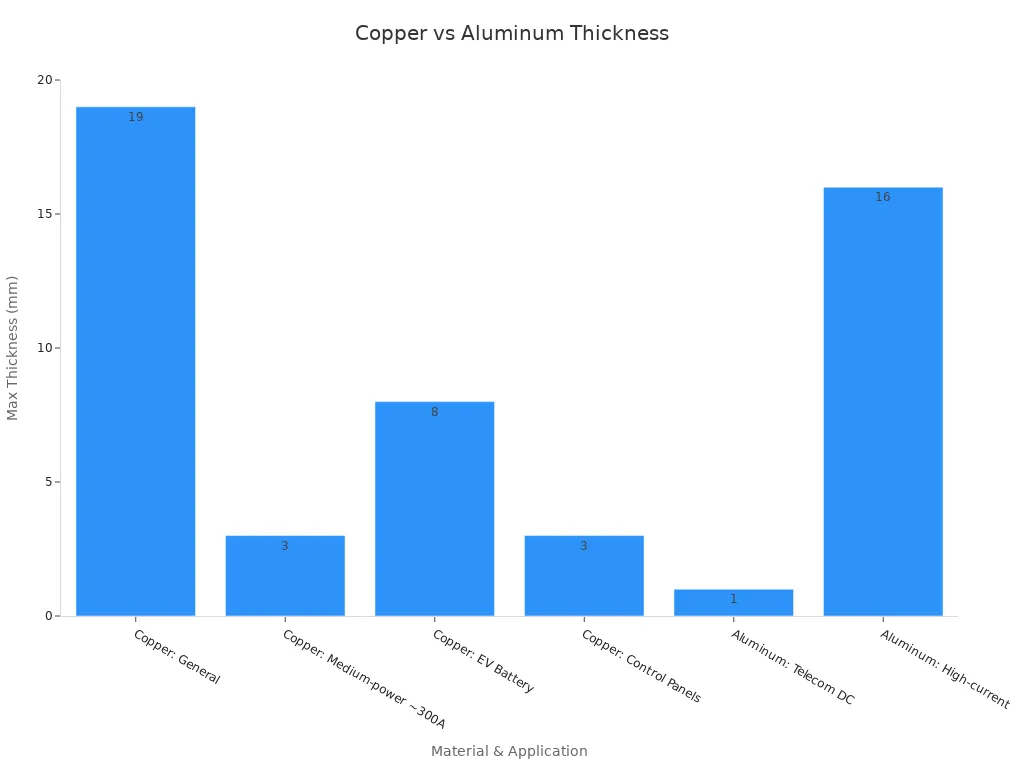
The material you use also changes your tool setup. Copper needs moderate die clearance and springs back more when bent. Aluminum needs slightly smaller clearance so it does not stick. Its soft surface scratches easily, so you need padded clamps. Aluminum also cracks at tight bend radii, so you must increase the bend radius. These differences affect setup time and tooling costs.
Your workshop situation also narrows your options. Low-volume or varied work suits manual or digital positioning machines. Recurring parts benefit from CNC or servo positioning with program recall. Limited floor space points to a 3-in-1 unit. Stable, high-volume production demands an automatic feeding system.
Your monthly output directly drives how fast a CNC busbar processing machine pays for itself. Higher volume production typically results in faster payback.
Remember that the initial machine price represents only one cost. Compare operator needs, tooling replacement, planned maintenance, expected downtime, material handling, setup time, inspection, and possible rework. A lower-priced machine may cost more overall if it needs extra operators or frequent manual fixes. Evaluate each setup by conforming parts produced per shift and per operator.
Automation level matters more as volume grows. A CNC busbar machine with servo positioning delivers repeatable accuracy across every batch. Advanced models automate punching, cutting, and embossing while adjusting for material rebound. This precision reduces scrap significantly in documented cases.
For high-volume settings, consider an integrated busbar processing system that automates material storage, selection, and feeding. It eliminates repetitive lifting, reduces operator fatigue, and prevents costly damage. This automation level supports Industry 4.0 manufacturing and keeps your production line running without interruption.
The right busbar processing machine balances your material needs, production volume, and budget. Match the automation level to your actual throughput. Choose servo positioning for precision work. Invest in integrated systems when volume justifies the cost. Your electrical product quality and production efficiency depend on this decision.
Busbar processing machines remain essential for fabricating precise conductors in electrical distribution systems. Your choice between hydraulic and CNC models depends on production volume, material type, and budget constraints. Hydraulic busbar machines offer affordability for small batches. A CNC busbar processing machine delivers superior processing accuracy for large-scale manufacturing applications. This busbar processing machine ensures repeatable results.
Modern busbar processing demands automation. Comprehensive solutions, from individual busbar machines to complete production lines, enhance production efficiency while maintaining consistent quality and performance. The automation level directly impacts your operational success. Every busbar you produce benefits from this precision.
Industry 4.0 continues reshaping busbar processing. Smart factories integrate data-driven controls, raising efficiency and accuracy across every production stage. This accuracy reduces waste and improves electrical safety. Choose your busbar processing machine wisely for optimal electrical performance and reliable production output. Each busbar connection depends on precise dimensions. Your busbar quality improves with CNC automation in manufacturing settings.
A hydraulic machine uses manual controls and fluid pressure. It costs less upfront. A CNC machine uses servo motors and computer programming. It delivers higher precision. You choose based on your production volume and processing needs.
Yes, it can. You must adjust the tool settings for each material. Copper needs moderate die clearance. Aluminum requires tighter clearance and padded clamps. The machine adjusts rebound coefficients based on the busbar material and width.
You find them in switchgear manufacturing and power distribution. Data centers also rely on them. These industries need precise busbars for reliable electrical connections. The applications of a busbar processing machine ensure safe and efficient power flow.
It combines cutting, punching, and bending into one station. You do not move the workpiece between separate machines. This reduces errors and shortens cycle times. It boosts production efficiency and saves floor space. This busbar processing machine design is highly effective.
Evaluate your busbar material type, thickness, and processing requirements. Match the automation level to your throughput. A CNC machine suits high-volume manufacturing. An integrated system reduces labor costs and material waste in electrical manufacturing.

