
Views: 0 Author: Site Editor Publish Time: 2026-06-29 Origin: Site


Busbar manufacturing needs good materials, careful steps, smart machines, and strong rules to make sure electricity works well. The busbar market is getting bigger around the world. It may be worth more than $3 billion by 2025. Last year, China sold over $1 billion in busbars to other countries. Picking the right Busbar Machines and using the right rules helps factories work better and make good products.
Key Factor | Impact on Busbar Manufacturing |
|---|---|
Core Components Determine Lifespan | Strong machines last longer and keep making busbars the same way. |
Processing Precision and Efficiency | Careful work makes busbars better and lets factories make more. |
Operational Convenience | Easy-to-use machines help workers and lower training costs. |
After-Sales Service | Good help means machines stop less and keep making busbars. |
Suzhou Kiande is known for smart busbar making solutions. They help factories work better and make good busbars every time. This FAQ gives useful tips for people who want to make their busbar factories better.
Busbars help move electricity in a safe way. They are made from copper or aluminum. These metals let electricity flow well.
Picking good materials is very important. Pure copper and the right aluminum alloys make busbars last longer and work better.
Using machines in busbar making helps people work faster. Smart machines make fewer mistakes. They also make the process quicker and cheaper.
Checking quality is important for safety. Testing often and following rules keeps busbars safe to use.
Teaching workers the best ways to do their jobs helps make better busbars. Learning new things helps keep the work safe and fast.
A busbar is a metal bar that carries electricity. Most busbars are made from copper or aluminum. These metals let electricity flow easily. Engineers design busbars to collect and send power. This helps electricity move smoothly in a system.
A busbar is a metal bar made from copper or aluminum. It acts as a conductor. It collects power in one place. This lets electricity spread out easily. Without busbars, electricity could not reach your home from power plants.
Busbars are important in many places. They help factories move lots of power. Data centers use busbars for strong power. Stores need busbars for lights and machines. Labs and tech places use busbars for steady power. Wind farms and solar panels use busbars to collect and share power. Spacecraft also use busbars for good energy flow.
Busbar manufacturing has a few main steps:
Raw Material Selection & Preparation: Pick the right metal, usually copper or aluminum alloys.
Cutting – Precision Sizing: Use special machines to cut busbars to the right length.
Punching – Creating Connection Points: Make holes for connections with automatic punching machines.
Bending & Forming – Shaping the Busbar: Bend the busbar carefully so it works well.
Busbars have many good points over regular wires. Their modular design makes them easy to install. Factory-made sections and bolted connections help a lot. Busbars carry more power in less space. This is great for building designs.
Other main benefits are:
Installation speed: Busbars go in about three times faster than cables.
Space efficiency: Their small size saves space in data centers and tall buildings.
Reliability: Busbars work well in tough places and hot temperatures.
Reduced labor costs: Fewer workers are needed for less time.
Heat dissipation: Busbars keep cool by spreading heat.
Safety: Busbars do not burn, so they are safer.
Improved maintenance access: Their small size makes fixing them easier and safer.
Busbar manufacturing is growing because these benefits help industries get safe, reliable, and efficient power.
Busbar production uses copper and aluminum. Engineers pick these metals because they let electricity flow well. Copper busbar fabrication is common in many places. Aluminum is important when weight matters most.
The table below shows how copper and aluminum compare:
Property | Copper | Aluminum |
|---|---|---|
Electrical Conductivity | Higher (58 MS/m) | Lower (37 MS/m) |
Ampacity | Higher | Lower |
Mechanical Strength | Higher | Adequate for many uses |
Density | Heavier | Lighter |
Cost | More expensive | More affordable |
Corrosion Resistance | Higher | Adequate (protective oxide) |
Thermal Expansion Coefficient | Lower | Higher |
Lifespan | Longer | Shorter |
Copper busbar fabrication gives good conductivity and lasts longer. Aluminum busbar fabrication is lighter and costs less. Factories use copper busbar for important power systems. Aluminum busbar is used in big projects where weight and price matter.
Material quality is important for busbar fabrication. High-purity copper helps copper busbar fabrication work better. If copper or aluminum has impurities, the busbar can get too hot and not last long. The right alloy mix makes busbar fabrication stronger and stops rust. This helps busbars last longer and stay safe.
Busbar processing needs careful checks on material quality. Workers test copper and aluminum purity before making busbars. They check the alloy mix to meet standards. Good materials make better copper busbar and aluminum busbar products. Strong materials and careful work help busbar fabrication be reliable.
Tip: Always use pure copper or the right aluminum alloy for busbar fabrication. This helps prevent problems and keeps electrical systems safe.
Material preparation is the first step in making busbars. Workers pick copper or aluminum sheets and bars that fit the job. They cut the metal to the right size. Then, they clean the pieces to get rid of dirt and oil. This helps the busbar carry electricity better. Aluminum needs extra steps to stop rust.
Copper sheets or bars get cut and cleaned.
Aluminum gets the same treatment, plus rust protection.
Factories follow strict steps to make sure the metal is ready:
Workers use special cleaners to remove oil and dirt.
Acid and water wash away anything left on the surface.
Drying the metal keeps water from causing problems.
These steps help the busbar last longer and work well. Good preparation makes the next steps easier.
Cutting and punching are important for making busbars. Workers use machines to cut copper and aluminum to the right length. They try to keep the size very close to what is needed. After cutting, workers smooth the edges. This keeps the busbar safe and stops problems later.
Some common ways to cut and punch are:
Press brake
Cutting
Punching
Technique | Tolerance Range |
|---|---|
Press Brake | ±0.010” to ±0.020” |
Cutting | |
Punching | Optimal material removal |
Punching makes holes for wires and connections. The holes must be clean so the busbar stays strong. Cutting and punching must be done well for the busbar to work right.
Bending and forming give the busbar its shape. Workers bend the metal so it fits in the right place. The bend must be bigger than 1.5 times the metal’s thickness. This helps stop problems with electricity. L-bends need a bend of at least 1.5 times the thickness. U-bends need a bend of 2 to 3 times the thickness. These rules keep the busbar strong.
Important things to remember:
Use even arms to spread power.
Only bend twice at a time to keep the metal strong.
Sometimes, heat the metal between bends to make it softer.
These steps help the busbar fit in panels and other equipment. Good bending and forming keep the busbar safe and strong.
Surface treatment keeps the busbar from rusting and helps it work better. The process cleans off anything that could hurt the metal. Then, workers add a special coating. Nickel, tin, or silver can be used to stop rust and help soldering. Nickel is good for aluminum busbars. Silver is best for hot places. Copper coating helps make strong connections.
Nickel is for aluminum, silver is for heat.
Copper coating helps make good joints.
Surface treatment is very important. It helps the busbar last longer and work well in tough places.
Quality control is very important in making busbars. Factories in China use strong rules to meet world standards. They test the busbars to make sure they work well. Some tests check how well the busbar works in hot places. Machines help make sure every step is done right. Workers get trained often to keep up with safety and quality.
Note: Quality control uses many tests, good machines, and worker training. These steps help factories make safe busbars that meet world rules.
Good quality control helps make busbars that are safe and work well.
Suzhou Kiande busbar machines are special in the industry. Engineers at Kiande make these machines for what customers need. The machines are strong and last longer than many others. Each busbar processing machine uses smart control technology. Operators can set things like current ratings, how many pieces, hole distance, and material length. The machines can cut, punch, bend, and emboss busbars. These features help factories make busbars that are very exact and always good.
Suzhou Kiande busbar machines help factories get good results. The machines lower mistakes and make busbar production more steady.
The machines can also run without workers. Workers just put in the settings, and the machines do the work. This saves money on workers and makes things faster. The machines change how they work based on the busbar’s material and width. This makes sure the connections are good and the joints do not get too hot. Kiande busbar processing machines follow CE safety rules. They work well in power systems, switchgear, and green energy jobs.
Suzhou Kiande busbar processing machines bring automation to making busbars. Factories can use these machines with little watching. Operators type in what they need, and the machines do the rest. Automation makes busbars faster and helps stop mistakes. The machines also keep workers safe by doing more of the hard work.
Customization is another good thing about Kiande busbar machines. Engineers can change the machines for different connection bar types. The machines change how they bend based on the material and width. This keeps the busbar shape even with the conductor. Kiande gives answers for special factory needs. Factories can ask for special parts or changes for their busbar processing machines. This helps factories make many kinds of busbars for different jobs.
Automation and customization make Kiande busbar machines a smart pick for factories that want to work faster and keep high quality.
Suzhou Kiande busbar machines do many jobs in making busbars. Each busbar processing machine does things that help factories make busbars for different electrical systems. The machines can work with copper and aluminum busbars easily. They are used in workshops, power lines, and power projects.
Function | Description |
|---|---|
Cutting | |
Bending | Bending busbars to fit where they need to go. |
Punching | Making holes or slots for wires or mounting. |
Embossing | Pressing marks, ratings, or other needed info on busbars. |
Factories use busbar machines to make busbars for switchgear, transformers, and busway systems. The machines help with building and making electrical devices. Kiande busbar processing machines also help with green energy projects. Their ability to change how they work makes them good for many industries.
Suzhou Kiande busbar machines help factories meet tough quality rules. The machines give the same good results and help factories work better.
Industry standards are very important for making busbars. These rules help factories make safe and good products. Groups like IEC and UL make the main rules for busbar design and safety. Each rule talks about a different part, like insulation or fire safety.
The table below lists important standards for busbar making:
Standard | Description |
|---|---|
These rules are for low-voltage switchgear and controlgear. They include tests for heat and insulation. | |
IEC 60364-4-41 & 412 | These rules are about insulation and stopping electric shock. They help keep systems safe and workers safe. |
IEC 60695-2-12 | This rule checks if busbar materials can resist flames. |
UL 94V-0 | This rule is for plastic that does not burn easily on busbars. |
UL 2885 | This rule checks what happens when busbar materials burn. It looks at acid gas and how well electricity moves. |
IEC 60754-1 & 60754-2 | These rules check the gases when busbars burn. They make sure the gases are not very toxic and have no halogen. |
IEC 62821-1 | This rule is for insulation that does not make smoke or halogen. It helps make busbars safer for the earth. |
IEC 61034-2 | This rule checks how much smoke comes out in a fire. It helps people see better if there is a fire. |
EN 45545 | This rule is for fire safety on trains in Europe. |
UV Resistance | UL 2556 and UL 854 check if busbars can be used outside. |
RoHS 2002/95/EC | This rule makes sure busbars do not have bad chemicals. |
CE Marking | This shows the busbar follows health and safety rules in Europe. |
EU CPR Class (Dca – s1b, d1, a2) | These rules are for fire, smoke, and acid for building products. |
These rules help factories make good busbars. They also keep workers and users safe from harm.
Busbar makers must follow hard steps to get certified. Certification shows the busbar is safe and good quality. Many countries need these papers before busbars can be sold.
The table below shows common busbar certifications:
Certification | Description |
|---|---|
This is for making sure the factory always does a good job. | |
ISO 14001 | This is for making busbars in a way that is good for the earth. |
UL Listing | This is needed to sell busbars in North America. |
CE Marking | This is needed to sell busbars in Europe. |
RoHS Compliance | This rule stops bad chemicals in busbar coatings. |
Factories check quality at every step. Auditors come to look at records and test busbars. Workers get training to learn the newest rules. These steps help factories make safe and high-quality busbars for customers.
Note: Following rules and getting certificates helps customers trust the factory. It also helps the factory do well for a long time.
Busbar production can have problems that hurt quality and safety. Many factories see trouble with precision, bending, welding, and surface treatment. Each problem has a main cause and a way to fix it. The table below lists the most common busbar problems, why they happen, and how top companies fix them.
Fabrication Issue | Root Cause Description | Example of Solution |
|---|---|---|
Precision Requirements and Dimensional Accuracy | Keeping sizes within ±0.1mm is important for busbars to fit right. | ABB’s factory made fewer mistakes by using better machines for copper busbar production. |
Bending and Forming Complexities | Wrong bend size causes about 34% of busbar failures. | Eaton Corporation fixed bending problems by using CNC bending machines. |
Welding and Joint Integrity | Bad welds can make contact resistance go up by 400%. | General Electric got 99.7% good joints with ultrasonic welding, better than TIG. |
Surface Treatment and Corrosion Protection | Copper without treatment does not last long in tough places. | Tin-plated copper busbars last 15 years, but untreated copper lasts only 8 years. |
Tip: Using smart machines and following careful steps helps stop busbar problems and makes them work better.
Regular care keeps busbar machines working well and keeps workers safe. Factories should check and clean machines on a set schedule. The table below shows important maintenance jobs, how often to do them, and what tools are needed.
Maintenance Task | Frequency | Time Required | Special Tools Needed |
|---|---|---|---|
Visual Inspection | Every three months | None | |
Infrared Scanning | Every six months | 2 hours | Thermal camera |
Connection Re-torque | Once a year | 4 hours | Calibrated torque wrench |
Insulation Testing | Every three years | 3 hours | Megohmmeter |
Deep Cleaning | Every five years | 8 hours | Approved solvents |
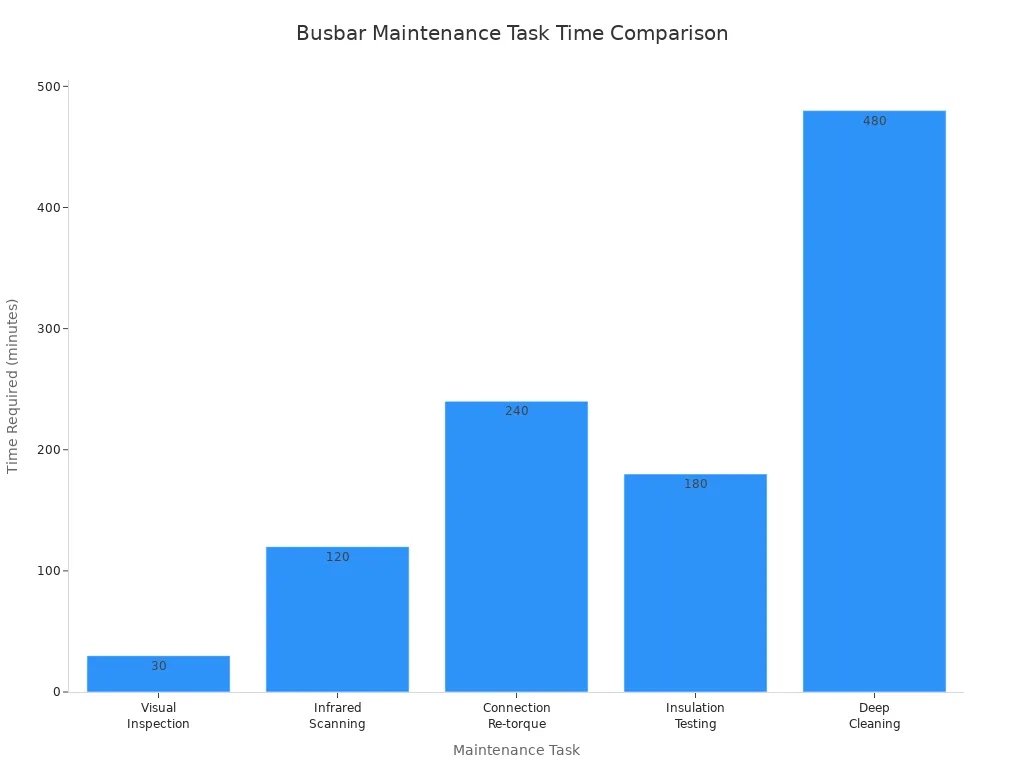
Factories can keep workers safe by using special features like windows for infrared checks and ways to separate each section. Automatic shutters and test points that do not touch live parts also help protect people.
Windows let workers do safe infrared checks.
Isolation lets workers fix one section at a time.
Automatic shutters close when tap-off units are removed.
Test points let workers check without touching live busbar parts.
Note: Following a maintenance plan and using safety features helps stop problems and keeps the busbar system safe for everyone.
Picking the right machine depends on what panels you need. Engineers look at flexibility, automation, and precision. The table below shows which machine works best for each job:
Production Type | Recommended Machine Type |
|---|---|
High and low voltage switchgear | Highly flexible 3-in-1 busbar machine |
Busway bus duct products | High-efficiency automatic CNC busbar punching and shearing machine |
New energy vehicle parts and power batteries | High-precision, high-efficiency, fully automated CNC busbar machine |
Suzhou Kiande has machines that fit these needs. Their machines help factories make panels with strong connections. Operators can change settings for different jobs. This makes the machines good for many kinds of busbar work.
Good quality starts with careful modeling and precise machining. Engineers use models to check heat and voltage. Precision CNC machining keeps sizes very close, like .001 inches. Progressive die stamping and waterjet cutting make exact shapes for panels. Skilled tool and die workers improve designs and help test new busbars. Quality control checks every step to make sure sizes and materials are right.
Method | Description |
|---|---|
Progressive Die Stamping | Heavy, fast stamping for accurate busbar making. |
Tool and Die Expertise | Skilled workers design and make high-quality busbars. |
Rapid Prototyping | Making and testing busbars to improve designs. |
Waterjet Cutting | Exact cuts and shapes for busbar making. |
Quality Control | Inspection checks every step in busbar making. |
Special lamination and segmented designs make installation and fixing easier. Engineers pick materials that lower losses and weight. This helps busbar making for panels.
Training helps workers stay safe and make busbars well. Programs teach safety rules and how to use machines. The SUNSHINE training program gives details about software and hardware. Factories focus on teaching and guiding workers. Safety comes from both the machine and the worker. Regular training helps workers learn new ways and quality rules. Teams follow best steps for handling panels and keeping the busbar line working.
Tip: Using Suzhou Kiande’s solutions can help factories work better and safer. Their machines and training help keep busbar quality high and production safe.
Knowing about materials, steps, machines, and rules helps factories make busbars well. New busbar machines help factories make more busbars and have fewer mistakes. The table shows how these machines help:
Aspect | Impact on Production Output and Defect Rates |
|---|---|
Increased Productivity | Busbars are made faster and more exact. |
Quality of Output | Careful work means fewer mistakes and less fixing. |
Suzhou Kiande gives smart busbar answers, cuts busbars very accurately, and helps customers after buying. If you need more help, look at the FAQ or ask Suzhou Kiande.
Engineers pick high-purity aluminum for making aluminum busbars. This metal lets power move well and costs less money. Factories check the quality and test each aluminum busbar. They want every busbar to meet the right standards. Using aluminum busbar processing also makes power systems lighter.
A multi-functional busbar machine can cut, punch, and bend in one step. This machine helps factories work faster and pay less for workers. Operators get better results from quality checks and tests. The machine works with both copper and aluminum busbars for power and switchgear jobs.
Quality control and testing make sure each busbar is safe and works right. Factories use smart machines for every step of the process. This way, there are fewer mistakes and the busbars are more reliable. Good quality also keeps costs down over time. Safe switchgear and high voltage switchgear need busbars made this way.
The cost depends on the material, how much the machines do, and how fast the work goes. Aluminum busbar processing usually costs less than copper. Machines that work by themselves save money and cut down on waste. Quality checks and tests help stop mistakes and save money on power and switchgear jobs.
Busbars are found in switchgear, transformers, and high voltage switchgear. They help move power in factories, data centers, and green energy projects. Making and using aluminum busbars helps new power systems work well. Good busbars keep power safe and flowing smoothly.

