
Views: 0 Author: Site Editor Publish Time: 2026-06-17 Origin: Site


In modern electrical manufacturing, a small processing error can create a big assembly problem. If a busbar is cut too short, punched in the wrong position, or bent at an inaccurate angle, the whole electrical cabinet may require rework. That is why many switchgear and panel manufacturers are replacing manual processing with a professional busbar machine.
A busbar machine is designed to process copper and aluminum busbars used in electrical power distribution systems. It can help manufacturers cut, punch, bend, and form busbars with better efficiency and consistency. For companies producing switchgear, control cabinets, distribution boards, transformers, EV charging systems, or energy storage equipment, choosing the right busbar machine can directly improve production quality.
In this article, we will explain what a busbar machine is, how it works, what functions it performs, what types are available, and how to choose a suitable model for your factory. You will also learn why the demand for accurate busbar processing is increasing as electrical infrastructure, renewable energy, data centers, and industrial automation continue to expand.
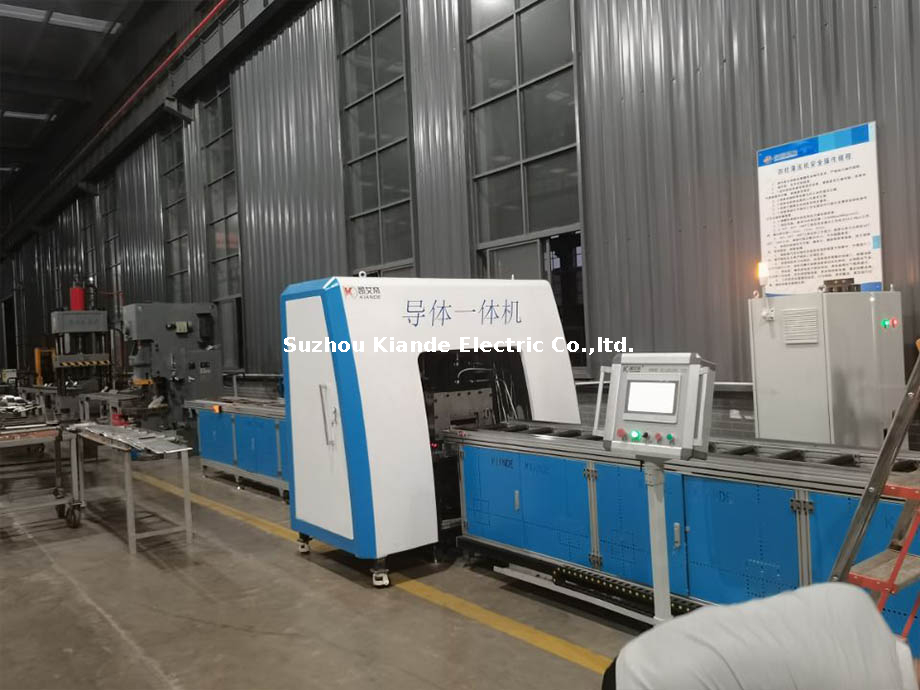
A busbar machine is a specialized industrial machine used to process copper or aluminum busbars. A busbar is a conductive metal bar that distributes electrical power inside electrical cabinets, switchgear, distribution systems, transformers, and other power equipment.
The main purpose of a busbar machine is to turn raw copper or aluminum bars into finished busbar components according to technical drawings. These components may need accurate length, clean edges, mounting holes, connection slots, and precise bending angles. A busbar machine helps complete these tasks more efficiently than manual sawing, drilling, and bending.
Depending on the model, a busbar machine may perform one single function or combine multiple functions. For example, some machines focus only on punching or bending, while a 3-in-1 busbar machine usually integrates cutting, punching, and bending in one unit. More advanced CNC models can also support automatic positioning, program storage, and batch production.
For manufacturers, a busbar machine is not just a metalworking tool. It is production equipment that supports stable quality, faster assembly, lower labor intensity, and better repeatability.
Busbars are widely used in electrical systems because they provide a reliable and compact way to distribute power. Compared with traditional cable wiring, busbars can offer better mechanical stability, cleaner layout, and higher current-carrying capacity in many applications.
You can find busbars in:
● Low-voltage and medium-voltage switchgear
● Electrical control cabinets
● Power distribution boards
● Transformer systems
● Industrial automation panels
● EV charging equipment
● Battery energy storage systems
● Data center power distribution units
● Renewable energy connection systems
Because busbars are directly related to power transmission, their processing quality matters. Poor hole alignment may make installation difficult. Rough cutting edges may require extra finishing. Inaccurate bending may cause interference inside a cabinet. In high-current systems, poor mechanical contact may also increase reliability risks.
A professional busbar machine helps avoid these problems by improving processing accuracy and repeatability.
Most busbar machine models are designed for copper and aluminum busbars. Copper is widely used because of its high electrical conductivity and strong mechanical performance. Aluminum is lighter and often more cost-effective, so it is also used in some power distribution applications.
Different materials require different processing force, tooling, and clamping methods. Before purchasing a busbar machine, buyers should confirm whether the machine can handle their actual material type, width, thickness, and production volume.
Material Type | Common Applications | Processing Notes |
Copper busbar | Switchgear, transformers, power cabinets, high-current systems | Requires strong cutting and bending force |
Aluminum busbar | Distribution boards, lightweight systems, cost-sensitive projects | Easier to process but needs stable clamping |
Tin-plated copper busbar | Electrical cabinets, corrosion-sensitive systems | Surface protection should be carefully handled |
Coated or insulated busbar | Compact power systems, battery systems | May require customized processing methods |
A suitable busbar machine should match the material characteristics and production requirements of the factory.
A busbar machine usually performs three core functions: cutting, punching, and bending. These are the most common processes required in busbar production.
Cutting is used to process the busbar to the required length. Compared with manual sawing, a busbar machine can provide cleaner cuts and better dimensional consistency.
Accurate cutting is important because the busbar must fit correctly inside the electrical cabinet or power equipment. If the busbar is too long or too short, it may not align with terminals, insulators, or circuit breakers. A good busbar machine uses stable clamping and strong cutting force to reduce deformation and improve cutting quality.
Clean cutting also reduces secondary finishing work. This helps manufacturers save time and improve production efficiency.
Punching is used to create holes, slots, or other connection features in the busbar. These holes are often used for bolts, terminals, connectors, and mounting components.
A busbar machine uses punching dies to form different hole shapes, such as round holes, oblong holes, square holes, or customized holes. Compared with drilling, punching is usually faster and more suitable for batch production.
Hole position accuracy is extremely important. If the punched holes are not aligned with the assembly drawing, the busbar may not connect properly with electrical components. CNC models can improve punching accuracy by using programmed positioning, which reduces manual measuring errors.
Bending is used to shape the busbar so that it can fit inside the electrical equipment. Busbars may need flat bending, vertical bending, offset bending, or special-angle bending depending on the cabinet layout.
Manual bending is difficult when processing thick copper busbars, especially in batch production. A busbar machine applies controlled force through bending molds to form the required angle. CNC bending systems can further improve angle consistency and repeatability.
Accurate bending helps ensure that the finished busbar fits the installation space and connects correctly with other components.
Although different machines have different structures, the basic working process of a busbar machine is similar. The process usually includes material preparation, parameter setting, cutting, punching, bending, and inspection.
Before processing, the operator checks the copper or aluminum busbar according to the drawing. Key details include material type, width, thickness, length, and surface condition.
This step is important because every busbar machine has a maximum processing capacity. If the busbar is too thick or too wide for the machine, processing quality may decline and the machine may be overloaded.
The operator then sets the required processing parameters. On a manual or hydraulic busbar machine, this may include adjusting stops, selecting dies, and positioning the busbar manually. On a CNC busbar machine, the operator can input dimensions, hole positions, bending angles, and production quantity through the control system.
CNC control is especially useful for repeated parts because it reduces manual measurement and improves consistency.
The machine clamps the busbar and cuts it to the required length. Stable clamping is essential because movement during cutting can cause inaccurate dimensions or uneven edges.
After cutting, the operator may check the length and edge quality. A reliable busbar machine can reduce rework and improve downstream assembly efficiency.
After cutting, the busbar is positioned at the punching station. The selected punching die creates holes or slots according to the required layout.
For CNC processing, the machine can automatically move the busbar to the correct position. This is helpful for complex busbar designs with multiple holes or repeated hole patterns.
The busbar is then placed at the bending station. The busbar machine applies force through the bending mold to form the required angle.
For simple bending tasks, a hydraulic machine may be enough. For more complex parts or high-volume production, a CNC busbar machine can provide better control and repeatability.
After processing, the finished busbar is inspected. Common inspection points include length, hole size, hole position, bending angle, surface quality, burrs, and deformation.
If necessary, the busbar may need deburring, cleaning, plating, insulation, or further assembly preparation.
Different production environments require different types of busbar machine. The right choice depends on production volume, accuracy requirements, budget, and available workshop space.
Machine Type | Main Features | Suitable For |
Manual busbar machine | Simple operation, lower investment | Small workshops and occasional processing |
Hydraulic busbar machine | Strong force, stable performance | Medium-duty cutting, punching, and bending |
CNC busbar machine | Programmed control, high repeatability | Batch production and high-accuracy parts |
3-in-1 busbar machine | Cutting, punching, and bending in one unit | Flexible workshops and panel manufacturers |
Automatic busbar processing line | Automatic feeding and high productivity | Large-scale electrical equipment factories |
A manual busbar machine is suitable for simple and low-volume processing. It has a lower initial cost but depends more on operator skill. It may not be suitable for factories that require high speed or high repeatability.
A hydraulic busbar machine uses hydraulic power for cutting, punching, and bending. It is widely used because it provides strong processing force and stable performance. This type is suitable for many small and medium-sized electrical equipment manufacturers.
A CNC busbar machine is controlled by a computer or PLC system. It allows operators to input processing data, store programs, and produce repeated parts with better consistency.
This type is suitable for switchgear manufacturers, panel builders, transformer producers, and factories with regular batch production. Although the initial investment is higher, a CNC busbar machine can reduce labor costs and improve long-term efficiency.
A 3-in-1 busbar machine combines cutting, punching, and bending functions in one machine. It is popular among electrical panel manufacturers because it saves space and supports flexible production.
For many factories, a 3-in-1 busbar machine offers a practical balance between cost, function, and efficiency.
An automatic busbar machine or processing line is designed for large-scale production. It may include automatic feeding, punching, shearing, bending, marking, and digital production management.
This type is suitable for factories with high production volume and standardized busbar designs.
Many buyers compare a busbar machine with traditional manual processing before making a purchase decision. Manual methods may work for occasional jobs, but they become less efficient when production volume increases.
Comparison Item | Manual Processing | Busbar Machine Processing |
Speed | Slow and labor-intensive | Faster and more efficient |
Accuracy | Depends on operator experience | More stable and repeatable |
Batch consistency | Difficult to control | Easier to maintain |
Labor requirement | Higher | Lower |
Safety | More manual handling | More controlled operation |
Long-term cost | May increase with rework | Better for regular production |
For factories that frequently process busbars, a busbar machine usually offers better long-term value. It helps reduce errors, improve productivity, and support more standardized manufacturing.
The demand for busbar machine equipment is closely connected to the growth of electrical infrastructure. As industries become more electrified, more power distribution systems are needed. This increases demand for switchgear, control cabinets, energy storage systems, EV charging stations, and industrial electrical equipment.
Several trends are driving this demand:
● Growth of renewable energy systems
● Expansion of EV charging infrastructure
● Increasing demand for data center power distribution
● Development of smart factories and automation systems
● Upgrades in industrial power equipment
● Higher quality requirements in electrical cabinet manufacturing
These trends create more demand for accurate busbar processing. Manufacturers need machines that can help them produce busbars quickly, accurately, and consistently. As a result, the busbar machine has become important equipment for many electrical manufacturing businesses.
A busbar machine can complete cutting, punching, and bending faster than manual methods. This reduces production time and improves workshop efficiency.
Accurate hole positions, cutting lengths, and bending angles help improve assembly quality. A busbar machine reduces human error and supports more consistent production.
Processing thick copper busbars manually can be difficult and time-consuming. A busbar machine reduces physical workload and allows operators to work more efficiently.
For repeated orders, consistency is essential. A busbar machine helps produce the same busbar design with stable quality across different batches.
A busbar machine reduces manual cutting, drilling, and bending operations. With proper training and safety protection, it can help create a safer production environment.
Choosing the right busbar machine requires careful evaluation of your production needs.
First, confirm the busbar material and size. The machine should support the maximum width and thickness you need to process. Second, check the required functions. If you need cutting, punching, and bending, a 3-in-1 busbar machine may be suitable. If you need high-volume and high-accuracy production, a CNC model may be better.
You should also consider punching force, bending force, tooling options, machine structure, control system, ease of operation, and maintenance requirements. For long-term use, supplier support is also important. A reliable manufacturer should provide technical guidance, training, spare parts, and after-sales service.
The best busbar machine is not always the most expensive model. It is the machine that matches your real production capacity, accuracy requirements, and future growth plan.
Some buyers focus only on price and ignore processing capacity. This can lead to problems if the machine cannot handle the required busbar size or production volume.
Another common mistake is ignoring tooling compatibility. Punching dies and bending molds must match your common busbar designs. If the tooling is not suitable, the busbar machine may not meet your actual production needs.
Some companies also fail to consider future production growth. If your order volume may increase, it is better to choose a machine with enough capacity and upgrade potential.
Finally, after-sales service should not be ignored. A busbar machine is long-term production equipment, so maintenance support, spare parts availability, and technical service are very important.
Regular maintenance helps keep a busbar machine accurate, safe, and reliable. Operators should clean the machine after use, remove metal chips, check hydraulic oil, inspect dies and molds, and lubricate moving parts.
Punching dies and cutting blades should be checked regularly because worn tooling can affect processing quality. CNC positioning systems should also be inspected to maintain accuracy.
Basic maintenance tips include:
● Clean the machine regularly
● Check hydraulic oil level and quality
● Inspect punching dies and cutting blades
● Lubricate moving parts
● Check electrical components
● Keep the work area clean
● Train operators properly
● Replace worn parts in time
A well-maintained busbar machine can provide longer service life and more stable processing quality.
A busbar machine is essential equipment for processing copper and aluminum busbars in modern electrical manufacturing. It can cut, punch, bend, and form busbars for switchgear, control cabinets, distribution boards, transformers, EV charging systems, energy storage equipment, and other power distribution applications.
Compared with manual processing, a busbar machine offers higher efficiency, better accuracy, lower labor intensity, improved consistency, and safer operation. As electrical infrastructure continues to expand, the need for reliable busbar processing will continue to grow.
For manufacturers, choosing the right busbar machine means choosing a more efficient and reliable production method. Before purchasing, buyers should evaluate material type, processing capacity, machine functions, automation level, tooling options, and supplier support. A suitable busbar machine can help your factory improve quality, reduce rework, and build stronger competitiveness in the electrical equipment market.
A busbar machine is used to cut, punch, bend, and form copper or aluminum busbars. These busbars are commonly used in switchgear, electrical panels, distribution boards, transformers, EV charging systems, and energy storage equipment.
A busbar machine works by using mechanical force, hydraulic power, tooling, and positioning systems to process busbars. The typical process includes material preparation, parameter setting, cutting, punching, bending, inspection, and finishing.
A hydraulic busbar machine uses hydraulic force for cutting, punching, and bending. A CNC busbar machine adds programmed control, automatic positioning, and better repeatability, making it more suitable for batch production and high-accuracy requirements.
Yes. A 3-in-1 busbar machine can usually complete cutting, punching, and bending in one machine. It is suitable for electrical panel manufacturers, switchgear factories, and workshops that need flexible busbar processing.
To choose the right busbar machine, consider your busbar material, maximum width and thickness, production volume, required accuracy, punching and bending functions, tooling options, automation level, and supplier after-sales support.

