
The manual compact busbar assembly machine engineered for double-layer busduct production represents a highly efficient, modular solution tailored for modern electrical distribution manufacturing. Designed to handle intense production demands and rigorous industrial environments, this equipment effectively integrates three core operational stages: the pre-assembly station, the riveting station, and the accessory assembly station. By dividing the complex busduct fabrication process into these distinct, manageable phases, operators can maintain a continuous, synchronized material flow that significantly reduces bottlenecks on the factory floor. Manufacturing double-layer busducts traditionally presents significant challenges regarding weight management and precise conductor alignment. This machine directly addresses those pain points by providing a stable, structurally sound platform that supports the heavy conductive materials throughout the entire assembly lifecycle, ensuring that every unit meets strict electrical safety standards before it leaves the facility.
This system is exceptionally adaptable, specifically configured to support both single-layer and double-layer busduct structures with equal proficiency. It easily accommodates a broad current range from 630A up to 2500A, making it incredibly versatile for various commercial and industrial project requirements. Facilities can process busbars with a maximum length of 4500mm and a maximum height of 330mm for single-layer configurations. Whether the production line requires standard two-piece or complex four-piece busbar profiles, the structural framework provides the exact alignment needed for secure fastening. Recognizing that facility layouts and technical specifications vary significantly across different manufacturing plants, this assembly line offers extensive non-standard customization capabilities. The power configuration—standardized at 380VAC 50~60Hz 1kW—can be fully tailored to match local grid requirements. Furthermore, the physical footprint, spanning up to 18,000mm in length (or customized to 13,500mm), can be modified to fit spatial constraints without compromising the integrity of the riveting or bolting processes.


The layout of the manual compact busbar assembly machine is meticulously designed to optimize the physical transfer of heavy conductive materials. At the pre-assembly station, operators carefully align the copper or aluminum conductors with their respective insulating layers, ensuring that there are no gaps that could compromise electrical performance. The materials are then smoothly transitioned along the aluminum frame to the riveting station, where the structural housing is permanently secured. Finally, the accessory assembly station handles the precise installation of joint blocks, end covers, and mounting brackets. This modular layout ensures that each workstation is ergonomically optimized, allowing workers to focus on specific tasks with maximum precision. The tactile feedback of the manual riveting process, combined with the solid metallic clank of the aluminum hangers engaging, provides operators with immediate confirmation of a secure mechanical bond. This sensory reinforcement helps maintain a consistent rhythm on the production line, reducing the likelihood of assembly errors.

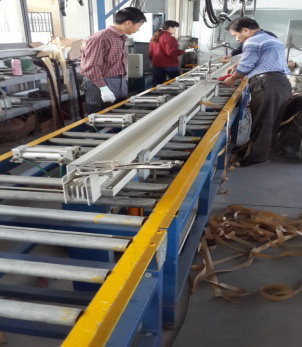
No. | Parameters |
Model | KD-SDX/2(4) -4.5 |
Max. Busbar Height | 330mm (single layer) |
Max. Busbar Length | 4500mm |
Working Efficiency | Around 3000mm/6min |
Lifting Fixture | 6 pieces |
Frame Material | Aluminum |
Hanger Material | Aluminum hanger |
Riveting Type | Manual riveting |
Power | 380VAC 50~60Hz 1kW( customized) |
Equipment Dimension | L18000(13500)mm*W800mm*H800mm |
When evaluating the economic impact of this manual compact busbar assembly machine, the primary advantage lies in its exceptional working efficiency and strict quality management capabilities. The system is engineered to elevate the overall production capacity of the facility while maintaining exact structural tolerances, ultimately delivering a superior return on investment through reduced labor costs and minimized material waste.


