
Views: 0 Author: Site Editor Publish Time: 2026-09-19 Origin: Site


Are you choosing between copper busbar and aluminum busbar options? Copper busbar systems conduct electricity exceptionally well, while aluminum busbar alternatives are lighter and more cost-effective. Engineers and electricians frequently face this decision. An incorrect selection can lead to overheating, voltage drops, or increased expenses. You need to understand how each material performs electrically. Copper busbar and aluminum busbar configurations serve distinct purposes. Your specific project requirements determine which option fits best. Copper busbar excels in conductivity, whereas aluminum busbar offers weight and cost advantages. Copper busbar solutions are ideal for high-density installations. Aluminum busbar systems suit larger-scale projects. For your power distribution needs, performance is critical. These busbar components are essential to your system's operation. This decision carries significant weight. Choosing the right busbar ensures optimal system performance. Your selection impacts reliability, budget, and long-term outcomes. Carefully evaluate these differences before making your final choice.
Copper busbars carry electricity better and naturally resist rust, but they are more expensive and heavier.
Aluminum busbars weigh less and cost less, but they must be bigger and need extra attention to stop rusting.
Use copper for small spaces, high reliability, or harsh environments.
Pick aluminum for big projects that have limited budgets or strict weight limits.
Making and installing them correctly is very important for both materials to keep them safe and working well.
Before you look at any specific product, you need a clear overview of how these two materials differ. The copper vs aluminum choice depends on several measurable properties that directly affect your system's electrical performance. Understanding these numbers helps you pick the right material for your project's needs.
The table below shows the most important differences between copper busbars and aluminum busbars. These numbers come from standard industry tests and show typical values you can expect from quality materials.
Property | Copper (ETP, C11000) | Aluminum (Al 1350) |
|---|---|---|
Electrical conductivity | 35 MS/m (~61% IACS) | |
Resistivity | 17.2 nΩ·m | 28.3 nΩ·m |
Density | 8,960 kg/m³ | 2,700 kg/m³ |
Thermal conductivity | 400 W/m·K | 230 W/m·K |
Relative weight (same size) | 100% | ~30% |
Corrosion resistance | Naturally high | Requires surface treatment |
Typical cost index | Higher | Significantly lower |
The conductivity difference between these materials drives most design choices. Copper busbars reach at least 100% IACS when annealed, while aluminum busbars usually hit only 50–61% IACS. This gap means copper carries more current with less resistance for the same physical size.
Ampacity ratings for identical cross-sections show this difference clearly. The table below lists current-carrying capacity for standard busbar sizes in open air at 35°C ambient temperature.
Busbar Size (mm) | Copper Ampacity (A) – Vertical Mount | Aluminum Ampacity (A) – Vertical Mount |
|---|---|---|
10×3 | 120 | 95 |
25×6 | 380 | 300 |
50×6 | 680 | 530 |
100×10 | 1850 | 1450 |
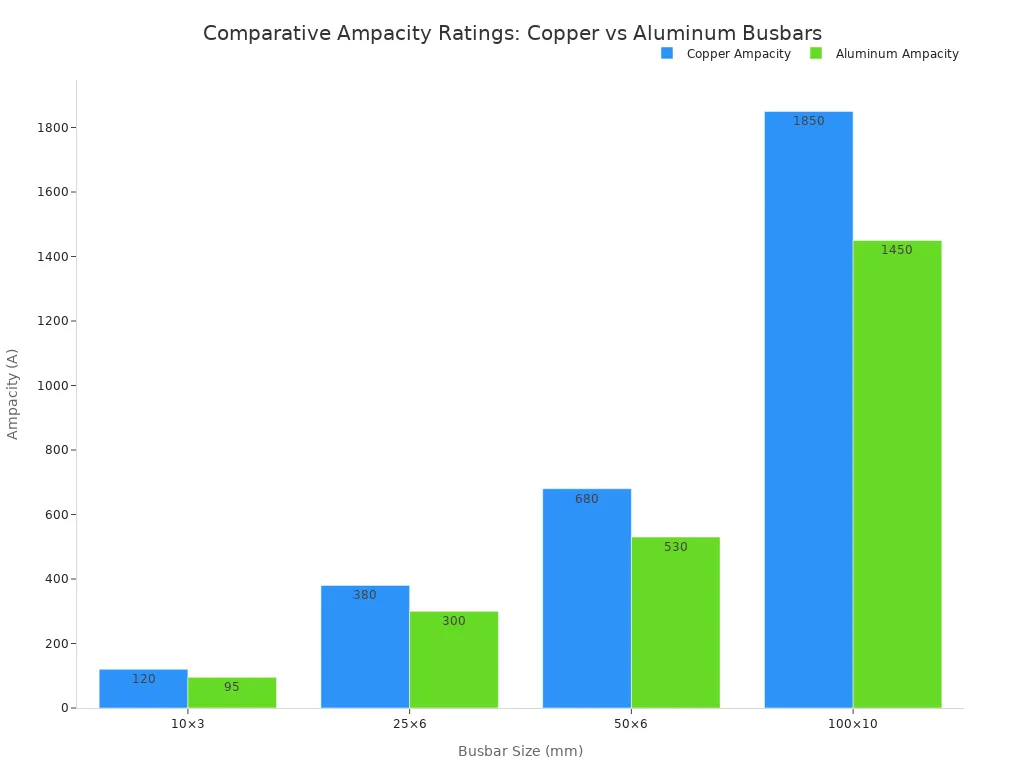
Notice that copper's ampacity runs about 1.27 times higher than aluminum's for the same cross-section. A 50×6 mm copper bar handles 680A, while an aluminum bar of the same size manages only 530A.
You cannot simply compare these numbers alone. Each property affects your overall system design in specific ways.
Conductivity and cross-sectional area. Because copper offers better electrical conductivity, you can get the same ampacity with a smaller bar. Aluminum needs roughly 1.43 times the cross-sectional area of copper to match its current-carrying capacity. For example, a 1/4" × 2" copper bar rated at 575A needs a larger 1/4" × 3" aluminum bar to carry a similar 554A. This size difference affects your enclosure dimensions, busbar spacing, and overall footprint.
Weight and structural support. Aluminum's density is just 2,700 kg/m³ compared to copper's 8,960 kg/m³. This means aluminum busbars weigh about 30% of copper busbars for the same physical dimensions. Lighter busbars reduce the need for heavy structural supports and make installation easier. However, you must also consider that aluminum's larger cross-section partly offsets this weight advantage.
Thermal performance. Copper's thermal conductivity reaches 400 W/m·K, nearly double aluminum's 230 W/m·K. This property helps copper busbars spread heat more effectively, which matters in high-density installations where heat buildup can hurt performance. For high-performance electrical systems, this thermal advantage often proves decisive.
Cost considerations. Aluminum busbars cost much less than copper busbars per pound. When you add in the larger cross-section needed, aluminum still saves a lot of money for large-scale projects. Yet copper's better conductivity and reliability often justify its higher price in critical applications where downtime costs far exceed material expenses.
These metrics work together to determine which material fits your specific applications. A compact switchgear installation with limited space favors copper's smaller footprint. A large industrial distribution system with budget limits may benefit more from aluminum's cost efficiency. Your priority—whether space, weight, cost, or long-term reliability—guides this basic choice.
Electrical conductivity affects how your busbar system works. The difference in electrical performance between copper and the lighter metal is big. This gap directly affects how well your system runs and how much it costs to operate. Knowing this helps you make smart design choices.
Copper gives about 1.5 times the electrical conductivity of the lighter metal. This high conductivity lowers resistance changes and cuts power loss in your system. Lower resistance means less energy turns into heat during use. Industry standards measure this as a percentage of IACS. Copper reaches 100% IACS. This benchmark gives you a clear point to compare.
Thermal conductivity follows the same pattern. Copper delivers about twice the thermal performance of the lighter material. This helps manage heat in tight installations. Standard values for each material are shown below.
Material | Thermal Conductivity (W/m·K) |
|---|---|
Copper (C110) | 401 |
Aluminum (6101-T6) | 210 |
This thermal advantage helps spread heat well. Lower operating temperatures improve electrical performance and make parts last longer. The resistivity of copper at 20°C is exactly 1.68 × 10⁻⁸ Ω·m in the standard resistance formula for busbars. This low resistivity means great conductivity and less energy turns into heat during use. Your system runs cooler and stays stable over time.
Aluminum cannot match the natural properties of the denser material. But you can design copper busbar and aluminum busbar setups with larger cross-sections to get similar ampacity. This is common practice in the industry. Engineers use larger bars to match the current-carrying ability of the denser material. The larger size does add bulk to your system design.
The trade-off is space. Larger busbars need more room inside enclosures and switchgear. You must plan for this bigger footprint during system design. The weight advantage partly offsets this concern. Aluminum alternatives weigh about 30% of comparable copper busbars for the same physical dimensions, even with the larger size. This mix of lower cost and lighter weight makes the lighter material appealing for large-scale projects where space is not the main limit. Many industrial setups benefit from this approach.
Your choice depends on what matters most to you. High conductivity favors the denser material. Cost savings and weight savings favor the lighter metal. Knowing these strategies helps you design a system that meets your needs. Look at your project details carefully before making this decision.
Weight and cost often decide which material you pick for big electrical projects. Aluminum has clear benefits in both areas. These plus points make aluminum busbars a good choice for many setups. You must compare these savings with the conductivity differences talked about earlier.
Aluminum's low density gives it a big weight edge. Copper weighs 8.9 g/cm³, but aluminum weighs only 2.7 g/cm³. This gap matters when you pick busbar sizes for the same current flow. Correctly sized aluminum busbars weigh about 48% less than copper ones. That drop changes how you install them.
Lighter busbars need less structural support. Heavy copper setups require strong steel frames, tough mounting brackets, and thicker enclosure walls. Aluminum removes much of that need. Your supports can use lighter materials and simpler designs. This cuts costs beyond just the busbar itself.
Installation work gets easier with aluminum too. Workers handle lighter parts with less effort. Crews need fewer lifting tools and less special gear. Long busbar runs that need cranes with copper may only need manual lifting with aluminum. This speed shortens install time and lowers labor costs. For projects on tight deadlines, this edge is valuable.
The weight benefit also helps shipping and delivery. Lighter busbars cut transport costs. You can fit more material in each load. Storing and moving items at the job site becomes simpler too. These savings add up across the whole project budget.
The price gap between these materials is huge. Aluminum busbars cost 60-75% less than copper busbars for materials. This amount takes up a large part of your total budget. For big projects, this cost check often decides which material you choose.
Think about a typical factory power system. Copper busbar material might eat up a big slice of your electrical budget. Switching to aluminum frees that money for other project needs. You could buy better switchgear, more safety devices, or improved tracking systems. The savings give you room in your overall financial plan.
Aluminum's cost edge goes beyond raw material. The lighter support needs mentioned earlier lower your extra costs. Cheaper support systems cost less. Smaller enclosures may work because aluminum's bigger size still weighs less overall. Every part of your setup gains from the weight drop.
But you should look at the full lifetime cost. Aluminum's lower conductivity means more energy lost during use. These losses turn into ongoing running costs. Your cost review must include these long-term factors. For occasional or low-load uses, the efficiency gap matters less. For steady high-current systems, copper's better conductivity may make its higher starting price worth it.
The final choice depends on what your project values most. Budget-focused uses favor aluminum's quick savings. Performance-focused setups may justify copper's higher cost. Your specific needs decide which material gives better overall value. Look at both the starting costs and the running expenses before you make your final pick.
Environmental factors affect how your busbar system performs over time. Corrosion and heat movement create different challenges for each material. Knowing these differences helps you build connections that last.
Copper busbars resist corrosion naturally. A thin oxide layer forms on the surface, but it still conducts electricity. This protective quality makes copper reliable in humid or industrial settings. You can install copper connections with standard hardware and expect them to work well for decades.
Aluminum acts differently. Its oxide layer forms quickly and blocks electrical flow. This layer creates resistance at connection points, which causes heat when current passes through. Without proper preparation, aluminum connections fail early. You must treat aluminum surfaces before assembly.
Bolt-busbar-terminal-extra thick washer-bellewille washer-nut is tried and proven. Not to forget scrubbing the parts with scotchbrite and applying noalox or similar to connections.
Surface preparation follows a clear order. First, remove the oxide layer with a stainless steel brush or fine abrasive pad until you see bright metal. Never use brushes that touched copper before, as tiny copper bits cause galvanic corrosion. Second, apply an oxide-blocking joint compound with zinc or aluminum particles within minutes of scrubbing. This compound keeps air and moisture away from the joint. Third, move the brush through the compound to break up new oxide and create fresh contact points.
You also need the right connector materials. Use aluminum hardware for aluminum-to-aluminum joints. For aluminum-to-copper connections, pick certified bimetallic connectors. Apply proper torque based on manufacturer instructions. Too little torque leaves gaps; too much torque cracks the compound layer. Finally, cover connections with heat-shrink boots or insulating tape to keep out moisture and dust.
Aluminum expands about twice as much as copper when heated. A long aluminum busbar run changes length noticeably as current loads shift. This movement stresses rigid connections and can loosen hardware over time. Copper's lower expansion rate makes it more stable in size.
You must plan for this movement in your system design. Expansion joints solve this problem. These flexible parts absorb size changes while keeping electrical flow steady.
Design Approach | Mechanism | Functional Benefit |
|---|---|---|
Flexible structures (bellows, corrugated sections, sliding mechanisms) | Lets busbar sections move relative to each other | Keeps electrical flow steady while reducing mechanical stress and preventing fatigue failure from heat cycling |
Material selection (copper alloys, aluminum alloys, composites) | Matches heat expansion rates of connected parts | Provides strength and electrical performance across many heat cycles |
Multi-layer or laminated configurations | Stacks thin conductive layers to spread stress | Lowers stress on individual parts and improves resistance to heat cycling fatigue |
Spring-loaded or pressure-compensated systems | Adjusts automatically to size changes | Keeps steady contact pressure, preventing loosening or separation that could cause overheating |
Protective coatings, surface treatments, or plating | Stops oxidation and corrosion at the joint surface | Keeps contact resistance low and extends service life during repeated heating and cooling cycles |
Place expansion joints at regular intervals along long busbar runs. Ask your system designer to set proper spacing based on expected temperature ranges. This planning keeps connections strong and extends the life of your whole installation.
Mechanical strength determines how well your busbar system withstands physical stress. Copper busbars offer superior mechanical strength compared to aluminum busbars. This difference matters in high-stress environments where vibration, bending, or impact can damage components.
The tensile strength comparison shows a clear gap between these materials. Copper reaches 32,000 psi, while aluminum alloy 6101 achieves 28,000 psi. This difference means copper resists deformation better under mechanical load. Copper is denser and has a higher tensile strength than aluminum, making copper busbars more resistant to mechanical stress and deformation.
Material | Tensile Strength (psi) |
|---|---|
Copper | 32,000 |
Aluminum (Alloy 6101) | 28,000 |
This strength advantage translates into real-world performance. Copper busbars handle repeated bending during installation without cracking. They resist fatigue from constant vibration in industrial machinery. Aluminum busbars require more careful handling and additional support in demanding applications.
Flexibility also differs between these materials. Copper bends more easily without breaking, allowing tighter radius bends during fabrication. Aluminum may crack if you bend it too sharply. Your fabrication team must account for this difference when designing busbar runs with tight corners or complex routing.
For switchgear and control panels subject to frequent maintenance access, copper's durability reduces the risk of damage. Workers can handle copper busbars more roughly without compromising their integrity. This resilience extends the service life of your installation.
Both copper and aluminum offer excellent recyclability. This factor grows increasingly important for eco-conscious projects and corporate sustainability goals. You can recover value from either material at the end of your system's service life.
Aluminum leads in recycling efficiency. Approximately 75 percent of all aluminum ever produced remains in use today. Copper falls slightly behind at 65 percent still being used or available for future use. These numbers reflect mature recycling infrastructure for both metals.
Copper global recycling rate: 65%
Aluminum retains its properties better through recycling cycles. You can melt and recast aluminum repeatedly without significant degradation. This characteristic makes aluminum an attractive choice for projects with strong circular economy requirements. Copper also recycles well, though it may require refining to remove impurities.
Your choice between these materials affects your project's environmental footprint. Aluminum's higher recycling rate and better property retention support sustainability claims. Copper's longer service life means fewer replacements over time, reducing overall material consumption.
Consider the full lifecycle when evaluating these options. A copper busbar that lasts 40 years may consume less material than an aluminum busbar replaced twice during the same period. Your durability requirements and sustainability targets both factor into this decision.
When your project demands uncompromising electrical performance, copper busbars deliver results that aluminum cannot match. These premium components excel in environments where failure costs far exceed material expenses. You need to understand when copper justifies its higher price tag.
Copper busbars maintain their electrical properties throughout decades of service. The natural oxide layer that forms on copper surfaces remains conductive, unlike aluminum's insulating oxide. This characteristic ensures stable connections without frequent maintenance. Your system keeps operating at peak efficiency year after year.
The thermal advantages of copper directly support long-term reliability. Copper's thermal conductivity reaches approximately double that of aluminum. This property allows copper busbars to dissipate heat effectively, even in densely packed enclosures. Lower operating temperatures protect insulation and reduce the risk of connection degradation. Your high-performance electrical systems benefit from this superior heat management.
Copper also resists creep and relaxation better than aluminum. Connections stay tight under repeated thermal cycling. This mechanical stability prevents loose joints that cause arcing and hotspots. For critical infrastructure, this reliability translates into fewer unplanned outages and lower lifetime costs.
Space-constrained installations represent prime copper applications. Data centers pack enormous current loads into compact racks. Copper's superior conductivity lets you achieve the required current-carrying capacity with smaller cross-sections. You save valuable enclosure space while maintaining excellent electrical performance.
Hospitals demand uninterrupted power for life-safety equipment. Copper busbars provide the dependable performance these facilities require. Their corrosion resistance suits the harsh cleaning chemicals used in medical environments. Industrial plants with continuous processes also favor copper for its durability under vibration and thermal stress.
For manufacturers like Suzhou Kiande, copper busbars represent a common material processed by their busbar machines. These machines handle copper's specific characteristics with precision. The equipment adjusts for copper's rebound coefficient and hardness during bending operations. This capability ensures accurate fabrication of complex busbar configurations.
Your choice of copper makes sense when downtime costs exceed material savings. Mission-critical facilities, high-density switchgear, and applications with limited maintenance access all justify copper's premium. The initial investment returns through decades of trouble-free operation. When you prioritize performance and reliability above budget constraints, copper busbars remain the industry standard.
Budget limits often guide material choices in electrical distribution. Aluminum busbars save you a lot of money while still working well. You can use those savings for other important parts of your project. This cost benefit makes aluminum the top pick for many big installations.
Aluminum busbars cost much less than copper ones. Raw material prices for aluminum run about 60-75% lower than copper. This price gap turns directly into project savings. A typical utility-scale installation might use thousands of pounds of conductive material. The cost difference becomes huge at that scale.
Weight reduction adds to these savings. Aluminum weighs about one-third as much as copper for the same physical dimensions. Lighter busbars need less structural support. You can use smaller mounting brackets and simpler enclosure designs. Shipping costs drop because you move less mass. Installation crews handle lighter parts with less equipment. These logistical benefits lower your total installed cost beyond just the material price.
The economic picture gets even better when you consider aluminum's good enough conductivity for many uses. While copper conducts about 1.5 times better, aluminum busbars with larger cross-sections reach similar ampacity. You give up some space efficiency for major cost efficiency. For projects without tight space limits, this trade-off makes excellent financial sense.
Large commercial buildings benefit greatly from aluminum busbar installations. Office towers and shopping centers spread power across huge floor areas. The weight savings reduce structural loading on building frames. The cost savings free budget for other electrical infrastructure investments.
Renewable energy installations represent another ideal application. Solar farms and wind facilities cover enormous territories. They need extensive busbar runs to collect power from spread-out generation points. Aluminum's lower cost makes these sprawling systems economically viable. Its lighter weight simplifies installation across challenging terrain.
Utility-scale power distribution networks also favor aluminum busbars. Substations and switching stations handle massive current loads over long distances. The cost advantage of aluminum becomes decisive at this scale. Many utilities specify aluminum for new installations based on proven performance and budget requirements.
Suzhou Kiande's busbar machines and busbar accessories work fully with aluminum busbars. These systems adjust for aluminum's rebound characteristics during bending operations. You achieve precise, reliable connections while leveraging aluminum's cost benefits. Modern processing equipment ensures quality results regardless of your material choice. For cost-sensitive applications, aluminum busbars deliver dependable performance at a fraction of copper's price.
Your project details decide which metal is best for you. There is no single answer for every setup. You need to think about different factors that matter for your needs. This guide helps you check your main concerns step by step.
Begin by looking at your project's details. Think about the space you have, your budget, the environment, and how reliable you need the system to be. Each factor points to a different metal option.
Scenario | Recommended Material | Primary Reason |
|---|---|---|
Limited enclosure space | Copper | Smaller cross-section achieves required ampacity |
Tight project budget | Aluminum | Material costs run 60-75% lower |
High-corrosion environment | Copper | Natural oxide layer remains conductive |
Weight-sensitive structures | Aluminum | Approximately 30% of copper's weight |
Mission-critical power | Copper | Long-term reliability justifies premium cost |
Large-scale distribution | Aluminum | Cost savings become decisive at scale |
The amount of current you need to carry affects your choice. Copper busbars give better conductivity in a smaller size. Aluminum busbars need about 1.43 times the area to carry the same current. If your box cannot fit that larger size, copper is the better pick.
Budget limits often matter more than technical details. Aluminum busbars cost much less per pound than copper. For big projects that go for thousands of feet, this saving changes the whole cost picture. You can use that money for other parts like switchgear, protection gear, or monitoring systems.
Where you put the system also matters. Copper busbars fight corrosion on their own, even in wet factories. Aluminum busbars need surface treatment and careful connection work. Places near the ocean with salty air prefer copper's natural strength. Indoor, climate-controlled spaces let aluminum work well if installed correctly.
How easy it is to reach your system also matters. Copper busbars keep steady connections for many years with no work. Aluminum connections need regular checks and tightening. Faraway or hard-to-reach places are better with copper's low upkeep needs.
Choosing the metal is only half the job. How well you make the busbars decides if they work as they should. Poorly made busbars fail no matter what they are made of. Careful manufacturing stops loose connections, hot spots, and early breakdown.
Today's busbar machines give the exactness your setup needs. CNC punching machines place holes within 0.004 inches of each other. This accuracy makes sure bolt holes line up perfectly where pieces join. Holes that are off cause uneven pressure and heat in one spot.
Bending also needs high precision. Good bending machines make bends within 0.20 degrees. This keeps the right spacing between conductors and stops stress spots. Wrong bend angles put strain on joints and reduce space between parts.
Suzhou Kiande makes busbar machines that work well with both copper and aluminum. These machines change settings for each metal's spring-back during bending. They can cut, punch, and bend in one go. You get the best electrical performance from exact manufacturing.
How you install the busbars finishes the job. Using the right torque, cleaning surfaces, and using joint compound keep aluminum joints from rusting. Copper joints need clean surfaces and the right hardware. Following the maker's instructions makes sure your system works well for its whole life.
The final choice between copper and aluminum busbars balances how well they work against how much they cost. Your project details guide this choice. No matter which metal you pick, use good processing tools. Careful manufacturing keeps your electrical system safe and long-lasting.
Copper busbar and aluminum busbar each serve distinct applications. Copper busbars deliver superior electrical performance and conductivity. Aluminum busbars provide significant weight and cost advantages. Aluminum busbars suit cost-sensitive projects with large-scale requirements. Aluminum offers good value for budget-constrained buyers. Your project parameters determine the optimal choice. Evaluate your priorities: current-carrying capacity, budget, weight constraints, and environmental conditions. Copper excels in high-performance applications with limited space. Copper offers unmatched reliability for mission-critical systems. Both busbars work well with proper processing equipment. Consult busbar equipment manufacturers like Suzhou Kiande. Their modern machines optimize processing for both materials. You achieve precise connections and long-term system reliability. The right choice depends on your specific needs and constraints. No single option works for every situation.
Copper conducts electricity about 1.5 times better than aluminum. This means copper busbars can carry more current with less resistance when they are the same size. To match copper's current capacity, you need aluminum busbars that are about 1.43 times larger in cross-section.
Aluminum oxidizes quickly when exposed to air. This oxide layer blocks electrical flow and creates resistance at connection points. You must apply anti-oxidant joint compound and use proper surface preparation during installation. Copper forms a conductive oxide naturally, requiring no special treatment.
Yes. Modern busbar machines handle both copper and aluminum effectively. Quality equipment adjusts for each material's rebound coefficient during bending operations. Suzhou Kiande's busbar machines cut, punch, and bend both metals with precision, ensuring reliable connections regardless of your material choice.
Your project parameters determine the better value. Copper busbars cost more initially but provide superior conductivity and require less maintenance. Aluminum busbars save 60-75% on material costs but need larger cross-sections and careful installation. Evaluate your budget, space constraints, and reliability requirements before deciding.
Yes. Aluminum connections demand meticulous surface preparation, including scrubbing with a stainless steel brush and applying joint compound immediately. Copper connections need only clean surfaces and proper torque. Aluminum also requires expansion joints in long runs because it expands twice as much as copper when heated.

