
Views: 0 Author: Site Editor Publish Time: 2026-09-25 Origin: Site


A CNC busbar machine cuts copper or aluminum busbar with computer precision. Think of this busbar machine as one machining center that does cutting, punching, and bending all in one smooth process. The CNC system controls each station using a programmed drawing of the busbar, so manual marking is not needed. The computerized numerical control makes sure the results are accurate and repeatable within tight tolerances. This article explains how it works, its advantages, and its role in modern manufacturing. Modern manufacturers depend on this equipment to make reliable electrical connections with consistent quality. It greatly speeds up production and lowers labor costs. Key industries like switchgear, substations, and new energy vehicles gain from its high-speed processing abilities.
A CNC busbar machine does cutting, punching, and bending all in one automated process.
It uses computer control to achieve high precision and repeatability, which reduces errors.
Manufacturers cut their labor costs by 40 to 50 percent and make products 3 to 5 times faster.
The machine makes things safer by keeping workers away from risky tasks.
It helps integrate smart factories with real-time monitoring and predictive maintenance.
A CNC busbar machine is a multi-purpose machining center for metal busbars. It uses a CNC system to combine tasks that used to need several machines, operators, and clamping steps. Now one machine does them all automatically, accurately, and efficiently. The machine has core parts like a CNC system (the brain), a workstation that holds the busbar, and processing units for punching, shearing, and bending. High-end models also have an automatic tool changer and a feeding system, and they all work together to automate the workflow.
The CNC system controls each station using a programmed drawing of the busbar. A busbar flat pattern is exported from ECAD/MCAD software as a DXF file. The DXF file is sent to the machine through USB or Ethernet. The CNC controller's DXF import module finds bend lines, holes, and trim lines by their CAD entity types. The controller builds an optimized processing sequence based on machine kinematics, taking into account tool change time and physical limits. The operator watches a graphical simulation of the full processing sequence on the CNC touch screen display to catch programming errors before material is processed. The operator loads the material and starts the automatic cycle, which the machine runs without more operator help.
The machine bends, punches, and cuts copper and aluminum busbars automatically. The busbar is clamped once at the start of the cycle, and it never leaves its reference frame. A single CNC controller coordinates all operations from a common datum. The servo back-gauge positions the busbar for the first bend. The hydraulic bending unit forms the bend to the programmed angle using real-time encoder feedback. The back-gauge repositions the busbar for a punched hole, and the hydraulic punch unit drives the tool through the material at the precise programmed coordinate. The back-gauge advances again for the next bend or punch. Finally, the busbar is positioned at the shear for the cut to length. Throughout the sequence, the busbar's positional relationship to every tool station is maintained by numerically controlled axes, not by operator skill or fixture transfers.
Component | Function |
|---|---|
Feeding mechanism | The X-axis uses two sets of main and auxiliary power clamps plus a servo clamping busbar; these can work independently or together to complete the feeding work. |
Stamping station | The machine includes a punching mold and related hydraulic center, indicating a dedicated punching/stamping station for busbar processing. |
Bending unit | The source describes busbar bending machines that use hydraulic drive or servo control with bending dies to bend copper or aluminum busbars into required shapes. |
Additional systems | The CNC busbar machine also includes a CNC controller, servo outfeed device, hydraulic center, cutting mold, and embossing mold. |
The ATC system with BT40 tool holders allows for rapid transitions between different machining tasks without downtime.
This cnc busbar processing machine is different from a conventional hydraulic busbar processor in a few ways. A CNC busbar machine uses an all-servo drive with independent AC servo motors and closed-loop position feedback on every axis. A conventional hydraulic busbar processor uses a hydraulic power unit with mechanical stops and pressure settings; it has no closed-loop control. The CNC busbar machine achieves bending angle accuracy of ±0.3° through real-time torque monitoring that compensates for material springback; no angle drift from oil temperature occurs. The conventional processor achieves ±1° accuracy, and angle drift occurs due to oil temperature variations and mechanical stop wear. The CNC busbar machine also offers 40–50% lower energy costs because servo motors draw power only during active motion, with idle consumption near zero. The conventional processor runs a continuous hydraulic pump, resulting in higher idle and total energy consumption.
A busbar is a metal strip that carries electricity inside electrical systems. These conductors move big currents between switchgear, transformers, and distribution panels. Copper and aluminum are the main materials for busbars. Each metal has different electrical properties that affect design choices.
ETP copper (C11000) has a conductivity of 58 MS/m, which is 100% IACS, and a resistivity of 17.2 nΩ·m. Aluminum 1350 has a conductivity of 35 MS/m, about 61% IACS, and a resistivity of 28.3 nΩ·m. Manufacturers pick flat strip for panels and switchgear because its wide surface gets rid of heat well. Hollow tube shapes weigh less and cool better. Braided or flexible types can bend in tight spaces.
Precision processing makes sure connections are reliable and keeps joint temperature from rising too much. Accurate cutting is very important for bus bars to fit and work properly. Good bending techniques keep the bus bars strong and able to conduct electricity.
Accurate cutting is very important for bus bars to fit and work properly. Good bending techniques keep the bus bars strong and able to conduct electricity.
When you bend a busbar, the contact surface changes a little, which raises contact resistance. This resistance depends on how flat and how tightly the surfaces press together. Bending too much leads to poor contact, unevenness, and loose connections. These problems raise resistance and can cause local heating or electrical fires.
Factor | Effect on Contact Resistance |
|---|---|
Bending angle increase | ~5% resistance increase per 5-degree increase |
Surface unevenness increase | ~10% resistance increase per 1 mm increase |
Excessive bending angle | Poor contact at connection due to reduced flatness and contact pressure |
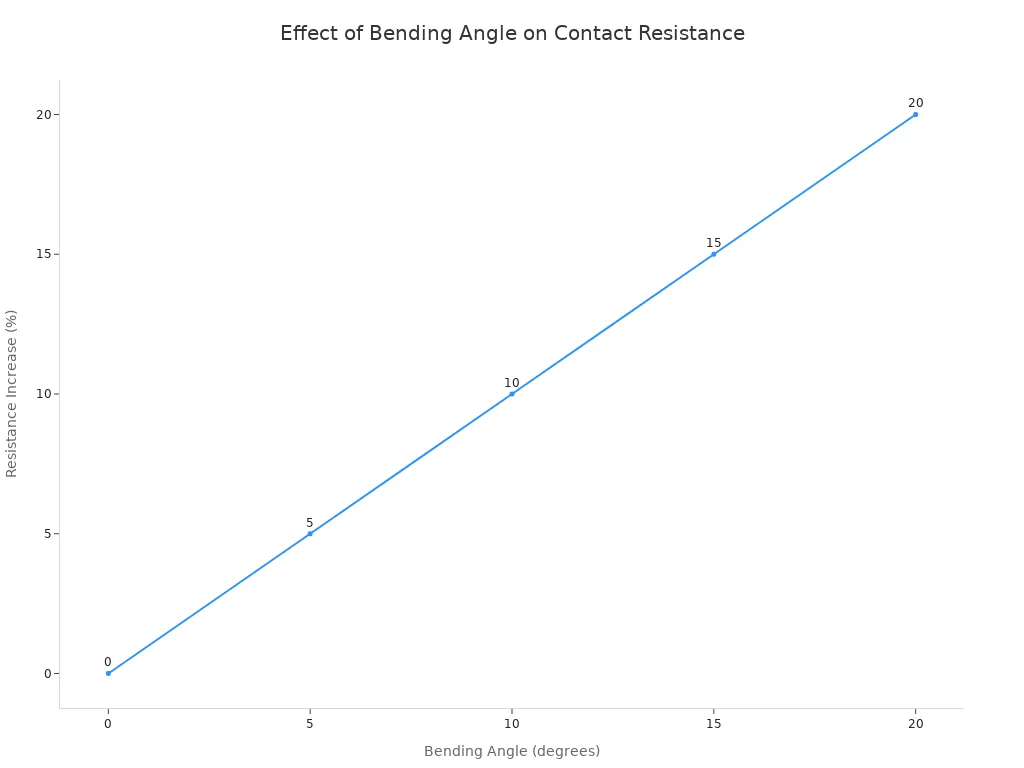
A CNC busbar machine handles these tight tolerances by itself. The machine places holes and important cut features about 3–4 times the material thickness away from bends to stop distortion during forming. It also thinks about tolerance stackup, because many bends change the final position of mounting and contact features.
Manufacturers who switch to a CNC busbar machine get quick benefits in three areas. Manual busbar work needs workers to measure, mark, and place each piece by hand. They use separate machines for cutting, punching, and bending. Each time they move a piece between machines, alignment errors happen. A single busbar machine removes these steps. It puts all operations into one automatic cycle.
Precision is the first benefit you can measure. Top CNC busbar machine models have ±0.3° bending angle accuracy for punching and bending stations. This repeatability is not possible with hand methods. Suzhou Kiande's machine goes even further. It actively adjusts for material springback. Sensors measure the real thickness and resistance during the first bend. The software figures out exactly how much extra bend is needed. Active algorithms use real-time material thickness and strength data. They over-bend the material so it relaxes into the exact target angle. This closed-loop process works for copper and aluminum. It adjusts the rebound coefficient based on the material's width and hardness. Production output increases three to five times compared to hand methods for complex shapes.
Efficiency gains are also big. Manufacturers that use a CNC busbar machine report 40–50 % labor cost savings per panel. A typical setup removes 1.5 to 2.5 full-time jobs. Depending on local wages, annual labor cost savings range from $20,000 to $50,000 per year. At US rates, removing 1.5 to 2 hand fabricator jobs saves $37,500 to $70,000 each year. These savings come from faster cycle times and less rework. The machine also offers flexibility. It handles different connection bar types, materials, and widths without manual changeovers. Suzhou Kiande's equipment does automatic hole punching, counter boring, cutting, and embossing. It follows programmed parameters.
Traditional processing relies heavily on skilled manual workers. They must read drawings correctly, keep steady quality, and avoid costly mistakes. Automation removes this need. The machine reads the DXF file directly. The operator loads material and starts the cycle. The CNC controller handles all positioning, bending, punching, and cutting choices. This change lets manufacturers keep steady output with less experienced operators.
Safety gets much better with automation. Modern CNC machines have multiple safety systems. Interlocking guards connect to the control system. If opened during operation, the machine shuts down right away. Light curtains create infrared barriers. They stop the machine if anything breaks the beam. Proximity sensors detect when an operator gets too close. Emergency stop buttons sit at many places you can reach. Overload protection checks machine performance and shuts off before damage happens.
Operators stay separate from the machine for safety. They mainly focus on programming and loading or unloading material. They do not directly do dangerous punching or shearing. The machine's safety design and automated processes keep operators away from danger zones. This stops serious injuries like hand injuries.
For manufacturers thinking about production upgrades, the benefits of CNC busbar equipment over hand methods are clear. Higher precision, lower costs, less need for skilled workers, and safer operation make a strong business case. Suzhou Kiande's equipment shows these benefits.
Switchgear builders, substation contractors, and power engineering firms make up the biggest group of CNC busbar equipment users. These industries need busbars that carry large currents between transformers, breakers, and distribution panels. One switchgear cabinet may hold dozens of bent and punched bars. Every bar must fit perfectly at each connection point. Manual processing cannot meet this volume and accuracy demand.
Suzhou Kiande supplies busduct production lines that handle processing, assembly, testing, and packaging in one connected flow. These lines come in manual, semi-automatic, and fully automatic setups. The company designs each line around the customer's factory layout, capacity, and process needs. Switchgear OEMs gain a smooth path from raw copper to finished busduct. Suzhou Kiande also builds switchgear cabinet production lines for high, medium, and low voltage classes. The company serves hundreds of power equipment manufacturers around the world.
Electric vehicle battery modules, rail transit power systems, and data center power distribution all depend on compact, high-precision busbars. EV busbars differ greatly from standard industrial bars. They use laminated thin copper or solid copper sheets. Their widths range from 15 mm to 40 mm. Bending tolerances tighten to plus or minus 0.2 degrees so terminals line up correctly. Low-clearance 40 mm U-bends and complex twists are common. Integrated laminated films replace heat-shrink tubing for insulation.
Parameter | Standard Industrial Busbar | EV Infrastructure and Battery Busbar |
|---|---|---|
Conductive Material | Solid Red Copper (3.0mm–12.0mm) | Laminated thin copper or solid copper sheets |
Typical Width | 50 mm - 120 mm+ | 15 mm - 40 mm (Highly compact) |
Bending Tolerance | ±1.0° | ±0.2° |
Bending Profile | Large flat/vertical bends | Low-clearance 40mm U-bends and complex twists |
Insulation Standard | Heat-shrink tubing | Integrated laminated films (Mylar/Kapton) |
A cnc busbar machine meets these demands through closed-loop control. C110 copper serves high electrical and thermal conductivity needs. Tin plating supports solderability or contact corrosion control. Nickel plating or bare copper may suit specific temperature and environmental conditions. Suzhou Kiande's Busbar Storage Loading System automates material handling for high-volume production. It tracks inventory in real time and integrates with CNC processing units. These systems support Industry 4.0 and smart factory integration. Manufacturers gain consistent quality and reduced labor costs across every application.
The busbar machine now sits at the center of a broader shift toward automated, intelligent, and digital production. IIoT connects equipment, sensors, and software to share data in real time. This connectivity lets a cnc busbar machine track cycle times, tool wear, and maintenance indicators. Predictive maintenance then flags potential issues before failure, which cuts unplanned downtime and extends equipment life. For manufacturers seeking consistency, speed, and safety, this equipment is a practical investment rather than a luxury.
The busbar bending machines market is driven by rising construction and manufacturing demand for efficient electrical distribution systems. Technological advances — specifically the integration of IoT for real-time monitoring and predictive maintenance — are enhancing operational efficiency.
CNC technology will keep evolving. Expect tighter integration with smart factory systems and deeper data analysis across every busbar processing line.
A busbar machine works with copper and aluminum busbars. It changes the rebound coefficient based on how wide and hard the material is. This keeps bending accurate so you don't have to fix it by hand.
A cnc busbar machine uses closed‑loop control and real‑time encoder feedback. It reaches ±0.3° for bending. The cnc system makes up for material springback on its own.
Yes. The machine reads DXF drawings directly. It handles different busbar types, materials, and widths without manual changeovers. Operators just load material and start the cycle.
Yes. It links with ERP systems and automatic inspection equipment. The machine supports Industry 4.0 with real‑time monitoring and predictive maintenance. Many manufacturers use this busbar machine to cut labor costs.

