
Views: 0 Author: Site Editor Publish Time: 2026-07-30 Origin: Site


The demand for custom switchgear, control panels, and power distribution units forces facilities to abandon high-volume production. Shops now operate in high-mix, low-volume (HMLV) environments. This reality exposes the severe limitations of legacy fabrication equipment. Relying on manual tooling changeovers, trial-and-error bending, and operator-dependent measurements creates massive hidden costs. High scrap rates and unpredictable production bottlenecks destroy shop floor efficiency.
Panel builders and electrical manufacturers must upgrade their fabrication floors to survive. Implementing a modern Busbar Machine serves as the primary intervention point. Shifting to software-driven fabrication directly increases throughput, reduces material waste, and stabilizes unit production times. Eliminating manual setup variables allows facilities to execute complex, custom runs confidently. You can maintain operational efficiency even when every job requires a completely different conductor configuration.
Changeover Speed is the Ultimate Metric: In high-mix production, the profitability of a CNC busbar machine is dictated by its automated tool-changing capabilities and software-to-machine communication speed, not just raw punching or bending speed.
Software Integration Precedes Hardware: Effective automated busbar processing requires seamless integration with 3D CAD/CAM environments to eliminate manual programming and reduce translation errors.
Scrap Reduction Drives ROI: Advanced digital busbar punching and bending systems utilize active spring-back compensation and precise material measurement to achieve first-part-correct production, critical when processing expensive copper and aluminum.
Implementation Requires Process Realignment: Adopting an integrated joint bar processing center necessitates a shift in floor layout, operator training, and maintenance protocols to realize advertised uptime.
Success in high-mix environments depends on Overall Equipment Effectiveness (OEE). You must heavily weight this metric toward minimizing downtime between distinct job runs. When every order requires a different configuration of copper or aluminum profiles, raw machine speed matters less than agility. A machine that punches rapidly but takes thirty minutes to retool for the next job destroys production schedules. True efficiency demands continuous operation across varied batch sizes with minimal human intervention. Operators need equipment that transitions from a 1/4-inch copper ground bar to a 1/2-inch aluminum phase conductor without requiring a complete teardown of the workstation.
Shop managers often miscalculate machine utilization by focusing solely on stroke speed. In reality, the spindle or punch cylinder only moves a fraction of the shift. The rest of the time gets consumed by material handling, tool swapping, and program loading. Optimizing these non-value-added tasks separates profitable shops from struggling ones. You must measure success by how quickly the first good part comes off the machine after a job change.
In HMLV manufacturing, the ratio of setup to execution often skews heavily in the wrong direction. Manual measurement, physical tool swapping, and trial bends erode margins rapidly when batch sizes remain small. If an operator spends twenty minutes setting up a machine for a run of five custom busbars, the setup cost eclipses the actual production value. Automated systems flip this ratio. They rely on digital instructions to adjust back-gauges, swap punch dies, and set bend angles instantly.
Consider a standard shift where an operator processes twelve different jobs. If each job requires a fifteen-minute manual setup, you lose three hours of production time daily. That equals nearly forty percent of the shift wasted on turning wrenches and measuring offsets. Upgrading to a CNC busbar machine reduces that setup time to seconds per job. The machine reads the barcode, loads the program, indexes the turret, and waits for the material. This shift in operational dynamics reclaims hundreds of hours annually.
The financial impact of scrap rates in copper and aluminum processing demands strict attention. Both materials experience significant market volatility. Precision and first-pass yield act as your primary cost-control mechanisms. A single miscalculated bend on a thick copper bar results in immediate financial loss. You cannot simply weld a mistake back together. The part goes straight into the scrap bin, taking your profit margin with it.
Copper and aluminum possess unique metallurgical differences that complicate fabrication. Aluminum is prone to galling and oxidation. It requires specific die clearances and lubrication strategies to prevent material from welding to the punch. Copper exhibits distinct spring-back variances depending on its temper and grain direction. Manual operations fail to adapt to these material inconsistencies on the fly. Operators guess at the over-bend required, leading to unpredictable quality and rejected assemblies.
Tracking dozens of custom busbar configurations across the shop floor introduces massive logistical complexity. Without clear identification, assembly-line mix-ups during panel integration become inevitable. A misidentified bar halts an entire switchgear assembly process. The assembly team wastes hours searching for the correct part or forcing the wrong part to fit, which compromises electrical clearances.
Modern fabrication requires parts to be marked, tracked, and verified from the moment the raw material is cut until it is bolted into the final assembly. Implementing a robust tracking system prevents these bottlenecks. You need a process that ties the physical part directly to the digital model. This ensures the right conductor reaches the right panel at the exact right time.
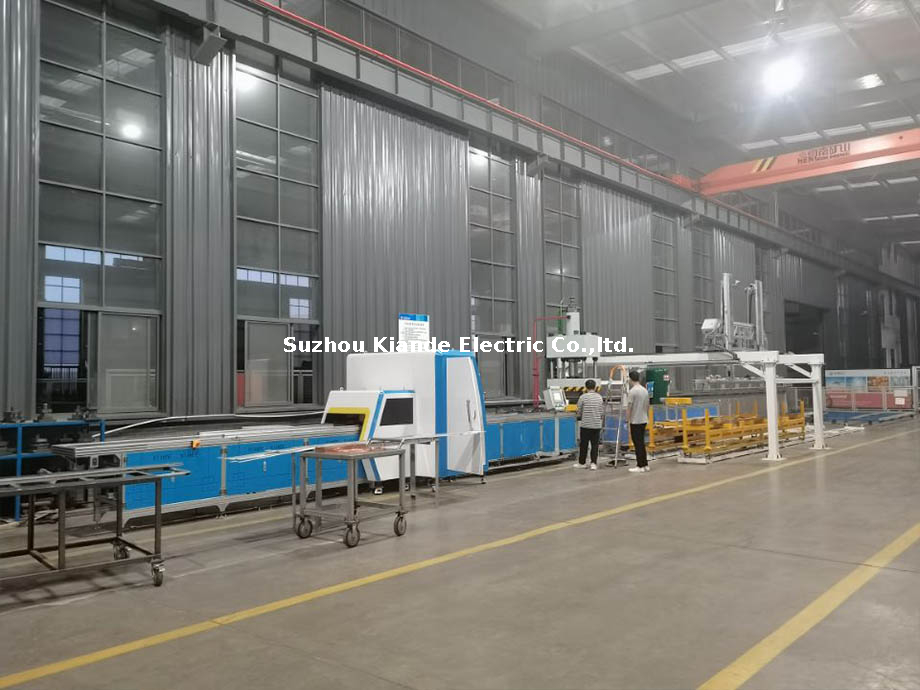
The mechanics of Automatic Tool Changers (ATC) define modern fabrication efficiency. Multi-station turrets, indexable tooling, and linear tool magazines eliminate manual intervention during complex, multi-step fabrication. A machine equipped with a robust ATC transitions from punching a standard hole to embossing or slotting in seconds. This continuous operation allows operators to load raw material and walk away. They trust the machine to execute complex geometries without mid-cycle stoppages.
Effective automated busbar processing relies on the machine's ability to hold a diverse library of tools simultaneously. You need standard round punches, obround slots for adjustability, and specialized tools for chamfering or tapping. When the machine holds all necessary tools, the operator never breaks the safety curtain to manually swap a die. This keeps the machine running and keeps the operator safe.
High accuracy requires specific technical specifications. Servo-driven hydraulic systems provide the necessary force while maintaining exact positional control. Closed-loop feedback mechanisms continuously monitor bend angles. They adjust for material resistance in real-time. Laser-assisted measurement ensures cut lengths remain exact, preventing tolerance stack-up in complex assemblies.
Advanced digital busbar punching and bending systems execute V-bends, U-bends, Z-bends, and twisting without requiring manual tool adjustments. This streamlines the production of intricate three-dimensional conductor paths. The machine calculates the exact flat length required, punches the holes in the flat state, and executes the bends perfectly. The holes align exactly where the 3D model dictates.
Integrated nesting algorithms automatically arrange diverse geometries on a single raw bar. This software-driven approach maximizes material utilization and minimizes drop. By calculating the most efficient layout for multiple distinct parts on a standard length of copper or aluminum, nesting software ensures you optimize material yield before making the first cut.
Consider a standard 12-foot copper bar. Without nesting, an operator might cut three parts and leave a 2-foot drop. Nesting software analyzes the entire daily production schedule. It mixes parts from different jobs onto that same 12-foot bar, reducing the drop to mere inches. This process alone pays for the software upgrade within months.
Integrated centers handle multiple operations in a single continuous flow. A joint bar processing center combines punching, shearing, bending, and tapping into one seamless process. This consolidation drastically reduces work-in-progress inventory and minimizes part handling. Instead of moving heavy copper bars between distinct punching and bending stations, the raw material enters the machine and exits as a fully finished component.
Reducing part handling directly reduces labor costs and prevents damage. Copper is soft. Every time a forklift or crane moves a batch of parts, you risk scratching the contact surfaces. Scratched surfaces create high-resistance joints, leading to thermal issues in the field. Processing the bar completely in one machine eliminates these handling risks.
A machine's ability to ingest standard 3D files and native electrical design files from platforms like EPLAN or AutoCAD Electrical is mandatory. Offline programming capabilities allow engineers to design and route busbars in the office while the machine continues running on the floor. Collision detection simulation verifies parts digitally before physical production. This ensures complex bends will not interfere with the machine tooling or frame.
You must test the software workflow before purchasing any equipment. Ask the vendor to process your most complex 3D assembly. Watch how many manual clicks it takes to generate the machine code. If the programmer has to manually assign tools or adjust bend deductions, the software integration is incomplete. You want a seamless push-button transition from the 3D model to the machine controller.
Active spring-back compensation algorithms dictate bending accuracy. These systems use real-time material thickness and tensile strength measurements to over-bend the material just enough so it relaxes into the exact desired angle. The rigidity of the machine frame dictates how well the machine handles the immense forces required for thick copper. Precision back-gauge systems across multiple axes ensure the material is positioned perfectly for every operation.
When evaluating kinematics, look closely at the back-gauge speed and stability. The back-gauge must move rapidly between positions but lock solidly before the punch strikes. Any deflection in the back-gauge translates directly into hole position errors. A robust mono-block frame absorbs the punching shock better than a bolted assembly, maintaining long-term accuracy.
Evaluating tooling configurations involves comparing turret designs against linear tool racks and multi-press stations. Turrets offer rapid indexing, while linear racks might hold a larger variety of specialized tools. Acceptable tool changeover times should remain in the sub-5-second range to maintain high OEE. The availability of specialized tooling expands the machine's versatility, allowing for complete part finishing without secondary manual operations.
| Tooling System Type | Average Changeover Time | Capacity | Best Application |
|---|---|---|---|
| Multi-Station Turret | 2 - 4 Seconds | 8 - 12 Tools | High-speed punching, standard shapes |
| Linear Tool Magazine | 5 - 8 Seconds | 15 - 30 Tools | Extreme high-mix, specialized forming |
| Multi-Press Station | 0 Seconds (Dedicated) | 3 - 5 Tools | Dedicated high-volume runs |
Modern fabrication equipment must interface seamlessly with Manufacturing Execution Systems (MES) and ERP platforms. Integrated marking features apply barcodes or part numbers directly to the busbar during the processing cycle. This connectivity ensures you track every part, simplifying assembly and providing a clear audit trail for quality control.
Implementing traceability requires a reliable marking system. Inkjet printers work well for flat surfaces but require regular maintenance. Dot peen or laser marking provides a permanent identifier that survives handling and oxidation. Choose a marking system that integrates directly with the machine's controller, pulling the part number automatically from the CAD file.
Facility constraints often dictate equipment selection. A compact 3-in-1 CNC busbar machine requires significantly less floor space, lower power consumption, and standard foundation requirements. In contrast, a modular, fully automated line with automated material loading and unloading systems demands a massive footprint. You will need specialized power drops and reinforced concrete foundations to handle the weight and vibration of continuous material handling.
Before committing to an automated line, map out your material flow. The machine itself is only part of the footprint. You must account for raw material staging, finished part sorting, and forklift access aisles. A highly automated machine starved of raw material because of poor floor layout becomes a very expensive paperweight.
Calculating ROI requires weighing initial CapEx against long-term OpEx reductions. Fully automated systems require a substantial upfront investment. However, they drastically reduce labor hours, minimize scrap material through optimized nesting, and eliminate expedited delivery penalties caused by production delays. Standalone machines offer a lower barrier to entry but rely heavier on operator interaction, which increases long-term operational costs.
You must calculate your true burden rate when evaluating OpEx. Include the cost of scrap material, the cost of rework, and the cost of assembly delays. When you factor in these hidden costs, the higher CapEx of a fully automated system often yields a faster payback period than a cheaper standalone machine.
Highly automated lines excel in sheer throughput but often require longer initial commissioning and complex programming for new parts. They fit perfectly for consistent, high-volume runs. Conversely, agile standalone CNC centers offer faster deployment and easier adaptations for extreme high-mix environments where batch sizes might be as small as one or two unique pieces.
If your shop builds custom switchgear where no two panels are identical, flexibility trumps throughput. You need a machine that can process a single custom part immediately without disrupting a larger production run. Standalone machines with rapid tool changers provide this agility.
Forward-thinking facilities evaluate whether a standalone machine can grow with their needs. Many modern systems are modular. This allows you to retrofit a standalone busbar machine later with automatic loading tables, storage towers, and sorting conveyors as production volumes dictate. This scalability mitigates the risk of outgrowing the equipment too quickly.
Ask vendors about their upgrade paths. Can you add an automated material tower next year? Does the software support automated sorting bins? Buying a modular system protects your initial investment and allows you to scale automation at your own pace.
Transitioning from manual machinists to CNC operators requires a structured approach. The focus shifts from physical metalworking skills to software management, machine calibration, and basic troubleshooting. Operators must understand how to navigate the HMI, interpret digital twin simulations, and execute preventative maintenance routines to keep the machine running at peak efficiency.
Identify operators with strong computer skills and spatial awareness.
Provide dedicated offline software training before the machine arrives.
Establish a clear escalation protocol for troubleshooting machine alarms.
Cross-train at least three operators to prevent production bottlenecks during absences.
Modern operations require strict adherence to safety standards. Crucial safety mechanisms include safety laser scanners, light curtains, and dual-hand control systems to prevent operator injury during the high-force punching and bending cycles. Enclosures must be CE and OSHA compliant. This ensures pinch points and high-voltage components remain fully isolated from the operator during production.
Never bypass safety systems to increase speed. The liability and risk of injury far outweigh any minor production gains. Ensure your maintenance team tests the light curtains and emergency stops daily before the first shift begins.
Consistent uptime relies on strict preventative maintenance schedules. Hydraulic systems require regular fluid checks and filter replacements. Punch and die sets must be sharpened on a schedule to prevent burrs and material deformation. Sensor calibration ensures bending accuracy remains tight over time. Additionally, facilities must implement robust waste management solutions.
Check hydraulic fluid levels and operating temperatures daily.
Inspect punch dies for galling or dull edges after every shift.
Calibrate the bending angle sensors weekly using a certified protractor.
Empty the copper slug bins before they overflow and jam the discharge chute.
Clean the aluminum dust extraction filters to prevent fire hazards.
Extended downtime destroys high-mix production schedules. Buyers must rigorously evaluate Service Level Agreements (SLAs), the availability of remote diagnostic capabilities, and domestic spare parts inventory before finalizing a purchase. A machine is only as reliable as the vendor's ability to support it when a critical component fails.
Demand a list of recommended spare parts and keep them on your shelf. Sensors, relays, and common punch dies should always be in stock locally. Relying on overnight shipping for a fifty-dollar sensor will cost you thousands of dollars in lost production.
Audit your current scrap rates and manual setup times to establish a baseline for ROI calculations.
Request a live software demonstration from vendors using your most complex 3D CAD files to verify seamless integration.
Evaluate your floor space and material flow to determine if a standalone or fully automated system fits your facility.
Develop a cross-training program for your operators focusing on software management and preventative maintenance.
A: Most facilities achieve full ROI within 18 to 36 months. The return is driven primarily by reduced labor hours, minimized material waste, and the complete elimination of manual setup times between custom jobs.
A: Digital systems use servo-driven back-gauges and laser positioning to place holes exactly according to the CAD file. This eliminates human measurement errors, ensuring perfect alignment for assembly and drastically reducing rejected parts.
A: Yes. Modern centers equipped with automatic tool changers swap between specific dies optimized for copper and aluminum. The software automatically adjusts hydraulic pressure and bending parameters based on the selected material.
A: The machine's CAM software must import native files from electrical design platforms like EPLAN, or standard 3D formats like STEP and IGES. It must translate them directly into machine code without manual data entry.
A: With an automatic tool changer or multi-station turret, a tool changeover typically takes between 2 to 5 seconds. This allows the machine to perform multiple different operations on a single bar without stopping.
A: They utilize active spring-back compensation. Sensors measure the material's actual thickness and resistance during the initial bend. The software then calculates the exact amount of over-bending required to achieve the target angle.
A: They must feature physical guarding, light curtains, safety laser scanners, and dual-hand controls to prevent operator access to pinch points. Electrical cabinets and hydraulic systems must also meet strict CE and OSHA isolation standards.

