
Views: 0 Author: Site Editor Publish Time: 2026-09-03 Origin: Site


High-amperage power distribution requires precision-engineered bus duct systems. Data centers and industrial facilities demand modular power ranging from 100A to 6500A. You face a specific operational bottleneck when manufacturing these systems. Balancing rapid production scaling with a zero-tolerance requirement for electrical faults is difficult. Manual fabrication introduces variance in insulation application and final assembly, leading to field failures. Evaluating a modern busduct production line requires a granular understanding of its distinct manufacturing stages. You must track every step from raw conductor processing to automated inspection. Mastering these stages guarantees capital investments yield compliant, defect-free infrastructure. We will break down the exact machinery, tolerances, and workflows needed to build a high-yield manufacturing floor.
Automation is Non-Negotiable for Consistency: Integrating an automatic busbar assembly line reduces mechanical variance and ensures uniform compression across the duct housing.
Insulation Integrity Dictates Lifespan: The automatic busbar wrapping machine is the critical failure point in production; precise tension and overlap control are mandatory to prevent partial discharge.
Continuous Compliance Requires Automated Testing: Manual testing is insufficient for high-throughput lines; an automatic busbar inspection machine standardizes visual, mechanical, and electrical validation.
System Integration Defines ROI: The true value of a production line lies in the seamless material flow between sheet metal fabrication, conductor processing, and final assembly.
Technical buyers must align production line specifications with exact market demands. You need a clear baseline of terminology before configuring a factory floor. A busbar refers strictly to the raw conductive element. We typically use T2 copper or 6101 aluminum for these internal conductors. A bus duct represents the fully enclosed system. It includes the conductors, the applied insulation, and the protective outer housing. A busway refers to prefabricated systems featuring plug-in capabilities. Facilities use busways for smart power distribution where tapping into the power supply requires flexibility. Knowing these distinctions prevents costly specification errors when ordering manufacturing equipment.
A successful production run hinges on strict quality metrics. You must achieve zero insulation voids across all phase conductors. Strict adherence to NEMA BU 1.1 and IEC 61439-6 design principles remains mandatory for global compliance. Minimized scrap rates directly impact manufacturing profitability, especially given the volatile commodity prices of copper and aluminum. Any deviation in conductor bending or insulation wrapping compromises the entire system. Electrical faults inside a sealed housing often lead to catastrophic arc flashes. The manufacturing process must engineer out human error entirely through programmable logic controllers (PLCs) and servo-driven machinery.
Manufacturers choose between fully automated, semi-automated, and manual production lines. Each category offers distinct throughput capabilities and layout flexibility. Manual lines require low initial capital but suffer from inconsistent quality and slow cycle times. Semi-automated lines balance cost and efficiency. They automate high-risk stages like wrapping while leaving custom fittings to manual assembly. Fully automated lines maximize throughput and guarantee repeatability. They require significant capital expenditure but deliver the lowest cycle time per meter.
| Production Line Type | Average Cycle Time (per 3m length) | Layout Flexibility | Defect Probability | Operator Requirement |
|---|---|---|---|---|
| Fully Automated | 3 to 5 minutes | Low (Rigid setups) | < 0.1% | 2-3 Technicians |
| Semi-Automated | 10 to 15 minutes | High (Custom fittings) | 1.5% | 5-7 Operators |
| Manual Fabrication | 30+ minutes | Maximum flexibility | > 5.0% | 10+ Laborers |
Evaluating production line efficiency requires tracking specific operational metrics. Factory managers rely on these key performance indicators to justify equipment upgrades.
Cycle Time Per Meter: Dictates overall factory output and delivery lead times.
Changeover Time: Measures the minutes required to switch production from a 400A profile to a 4000A profile.
Footprint-to-Output Ratio: Evaluates how effectively the equipment utilizes available floor space.
First Pass Yield (FPY): Tracks the percentage of finished ducts that pass electrical inspection without requiring rework.
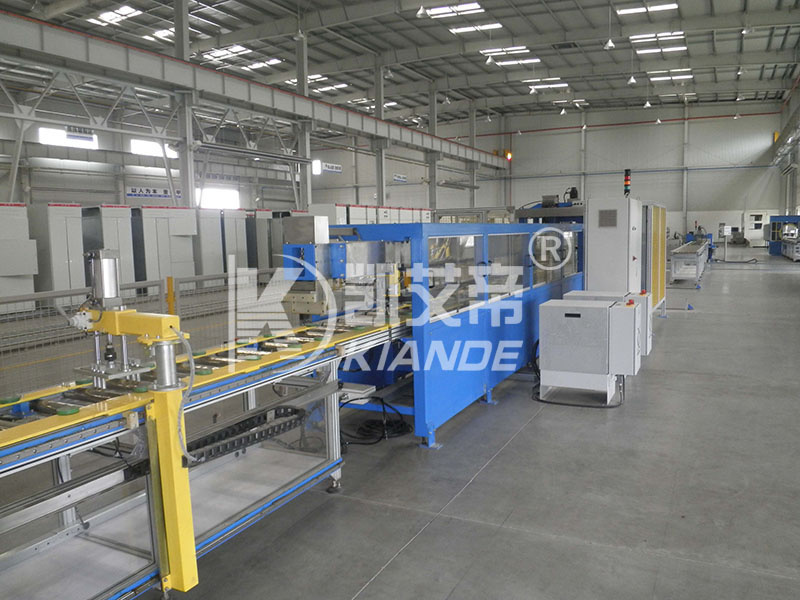
Manufacturing begins with processing raw copper or aluminum conductors. The system cuts, punches, and bends the metal to exact specifications. Precision CNC equipment handles these tasks to prevent mechanical stress on the conductive material. Cutting blades must remain sharp to avoid creating burrs along the edges. Burrs act as sharp points that easily pierce insulation films during later stages. We utilize automated deburring brushes immediately after the shearing station to round off sharp edges. Punching operations create the necessary holes for joint blocks and structural supports. CNC bending ensures the conductors maintain proper phase spacing within the final enclosure, holding tolerances as tight as +/- 0.1mm.
Power distribution networks rarely run in straight lines. Facilities require elbows, tees, and flanged ends to navigate structural obstacles. These custom fittings demand specialized fabrication techniques. Bending a 90-degree elbow requires distinct CNC profiles compared to standard straight lengths. You must account for material spring-back, which varies between copper and aluminum. Layout flexibility becomes highly relevant here. Production lines often route custom fittings to dedicated semi-automated stations. This prevents bottlenecks on the main high-speed straight-length line.
The outer enclosure protects the internal conductors from environmental damage and mechanical impact. Roll-forming machines shape flat sheet metal into rigid structural profiles. Galvanized steel and extruded aluminum serve as the primary housing materials. Aluminum offers excellent heat dissipation and reduced weight, making it ideal for high-capacity data centers. Steel provides superior mechanical strength for heavy industrial applications. The sheet-metal processes include laser cutting, bending, and powder coating. Precise fabrication ensures the housing pieces interlock perfectly during final assembly, preventing moisture ingress.
Real-world applications dictate specific manufacturing differences. Isolated phase bus ducts enclose each phase conductor separately. Power plants use these to prevent phase-to-phase faults. Segregated phase bus ducts place all conductors in one enclosure but separate them with grounded metal barriers. Non-segregated phase systems house all conductors together without barriers. The production line must adapt its sheet metal fabrication and assembly stations to match these distinct structural requirements. Changing between these designs requires programmable tooling adjustments on the roll-forming line.
Insulation transforms a raw conductor into a safe electrical phase. Manufacturers typically use Mylar (PET) film or epoxy coatings. Mylar film provides exceptional dielectric strength and thermal resistance. We specify Class B (130°C) or Class F (155°C) insulation depending on the target amperage. The insulation layer prevents electrical arcing between adjacent phases. It also protects against short circuits to the grounded metal housing. Consistent insulation thickness guarantees the system meets its rated voltage capacity without degradation over decades of continuous operation.
Applying insulation film manually invites dangerous inconsistencies. An automatic busbar wrapping machine eliminates this risk entirely. The machine feeds the conductor through a rotating wrapping head powered by synchronized servo motors. Spools of Mylar film revolve around the advancing busbar. Programmable logic controllers dictate the exact speed and rotation. This synchronization ensures a flawless, continuous wrap along the entire length of the conductor. Operators input the conductor dimensions into the HMI, and the machine automatically calculates the required pitch and rotational speed.
Automated tension control prevents the film from stretching or sagging. Stretching reduces the dielectric strength of the PET film, creating weak points. Sagging creates air pockets between the insulation and the metal. Air pockets lead to partial discharge and eventual thermal hotspots. We typically set wrapping tension between 15 and 25 Newtons. Precise overlap programming guarantees the film layers stack perfectly. A standard 50% overlap provides double insulation thickness across the entire busbar. These automated features directly prevent catastrophic insulation breakdown in the field.
High-speed wrapping carries inherent mechanical risks. Film tearing halts production and requires manual rework. Inconsistent film thickness compromises electrical safety. Modern wrapping machines mitigate these issues using advanced optical sensors. The sensors monitor film tension in real-time. They detect micro-tears and automatically pause the machine before defective segments advance. This closed-loop feedback system ensures only perfectly insulated conductors reach the assembly stage. Maintenance teams must clean these optical sensors daily to prevent false positive readings caused by factory dust.
Assembly marks the convergence of the prepared conductors and the fabricated housing. The insulated phases align within the bottom half of the sheet metal enclosure. Polycarbonate spacers and insulators lock the conductors into their designated positions, maintaining exact phase-to-phase clearance. The top half of the housing then lowers into place. This stage requires absolute precision to avoid pinching or scraping the Mylar insulation. Any damage here renders the previous wrapping stage useless and creates a hidden fault inside the sealed duct.
Securing the housing involves riveting, pressing, and bolting. An automatic busbar assembly line applies uniform pressure across the entire duct. Hydraulic presses squeeze the housing halves together at pressures exceeding 150 bar. Automated riveting stations secure the seams permanently using self-piercing rivets (SPR) spaced exactly 150mm apart. Torque-controlled drivers tighten bolts to exact engineering specifications. This consistency maintains structural integrity across standard lengths up to 3 meters. Uniform compression also improves heat dissipation by eliminating air gaps between the conductors and the housing.
Modern facilities demand intelligent infrastructure. Smart power distribution requires embedded monitoring systems. The assembly line must accommodate the installation of thermal sensors and smart metering modules. Technicians embed fiber optic temperature sensors within the housing before final sealing. These sensors monitor real-time temperature fluctuations across the phase conductors. Integrating these modules during assembly future-proofs the infrastructure for advanced data center applications, allowing facility managers to monitor load balancing dynamically.
Factory managers must balance automation with flexibility. Manual assembly works best for custom directional fittings and low-amperage runs. Human operators can easily adapt to unique angles and complex joint configurations. Automated lines excel at high-speed repeatability for standard commercial runs. A hybrid approach often yields the best results. Factories use the automated line for straight lengths and route elbows to specialized manual assembly stations equipped with pneumatic assist tools.
Quality control prevents defective infrastructure from reaching the field. Every finished bus duct undergoes rigorous testing before dispatch. Visual and mechanical inspections verify structural dimensions and fastener torque. Contact resistance testing ensures joint blocks conduct electricity efficiently, typically requiring readings under 10 micro-ohms. Phasing testing confirms the correct alignment of individual conductors. Insulation resistance testing measures the integrity of the Mylar wrap using a 1000V megohmmeter. AC over-potential (dielectric or hipot) testing subjects the system to high voltage, often 2.5kV for one minute, to expose hidden insulation weaknesses.
Manual testing creates massive production bottlenecks and introduces subjective errors. An automatic busbar inspection machine executes these tests sequentially without human intervention. The finished duct rolls into the testing bay on motorized conveyors. Robotic arms connect testing probes to the exposed conductor ends. The machine runs the full suite of electrical tests in under three minutes. It also validates the functionality of any integrated smart sensors. Automated testing standardizes the validation process and eliminates subjective human judgment.
Automated inspection systems capture vast amounts of testing data. The machine logs the exact resistance and voltage metrics for every single unit into a centralized SQL database. This automated data capture simplifies compliance reporting for NEMA and IEC standards. It tracks machine calibration schedules to ensure testing accuracy. In the event of a field failure, batch traceability allows manufacturers to isolate the exact production run. This data-driven approach protects the manufacturer from liability and guarantees product safety.
The final manufacturing stages prepare the product for field installation. Technicians install joint blocks at the ends of the bus duct. These blocks utilize a single-bolt design that allows contractors to connect multiple lengths together on-site rapidly. Labeling systems apply barcodes and QR codes to the housing. These labels guide field assembly and provide instant access to testing data via mobile devices. Protective packaging shields the equipment from moisture and impact during transit. Heat-shrink plastics and custom wooden crates ensure the product arrives undamaged at the construction site.
High-amperage bus ducts represent massive, heavy infrastructure. A 6500A system contains substantial amounts of solid copper, often weighing over 100 kilograms per meter. Moving these finished units requires specialized material handling equipment. Overhead bridge cranes equipped with vacuum lifters move the heavy ducts from the assembly line. Motorized roller conveyors transport the units to the shipping bay. Safe handling protocols prevent structural bending and protect factory personnel from lifting injuries.
Integrating a complete production line demands careful spatial planning. A linear layout maximizes high-speed throughput but requires massive floor space, often exceeding 50 meters in length. A U-shaped layout conserves space and centralizes material handling. You must factor in the space needed for straight-length automation alongside custom fitting stations. Inline testing bays and packaging zones also consume significant square footage. Proper layout engineering prevents material flow bottlenecks and forklift traffic jams.
Automated manufacturing shifts the required labor skill set. You no longer need armies of manual laborers. You need technicians capable of CNC programming, PLC troubleshooting, and machine calibration. Operating an automated wrapping or assembly machine requires specialized software knowledge. The skill gap presents a major implementation risk. Facilities must invest heavily in operator training to maximize equipment uptime and prevent programming errors that lead to material waste.
High-precision machinery demands rigorous maintenance schedules. Routine calibration remains essential for inspection machines and wrapping tensioners. A miscalibrated inspection machine might pass defective insulation. A loose wrapping tensioner will create dangerous air pockets. Strict maintenance protocols maintain compliance and guarantee product safety. Factory managers must stock critical spare parts to minimize unplanned downtime.
Inspect and clean optical sensors on the wrapping machine daily.
Verify hydraulic fluid levels and pressure gauges on the assembly press weekly.
Calibrate the hipot testing probes against a known standard monthly.
Replace deburring brushes on the conductor processing line every 500 hours of operation.
Audit your current facility floor plan to determine if a linear or U-shaped layout best accommodates your target throughput and material handling constraints.
Define your exact amperage ranges and daily volume requirements to size the conductor processing machinery and hydraulic presses correctly.
Request detailed cycle-time simulations from equipment manufacturers to verify their throughput claims before issuing purchase orders.
Establish a dedicated training program focused on CNC programming, PLC troubleshooting, and optical sensor calibration for your maintenance technicians.
A: The busbar is the internal conductive element, usually raw copper or aluminum. The bus duct includes these busbars, the applied insulation, and the protective outer housing. A busway typically refers to a specific type of prefabricated bus duct featuring plug-in capabilities for smart power distribution.
A: It eliminates human error in insulation application. The machine guarantees precise tension control and uniform film overlap. This prevents air pockets and thermal hotspots, ensuring uniform dielectric strength and preventing catastrophic arc flashes.
A: The machine executes a comprehensive suite of tests. These include contact resistance testing, insulation resistance testing, phasing verification, and AC over-potential (dielectric) testing. It also performs automated mechanical and visual inspections.
A: While straight lengths run through highly automated main lines, custom fittings require different handling. Elbows, tees, and offsets often route to semi-automated CNC bending and specialized assembly stations to ensure necessary layout flexibility.
A: Yes. Modern automated lines feature programmable torque and hydraulic pressure settings. Operators adjust these parameters to accommodate the different mechanical properties, tensile strengths, and expansion rates of both copper and aluminum metals.
A: The footprint varies based on capacity and layout design. However, automated material handling, inline testing bays, and high-speed assembly require significant linear floor space. A fully integrated line often spans several hundred square meters.
A: Automated CNC equipment and programmable assembly lines drastically reduce changeover times. What used to take hours on legacy manual systems now takes minutes. Operators simply load new software profiles to adjust bending angles and assembly pressures.

