
Views: 0 Author: Site Editor Publish Time: 2026-09-20 Origin: Site


Are human errors costing your factory time, money, and its hard-earned reputation? In the high-stakes realm of electrical manufacturing, manual data entry often paves the way for false passes or catastrophically damaged equipment. When a technician is forced to punch in complex parameters under the pressure of tight production quotas, mistakes are inevitable. Fortunately, the bridge between physical manufacturing and digital automation has never been stronger. By leveraging barcode data, facilities can completely automate test program selection. This systematically eliminates the risks associated with human fatigue. In this comprehensive guide, we will explore how intelligent scanning systems streamline operations. We will compare legacy setups with modern automated solutions and help you select the precise infrastructure needed to future-proof your facility.
Absolute Error Elimination: Utilizing embedded barcode data automates the selection of testing programs, systematically removing human keystroke errors and ensuring highly accurate, repeatable testing protocols.
Seamless Digital Integration: Industrial-grade barcode scanners communicate instantaneously with Programmable Logic Controllers and Manufacturing Execution Systems to auto-load precise parameters directly into the testing machinery.
Complete Traceability: Every evaluated component is meticulously logged into a centralized database, facilitating strict regulatory compliance and robust quality control from the initial assembly stage through to final shipping.
Operational Scalability: Transitioning from outdated manual workstations to automated diagnostic solutions significantly increases production throughput while delivering a measurable and rapid Return on Investment.
Looking at broader sector trajectories, the electrical manufacturing industry is undergoing a massive paradigm shift driven by smart factory principles. Recent market analyses reveal that global regulatory bodies are enforcing much stricter compliance and traceability mandates for power distribution networks. Consequently, there is a surging industry-wide demand for data-driven quality control frameworks. Leading manufacturers are rapidly abandoning siloed, offline testing stations. Instead, the trend heavily favors interconnected ecosystems where embedded barcode data not only triggers immediate test protocols but also feeds into predictive maintenance algorithms and comprehensive digital twin models. This strategic pivot transforms quality assurance from a mere reactive checkpoint into a highly proactive pillar of modern manufacturing.
In the electrical distribution sector, testing is far more than a routine quality control checkpoint. It is a critical, non-negotiable safety mandate. A modern setup utilizing advanced busduct testing equipment requires stringent validation processes before any product can be deployed in commercial skyscrapers or heavy industrial power networks. These mandatory evaluations typically encompass high-potential testing, ground continuity verification, and precise insulation resistance measurement. The ultimate objective is to guarantee that the busway can withstand specified electrical loads without succumbing to failure, short circuits, or life-threatening hazards.
Modern manufacturing facilities rarely have the luxury of producing a single, uniform type of busbar day in and day out. Instead, a standard plant operates on a high-mix, variable-volume production schedule. Within a single shift, the conveyor might carry busbars featuring vastly different specifications. These variations encompass distinct voltage ratings such as 400V versus 1000V, unique phase configurations like 3-phase 3-wire versus 3-phase 5-wire, wildly varying physical lengths, and current ratings that stretch from a modest 400A up to a massive 6300A. Each specific configuration demands a highly tailored testing protocol. Applying a generic, one-size-fits-all diagnostic to a highly customized component severely compromises the integrity of the entire quality assurance framework.
Picture a bustling factory floor where an operator is tasked with manually inputting testing parameters into a terminal for hundreds of heavy copper units per shift. Under the glare of industrial lighting and the relentless pace of the conveyor, cognitive fatigue inevitably sets in. Relying on this manual methodology is fraught with immense risk. The operational consequences of these keystroke errors are severe. If a technician mistakenly selects a 1000V high-potential test program for a busbar rated for only 400V, the excessive voltage will permanently scorch the insulation, resulting in expensive, immediate scrap. Conversely, applying a low-voltage test to a high-voltage component triggers a false pass. This dangerous scenario allows a defective product to leave the facility, creating severe liability issues and opening the door to catastrophic electrical fires in the field.
To mitigate the liabilities tied to manual entry, forward-thinking facilities are aggressively implementing barcode-driven automation. This technology acts as the vital nervous system of the factory floor. It enables a hands-free, foolproof testing environment that reacts dynamically to the product directly in front of it.
Long before a polished copper or aluminum busbar ever glides into the testing chamber, the automation journey begins. During the initial fabrication stages, a unique identifier—typically a rugged 2D Data Matrix or high-density QR code—is laser-engraved or securely affixed via a thermal-resistant label to the component. This barcode does not merely hold a random string of digits. It encapsulates a wealth of critical production data. A standard industrial code for electrical components securely embeds the unique Work Order ID, the exact Product SKU, the designated Voltage Rating, and the Phase Configuration. In highly advanced enterprise setups, this code acts as the primary digital key, linking the physical metal directly to a comprehensive digital twin stored on the local server or cloud.
The core mechanism of automated test selection relies on seamless, high-speed communication between the physical scanner and the overarching software ecosystem of the factory. As the heavy busbar approaches the diagnostic station, a ruggedized industrial scanner captures the code in a fraction of a second. This scanned data is instantaneously transmitted via robust industrial communication protocols to the Programmable Logic Controller. The controller then queries the central database, cross-referencing the scanned Work Order ID. Within milliseconds, the system identifies the exact engineering specifications of that specific unit and retrieves the corresponding testing recipe.
Furthermore, once the software retrieves the correct recipe, it automatically pushes these parameters down to the testing machinery. The software instantly locks in the required voltage levels, the exact duration of the electrical stress test, and the specific pass or fail threshold values, such as the maximum allowable leakage current. Because this sophisticated process requires absolutely zero manual keystrokes, the role of the operator fundamentally shifts from tedious data entry to high-level process monitoring. The system physically prevents the test from initiating unless the loaded parameters perfectly match the requirements of the scanned barcode, creating an unbreakable operational loop.
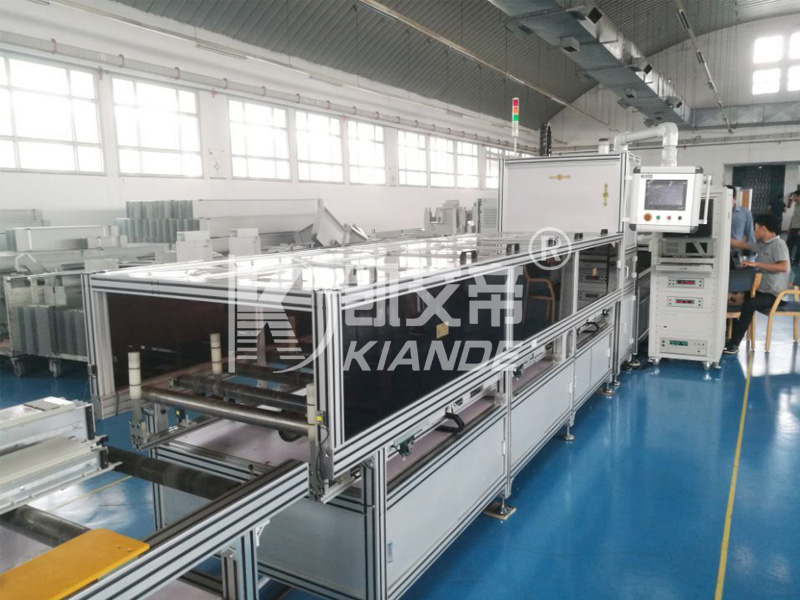
For plant managers and manufacturing engineers evaluating infrastructure upgrades, understanding the objective, mechanical differences between legacy and automated testing systems is crucial for calculating long-term returns. Replacing a manual busbar inspection line with an automated counterpart transforms the entire production rhythm.
Below is a detailed technical comparison of the two distinct methodologies based on real-world engineering parameters.
| Core Feature | Manual Inspection Line | Automatic Inspection Machine |
|---|---|---|
| Parameter Selection | Manual keyboard entry by operator, highly prone to keystroke errors. | Auto-loaded via barcode scan in milliseconds, guaranteeing zero selection errors. |
| Typical Cycle Time | 5 to 8 minutes per unit due to manual plug-in and program navigation. | Under 2 minutes per unit with motorized conveyors and automated pneumatic contacts. |
| Testing Capabilities | Subject to manual calibration, often limited in continuous high-voltage endurance. | Auto-calibrated withstand voltage up to 5000V AC or 6000V DC, plus precise ground continuity. |
| Data Traceability | Fragmented paper logbooks or basic spreadsheets, complicating compliance audits. | 100 percent real-time integration with local databases for absolute traceability. |
| Labor Requirement | Requires a highly skilled electrical technician to interpret testing schematics. | Requires only a standard machine operator for high-level process monitoring. |
When specifying new diagnostic stations for a facility, decision-makers must look far beyond basic electrical functionality. The true effectiveness of an automated testing system relies heavily on the caliber of its sub-components and its innate ability to handshake with existing factory networks.
In a high-throughput environment, busbars move continuously along mechanical conveyors. The exact orientation of the barcode may vary depending on how a robotic arm or human handler placed the component on the line. Standard directional scanners require precise alignment, which inevitably causes frustrating reading faults and halts production. Therefore, specifying industrial-grade omnidirectional scanners is a mandatory requirement. These sophisticated optical devices utilize complex imaging algorithms to capture and decode codes from any angle. Equipped with polarized lighting to pierce through the glare of reflective copper or aluminum, a robust scanning system ensures that the automatic busbar inspection machine receives the correct data instantaneously, regardless of conveyor speed or ambient factory lighting.
Hardware is ultimately only as effective as the software breathing life into it. For barcode data to successfully trigger a test program, the internal controller of the machine must communicate fluidly with the overarching management software of your plant. When upgrading your floor, verify that the new equipment supports open industrial communication protocols such as PROFINET, EtherNet/IP, or Modbus TCP. This native compatibility guarantees that when a code is scanned, the machine can query the central database and pull the testing recipe without relying on clunky, expensive custom-coded middleware.
Electrical testing involves lethal voltages that pose severe risks if mismanaged. High-potential testing can apply thousands of volts to verify insulation integrity. Barcode integration significantly elevates floor safety through dynamic, automated interlocks. Specifically, when the scanner reads the code and identifies that a high-voltage test is imminent, the controller automatically engages physical safety mechanisms. Heavy chamber doors lock shut, invisible light curtains are activated, and warning beacons flash before a single volt is applied. This data-driven approach to safety physically prevents operators from bypassing critical protocols, thereby mitigating the terrifying risk of arc flashes.
Deploying barcode technology is not merely about bolting a scanner onto a machine frame. It requires strategic mechanical and digital orchestration across the entire manufacturing workflow to ensure data flows logically.
The physical placement of optical readers along the automatic busbar assembly line dictates the fluidity of your production. Scanners must be deployed at strategic waypoints to forge a continuous track-and-trace environment. A primary scanner should be stationed immediately after the initial assembly junction to verify that the correct copper profiles and insulation materials have been mated according to the digital work order. The most crucial placement, however, is directly at the entrance of the testing chamber. Reading the code here gives the software the few critical seconds it needs to download parameters and configure internal relays before the busbar even comes to a halt, eliminating idle time.
A truly intelligent system does more than just initiate tests. It creates a closed-loop quality assurance ecosystem. When the diagnostic cycle concludes, the exact results—pass, fail, precise resistance values, and leakage current—are immediately and permanently linked back to that specific barcode in the central server. If a component passes, the controller signals the conveyor to route it toward the packaging sector. Should it fail, the system automatically redirects the heavy unit to a designated rework spur. A technician at the rework station can then simply scan the code with a handheld terminal to instantly view the exact reason for failure. This eliminates tedious guesswork and ensures defective products never accidentally reach the end customer.
For financial decision-makers, capital expenditure on new automation must be justified by a clear, aggressive return on investment. Transitioning to a barcode-driven automated system provides highly measurable financial benefits across multiple operational vectors.
In a traditional manual setup, operators must possess extensive technical training to decipher complex engineering schematics, understand nuanced voltage ratings, and input parameters without typographical errors. This requires long onboarding periods and higher wages for specialized technicians. By automating the parameter selection via optical barcodes, the cognitive load on the operator is virtually eradicated. Facilities can deploy standard machine operators rather than highly specialized electrical technicians to oversee the line. The minutes previously wasted on manual data entry are reclaimed, allowing the exact same workforce to produce significantly higher volumes per shift.
In contrast to automated systems, human error in test selection is the leading root cause of false passes. If an operator accidentally tests a 1000V-rated busbar using a 400V program, the unit will pass despite harboring insulation defects that would fail under real-world operating conditions. If this under-tested busbar is installed in a commercial data center, it can lead to catastrophic electrical fires and massive liability claims. Automated test selection guarantees absolute adherence to the engineering specifications. The financial protection against just a single product recall often pays for the entire automated inspection machine several times over.
Overall Equipment Effectiveness remains the gold standard for measuring manufacturing productivity, calculated by multiplying availability, performance, and quality. Barcode integration elevates all three metrics simultaneously. It boosts availability by eliminating setup time between distinct product batches. It enhances performance by allowing the machine to operate at its maximum mechanical cycle time. Finally, it drives quality by eliminating false passes and automating the routing of scrap, pushing the first-pass yield closer to perfection.
Investing in heavy automated machinery is a monumental operational decision. You must base your equipment selection on concrete production metrics rather than abstract features. The ultimate success of this upgrade hinges on selecting an equipment configuration capable of delivering rugged industrial hardware paired with sophisticated software integration.
First, analyze your production volume and mix. If your facility processes fewer than 50 units per shift with minimal variation, a semi-automated station with handheld scanners may suffice. However, if your plant handles a high-mix schedule exceeding 100 units daily, you require a fully automated inspection machine featuring motorized conveyors and real-time database querying to prevent massive bottlenecks.
Second, verify software handshake capabilities. Do not purchase isolated hardware. Ensure the equipment manufacturer provides native drivers for your specific enterprise resource planning software. The ideal vendor must offer deep mechanical customization to align the new testing equipment with your current conveyor heights, structural pillars, and safety zones. Look for partners who provide comprehensive after-sales support, including remote digital diagnostics and on-site preventative maintenance training for your in-house crew.
Relying on manual test selection is an outdated practice that creates unnecessary risks for both product quality and worker safety. In an era where precision is paramount, allowing human fatigue to dictate the integrity of high-voltage electrical components is a liability no modern manufacturer can afford. Implementing barcode data is the definitive key to unlocking true factory automation. This elegant technological shift eliminates human error during daily production, dramatically accelerates cycle times, and provides the digital traceability required by today's strict regulatory standards.
We encourage you to evaluate your current manufacturing processes carefully. Upgrading your testing infrastructure will optimize your entire operation, guaranteeing consistent results and reliable product output. To explore industry-leading solutions tailored to your specific production volume and technical requirements, discover the right automated systems for your facility at Busbar Equipment and take the leap into modern, error-free manufacturing today.
A barcode or QR code on a busbar typically does not store the full, heavy engineering schematic. Instead, it contains a unique alphanumeric identifier, such as a Work Order ID or Serial Number. When scanned, the system uses this secure ID to query the central database. The database then instantaneously transmits the associated manufacturing data—including voltage rating, amperage capacity, physical length, and phase configuration—directly to the testing equipment.
While it is physically possible to add handheld barcode scanners to a manual line for basic data logging and inventory tracking, achieving true automated test selection is significantly more complex. It usually requires completely upgrading the existing controller, installing new automated high-voltage relays, and rewriting the core testing software to accept external database commands. In many cases, investing in a purpose-built automated inspection machine yields a much better return on investment than attempting to retrofit legacy manual equipment.
Industrial systems are intentionally designed with robust fallback protocols. If a barcode is scratched, missing, or rendered unreadable by the omnidirectional scanner, the controller will immediately flag an error and halt the conveyor. The system will then either automatically route the busbar to a manual inspection station via a bypass conveyor, or prompt a floor supervisor to enter a secure override code, allowing them to manually input the test parameters based on the physical work order documentation.
Barcode integration strictly enforces voltage-specific safety protocols without relying on human memory. By auto-selecting the exact voltage required for a specific busbar, it physically prevents an operator from accidentally applying 5000V to a component only rated for 1000V. This automated precision eliminates the risk of catastrophic arc flashes, equipment fires, and potential operator injury caused by simple manual data entry errors.
Yes. Modern automated testing equipment is built from the ground up with smart factory connectivity in mind. The controllers and industrial computers operating these sophisticated machines utilize standard application programming interfaces and communication protocols like OPC UA, PROFINET, or MQTT. These open protocols are specifically designed to sync seamlessly with major enterprise systems like SAP, Oracle, and Microsoft Dynamics, allowing for real-time data exchange across your entire global manufacturing network.
In a properly integrated industrial network, the entire sequence from the physical scan to the parameter loading takes less than a few hundred milliseconds. Industrial-grade omnidirectional scanners decode the label instantly, and communication protocols like PROFINET ensure that querying the local server and pushing the recipe back to the machine controller happens in real time. This eliminates any idle waiting period on the production floor.
Automated test selection drastically improves the accuracy of the first-pass yield metric. In manual setups, false passes inflate the yield, while false failures caused by selecting overly stringent parameters artificially lower it. By ensuring the exact engineering specifications are applied to every single unit through barcode data, manufacturers gain a completely authentic, highly accurate first-pass yield that reflects true production quality.

