
Views: 0 Author: Site Editor Publish Time: 2026-09-22 Origin: Site


The price of a busbar processing machine depends on how automated you want it to be. Manual portable models start around $1,000 to $2,500. Manual 3-in-1 units cost between $1,500 and $3,500. Semi-automatic machines fall in the $3,500 to $8,000 range. Fully automatic CNC busbar bending machines with CAD/CAM systems run from $8,000 to $25,000 or more.
A semi-automatic 3-in-1 busbar machine with CNC control costs $4,900 to $6,500. A fully automatic CNC busbar bending machine with CAD/CAM integration is priced at $9,500 to $11,500. Your choice of automation level, machine type, and brand reputation drives these price gaps. Picking the right busbar processing machine for your needs helps you spend your money well.
A machine's price depends on its automation level. Manual models cost less. CNC machines cost more but give better precision.
The total cost covers tooling, upkeep, and worker time. Over time, these regular expenses can equal the starting purchase price.
CNC machines cut down on waste and save on labor costs. They cover their own cost in months, not years.
Pick a machine that fits how much you produce. Don’t choose one too big or too small.
Look at the full value, not just the price tag. Also think about the supplier's reputation and their service after the sale.
The machine's main job is the first big cost factor. Single-function machines do just one task, like bending or shearing busbars. These fit workshops with limited work ranges. Multi-function machines combine cutting, punching, and bending in one place. This setup removes the need to carry parts between different machines. Multi-function machines usually cost more than single-function ones. You pay for easier workflow and less floor space needed.
The table below shows typical price ranges for common machine configurations:
Machine Type | Price Range (USD) |
|---|---|
4,850 – 6,500 | |
CNC Busbar Bending Machine | 9,500 – 13,000 |
CNC Busbar Punching & Shearing Machine | 10,050 – 15,500 |
These prices reflect standard setups with matching tooling. A 3-in-1 unit gives the best value for general shop work. You get cutting, punching, and bending in one compact design. Dedicated machines cost more because they offer special performance for high-volume work of one task.
Automation level directly controls both price and precision. Manual machines need operators to place each busbar and do every step by hand. Semi-automatic hydraulic units help with force but still need manual material handling. CNC machines run programmed sequences with little human input.
The precision gap between these levels is large. Entry-level manual or semi-automatic machines reach angle accuracy of ±1.5–2 degrees. Mid-range semi-automatic through CNC systems reach ±0.5–1 degree. Premium full CNC machines hold ±0.3–0.5 degrees. This matters for busbar work where tight tolerances ensure good electrical contact.
CNC models cost more because they offer programmable busbar cutting and punching sequences. You can store many part programs and call them up instantly. This cuts material waste from measurement mistakes. It also removes labor errors from manual setup mistakes. The machine repeats the same operation hundreds of times with identical results.
CNC busbar machines exemplify this high-precision, automated approach. Operators set parameters for the specific job, and the machine processes busbars without constant supervision, ensuring consistent quality across production runs.
For steady busbar production, CNC automation gives clear benefits. Production volume rises because the machine works faster than manual methods. Scrap rates drop because programmed operations remove human error. Labor costs fall because one operator can watch multiple machines at once.
The table below summarizes the key differences between automation levels:
Feature | CNC | |
|---|---|---|
Automation level | Semi-automatic operation | High automation |
Processing accuracy | High accuracy | Higher precision and repeatability |
Initial investment | Lower | Higher |
Production volume | Small and medium batches | Large-scale production |
Your choice depends on production needs. Small shops handling occasional batches may find semi-automatic machines enough. Manufacturers running steady production need CNC automation to keep efficiency and quality. The higher starting cost for CNC equipment pays back through less waste and more output. Think about your maximum bending capacity needs and typical batch sizes before choosing which automation level fits your work.
The price you see on a quote is only part of the story. A busbar processing machine has ongoing costs that add up year after year. Many buyers focus on the starting price and miss these repeating charges. Knowing the full picture helps you make a smarter choice.
Your busbar processing machine needs regular care to keep working well. Replacement dies wear down from normal use. Punching dies alone can cost from $50 to over $500 each, depending on their complexity and material quality. You might replace them every few months or once a year, based on how much you produce. Hydraulic seals and hoses also need replacing from time to time, usually costing $10 to $50 per part. Routine lubrication adds another $10 to $100 per container every month or two. Professional service visits, when big repairs are needed, cost $100 to $300 each time.
These numbers add up faster than most buyers expect. Think about a 10-year ownership period. Equipment purchase and installation might total $103,750. Tooling supplies add up to about $65,000 over that same time. Maintenance and spare parts add another $32,000. Together, tooling and maintenance reach $97,000 — that is 93.5% of your starting purchase price. Your ongoing costs are almost equal to what you paid for the machine itself.
Cost Part (10-Year Period) | Total Amount | Percent of Total Cost of Ownership |
|---|---|---|
Equipment purchase + setup | $103,750 | 27% |
Tooling supplies (over time) | $65,000 | 17% |
Maintenance + spare parts (over time) | $32,000 | 8% |
Energy use adds another layer. Hydraulic systems use power during every cut, punch, and bend. Over years of operation, electricity costs become a real part of your budget.
Higher automation levels need a bigger starting investment, but they lower your running costs a lot. A fully automated busduct production line replaces boring manual tasks with programmed steps. This change cuts labor costs because you need fewer workers for the same amount of work.
The speed gains are real. Manufacturers using CNC busbar machines report speed increases up to 30%. Productivity rises by 35% with advanced busbar punching models. Automated lines can make thousands of busbars each day — a level manual methods cannot match. This output comes with steady quality and fewer mistakes, which lowers rework costs.
Fully automated busduct production lines replace manual tasks with programmed steps. This change cuts labor costs because you need fewer workers for the same amount of work. The system can handle various busbar configurations, giving flexibility across different product runs.
When you figure total cost of ownership, add in these labor savings. A higher-priced machine with strong automation gives better long-term value than a cheaper manual unit that needs constant operator attention. Your busbar fabrication operation gains production efficiency when machines do the work by themselves. The busbar bending machine you choose should match your production volume — buying too much machine wastes money, while buying too little creates bottlenecks that hurt your productivity gains.
The market splits into three clear price groups, and each group serves a different production need. Manual machines cost $1,000 to $3,500, depending on the type. These fit small workshops that handle occasional busbar customization jobs. They need constant operator attention for every cutting, punching, and bending step. Semi-automatic machines cost $3,500 to $8,000. These models add hydraulic power and some programmable control, which boosts consistency for medium-batch work. Fully automated CNC systems start at $8,000 and can go over $50,000 for high-end models. These machines run programmed sequences with little supervision, giving the high accuracy that large-scale busbar fabrication needs.
CNC 3-in-1 busbar machines combine cutting, punching, and bending in one unit, giving a balanced entry into automated processing. Dedicated bending machines offer performance for high-volume bending tasks. At the top, fully automated busduct production lines integrate cutting, bending, punching, insulation wrapping, and testing into a fully automated workflow. Each step up the price ladder buys more throughput, tighter tolerances, and less manual labor.
The table below shows what each price tier delivers:
Machine Category | Price Range | Best For | Typical Accuracy |
|---|---|---|---|
Manual | $1,000–$3,500 | Occasional jobs, small shops | ±1.5–2 degrees |
Semi-Automatic | $3,500–$8,000 | Medium batches, consistent output | ±0.5–1 degree |
Fully Automated CNC | $8,000–$150,000+ | High-volume production, tight tolerances | ±0.3–0.5 degrees |
The sticker price tells you little about true value. You need a return on investment calculation that factors production volume, labor costs, and scrap rates. Start with your monthly copper throughput. Then estimate what automation saves you across four areas: direct labor, scrap reduction, rework elimination, and throughput gains.
Consider a mid-volume operation processing 8 tons of copper monthly. A full CNC 3-in-1 machine costs around $22,000 delivered. Monthly savings break down this way: direct labor savings of $7,500 to $14,000 from eliminating 1.5 to 2 operators, scrap reduction worth $2,400 to $5,400 from cutting waste from 6% to under 1%, rework elimination saving $800 to $2,500, and throughput gains adding $3,000 to $8,000. Total monthly savings average $22,075. Divide the $22,000 machine cost by that figure, and your payback period lands near 10 months. U.S. customers typically see payback between 6.5 and 15 months.
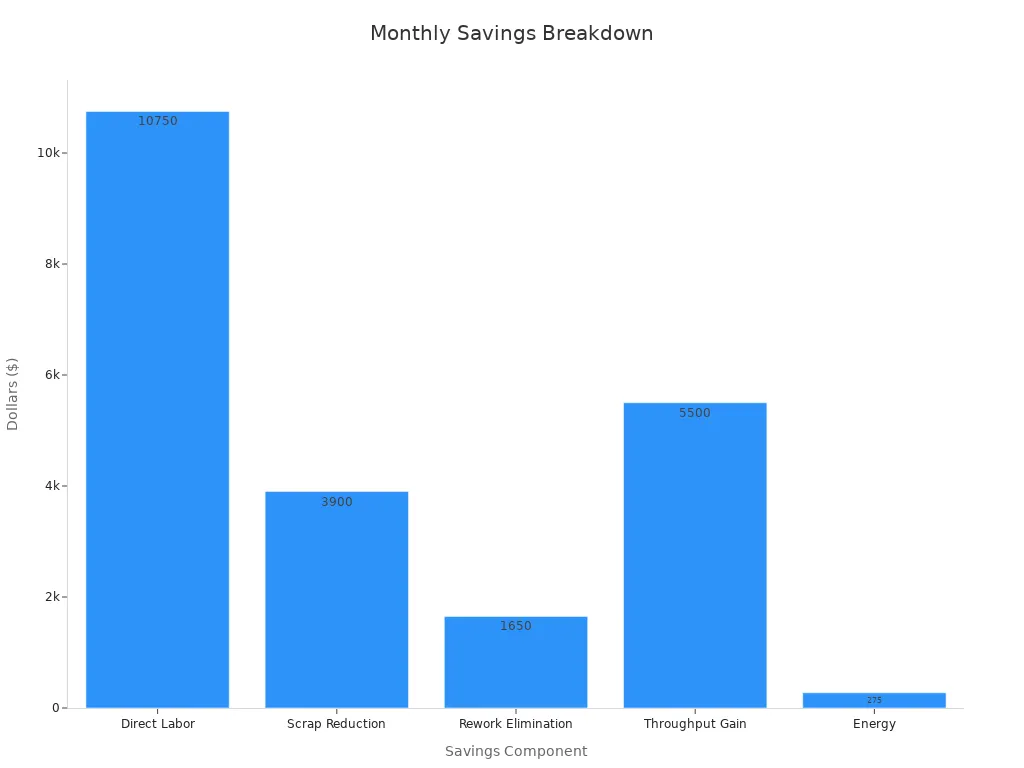
Regional labor rates shift this timeline. In higher-wage regions, labor savings are larger, driving faster payback. In lower-wage regions, scrap reduction and throughput gains become the primary ROI drivers.
Scrap alone can justify the investment. On 8,000 kg of monthly copper throughput, a manual process losing 6% to scrap costs significant money. A CNC machine reduces that loss dramatically, saving $2,400 to $5,400 per month. Over a year, that amounts to $28,800 to $64,800. Combined with other savings, the machine pays for itself within the typical 6.5 to 15 months.
When you evaluate any busbar processing machine, weigh these factors systematically:
Supplier reputation: Choose established brands with quality assurance and responsive after-sales support.
Model comparison: Compare processing range, accuracy, speed, and upgrade potential across models.
After-sales service: Confirm the manufacturer offers prompt problem resolution and operator training.
Environmental impact: Select equipment with low noise and low energy consumption to trim operating costs.
Return on investment: Set a realistic budget, compare price against performance, and factor long-term maintenance.
Avoid over-specifying. A high-end CNC line makes little sense for a shop producing very low volumes. Likewise, under-specifying creates bottlenecks that stall your busbar fabrication workflow. Match the machine's capacity to your actual production volume, then verify the numbers hold across a 5-year total cost of ownership horizon. That disciplined approach turns a capital purchase into a genuine productivity investment.
The cheapest busbar processing machine rarely delivers the best long-term value. You must consider tooling, maintenance, labor, and production efficiency alongside the purchase price. A busbar bending machine that reduces scrap from 6% to under 1% saves you thousands yearly. Cutting and punching operations reduce material waste. Another busbar bending machine might offer different features. List your specific busbar requirements before comparing machines. Evaluate overall value, not just the sticker price. Reputable manufacturers offer tailored solutions for customization. A well-chosen busbar bending machine becomes an investment in efficiency. Automated processing boosts your fabrication output. Efficient processing cuts waste and improves your bottom line. Advanced cutting and punching technology reduces material waste further.
Automation level creates the biggest price gap. Manual busbar machines start around $1,000, but fully automated CNC systems can go over $50,000. Your production volume should guide this choice. High-volume operations can justify the higher upfront cost because they save on labor and reduce scrap.
U.S. customers typically see payback in 6.5 to 15 months. A mid-volume shop that processes 8 tons of copper each month saves about $22,075 monthly through less labor, lower scrap rates, and faster output. A $22,000 machine pays for itself in roughly 10 months.
Tooling, dies, and maintenance can add up to 93.5% of your initial purchase price over 10 years. Replacement punching dies cost $50 to $500 each. Hydraulic seals, lubrication, and service visits create ongoing expenses. Energy use also adds to your total cost of ownership.
Yes. Automated systems reduce the need for manual operators, as one operator can watch multiple machines, lowering direct labor costs while maintaining output quality.
Match machine capacity to your actual monthly output. A high-end CNC line wastes money for a shop making very low volumes. On the other hand, a manual machine creates bottlenecks for steady production. Calculate your monthly copper volume, labor rates, and scrap percentages, then compare total cost of ownership over 5 years before you decide.

