
Views: 0 Author: Site Editor Publish Time: 2026-09-18 Origin: Site


When manufacturing electrical switchgears, control panels, or high-voltage transformers, the safety and efficiency of your power distribution rely entirely on precisely fabricated conductive components. In modern electrical engineering, meeting strict industry standards requires exact tolerances during the cutting, punching, and bending phases. However, one of the most common hurdles procurement managers and electrical engineers face is selecting the right equipment for their specific operational needs. The absolute most critical factor driving this technical decision is busbar size.
The thickness, width, length, and material composition of the conductors you process dictate the necessary hydraulic tonnage, blade dimensions, bending dies, and automation level of your equipment. Choosing an underpowered unit inevitably leads to mechanical failure, shattered tooling, and poor fabrication tolerances. Conversely, over-specifying equipment results in wasted capital expenditure and an inefficient use of factory floor space. This comprehensive guide will break down exactly how dimensional specifications influence your equipment choices, helping you confidently select the perfect busbar processing machine to streamline your manufacturing facility.
Before diving into dimensional mechanics, we must acknowledge the macro trends reshaping electrical manufacturing. The explosive growth of electric vehicle charging infrastructure, hyper-scale data centers, and renewable energy grids is forcing panel builders to handle massive current loads. To accommodate higher ampacity, engineers are designing systems with increasingly thicker and wider copper busbars. Consequently, traditional low-tonnage manual equipment is rapidly becoming obsolete. Facilities are now required to upgrade to heavy-duty, highly automated systems capable of processing large-gauge conductors with zero margin for error. Understanding this shift is vital for future-proofing your factory floor.
Thickness Dictates Power: The exact gauge of your conductive material directly determines the hydraulic tonnage required to execute clean punching, cutting, and bending procedures without causing structural material distortion.
Width Determines Tooling: The maximum width of your busbar establishes the physical spatial parameters needed for your cutting shear blades, bending dies, and station throat clearances.
Material Properties Matter: Copper and aluminum possess vastly different tensile strengths. Equipment rated for 15-millimeter aluminum may experience catastrophic hydraulic stall when attempting to process 15-millimeter copper.
Machine Type Alignment: Small-to-medium batch operations thrive on integrated systems, whereas high-volume, thick-gauge production necessitates specialized, heavy-duty digital processing equipment.
Future-Proofing is Crucial: Engineering best practices suggest sizing your machinery for the maximum busbar capacity anticipated over the next three to five years, rather than limiting specifications to current, immediate project requirements.
To select the appropriate industrial equipment, you must first understand how specific dimensional profiles interact with machine mechanics. Equipment specifications are not arbitrary; they are engineered based on strict geometric limits. Failing to account for any of these three variables will inevitably lead to operational bottlenecks or accelerated tool wear.
Thickness acts as the foundational baseline for determining the hydraulic pressure your equipment needs to exert safely. Standard industrial applications usually range from 3 millimeters to 20 millimeters. Meanwhile, width dictates the physical real estate required within the processing stations, directly impacting shear blade length and bending die width. Widths typically range from 20 millimeters up to 250 millimeters or more.
Furthermore, standard raw busbar lengths often span 4 to 6 meters. Maneuvering long, heavy bars requires equipment outfitted with adequate support tables, automated feeding mechanisms, and robust linear guides to prevent material bowing.
| Dimension Metric | Typical Industrial Range | Primary Machine Impact |
|---|---|---|
| Thickness | 3mm to 20mm | Determines required hydraulic pressure tonnage and structural frame rigidity. |
| Width | 20mm to 250mm+ | Dictates shear blade length, bending die width, and punching throat depth. |
| Length | 4 Meters to 6 Meters | Influences material handling systems, support tables, and automated feeding mechanisms. |
The thicker the conductive material, the exponentially greater the mechanical resistance it offers against your cutting and punching tools. Understanding this resistance is vital for preventing equipment overload and ensuring consistent fabrication quality.
Calculating the required punching force involves a standard engineering formula where force equals the perimeter of the hole multiplied by material thickness and the shear strength of the material. Because thickness acts as a multiplier in this equation, the required tonnage scales aggressively. For instance, cleanly punching a standard 14-millimeter hole in 15-millimeter copper requires significantly more hydraulic force than punching that exact same hole in 10-millimeter copper. If the machine's hydraulic cylinder is underpowered, the punch will stall mid-stroke. This jams the tool inside the die and instantly ruins an expensive workpiece.
Thickness also heavily influences the minimum bending radius. Thick copper bars require immense, steady hydraulic force to bend accurately. If a machine lacks the necessary sustained power, operators will experience inconsistent bend angles. Inadequate force applied to thick materials can also cause micro-cracking along the outer radius of the bend. This specific defect severely compromises the electrical conductivity and safety of the switchgear.
In addition, the impact of material thickness on the shearing station is profound. Thicker bars mandate heavy-duty, double-column shearing mechanisms to ensure the blade descends perfectly parallel to the material. Standard single-column shears applied to thick copper often cause the edges to droop, burr, or deform. This forces technicians to waste time on secondary grinding processes to smooth the connection points.
While thickness determines the required brute force, width is equally critical when evaluating the physical tooling and station design of your prospective equipment. Width establishes the spatial parameters of the entire mechanical system.
The cutting blade must always exceed the maximum width of your busbar. Imagine a technician trying to shear a 200-millimeter wide copper bar with a 150-millimeter blade. They are forced to slide the heavy material over, align it by eye, and strike again. This overlapping double-cut inevitably creates a jagged, stepped edge. Such an edge is a prime candidate for dangerous electrical arcing and heat buildup in a live panel. Your blade must clear the total width of the material in a single, clean stroke.
Wide busbars naturally require correspondingly wider bending dies. The machine must also possess sufficient throat depth and open clearance within the bending station. When fabricating complex geometries like deep U-bends or Z-bends, a wide busbar requires substantial rotational space. Without adequate clearance, the conductive bar will physically collide with the machine frame mid-bend.
Throat depth refers to the distance from the center of the punching tool to the back frame of the machine. If you need to punch a hole exactly in the center of a 250-millimeter wide busbar, the machine must have a minimum throat depth of 125 millimeters. Insufficient throat depth completely eliminates the ability to center-punch wide materials, severely limiting your daily fabrication capabilities.
Size specifications listed on equipment data sheets are intrinsically linked to the specific metallurgy being processed. A frequent procurement error is assuming that dimensional capacities apply universally across all conductive metals.
Copper is significantly denser and harder than aluminum. Standard electrical-grade copper boasts a tensile strength ranging from 210 to 250 Megapascals, whereas aluminum typically sits between 90 and 130 Megapascals. Consequently, a machine rated to process a maximum size of 160 by 15 millimeters in aluminum will likely stall, or even break, if tasked with processing 160 by 15 millimeters in copper. Always verify the maximum capacity specifically for copper, as it represents the highest mechanical load.
When metal is bent, it naturally attempts to return to its original flat shape. The combination of larger sizes and harder materials exacerbates this springback effect. Bending a 160 by 15 millimeter copper bar requires precise over-bending to achieve a true 90-degree angle. Advanced digital controls are often necessary to mathematically compensate for the severe springback inherent in large copper dimensions.
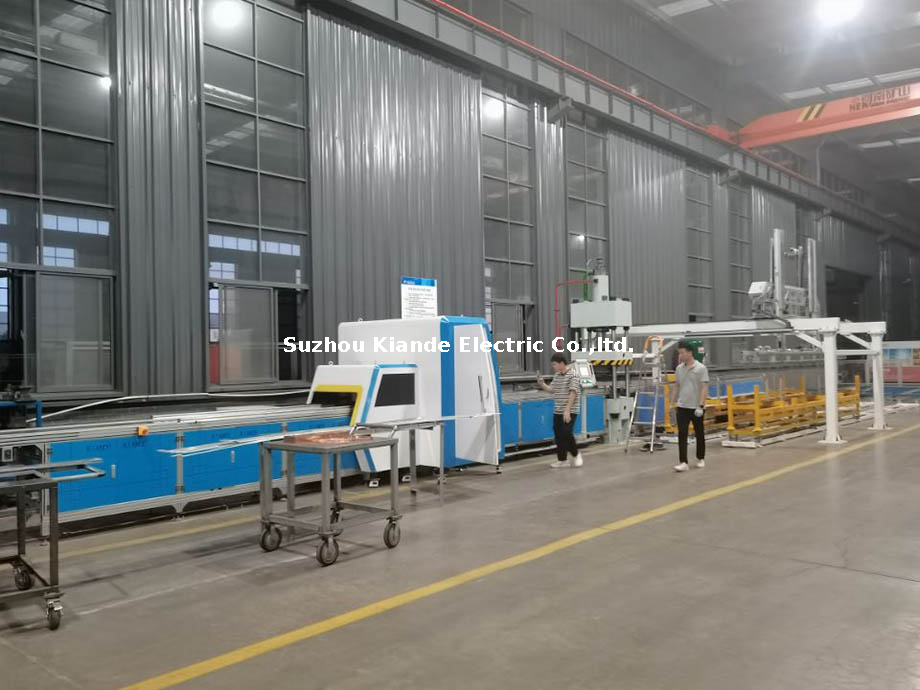
Different dimensional profiles and production volumes call for distinct machine architectures. Selecting the correct configuration ensures operational efficiency and extends the lifecycle of your capital equipment. Here is a practical framework for matching your sizes to the right technology.
For panel builders and switchgear manufacturers processing small to medium sizes up to 120 by 10 millimeters or 160 by 15 millimeters, an integrated solution is highly efficient. A 3 in 1 busbar machine combines cutting, punching, and bending stations into a single, compact footprint. This configuration is ideal for varied, low-to-medium volume batches where factory space is limited, but precision remains absolutely necessary.
As busbar sizes increase and production demands scale, basic manual systems become inadequate. For medium to large sizes requiring high precision, rapid repeatability, and complex processing, a multifunction busbar processing machine equipped with advanced controls is the objective industry standard. These systems often feature independent hydraulic pumps. This crucial design element allows multiple operators to work simultaneously on the punching, shearing, and bending stations without experiencing a drop in hydraulic pressure.
For extreme sizes such as 200 by 20 millimeters or 250 by 20 millimeters copper, integrated machines may lack the sheer structural mass required to handle the load safely. In these high-capacity scenarios, dedicated, single-station heavy-duty machines are safer, more robust, and significantly more efficient over the long term.
Because large conductive materials represent a significant capital investment, a single fabrication mistake on a 6-meter length of 200 by 15 millimeter copper can cost hundreds of dollars in unrecoverable scrap. The reliance on manual measurement is rapidly becoming a financial liability.
Maneuvering bulky, heavy bars is physically taxing, making manual tape measurements highly prone to operator error. A modern digital busbar punching machine utilizes servo-motor-driven linear guides, laser positioning, and touchscreens to eliminate human estimation entirely. The operator simply inputs the coordinates, and the machine automatically positions the heavy bar with sub-millimeter accuracy.
Achieving accurate bends on thick materials is notoriously difficult. Digital machines utilize sophisticated algorithms that factor in the busbar's exact thickness and width. The system automatically calculates the precise hydraulic stroke length required to execute a perfect 90-degree bend, automatically accounting for the material's specific springback coefficient. By digitally mapping the cuts before the machine ever engages the material, facilities can optimize their layouts and drastically minimize waste on expensive large-gauge copper.
Procurement errors in the heavy machinery sector carry long-term financial consequences. Avoiding these common sizing pitfalls is critical for maintaining a high return on investment and preventing workflow bottlenecks.
The most frequent mistake is purchasing a machine that maxes out at your current standard size. If your facility secures a heavy-duty contract next year requiring 160 by 15 millimeter busbars, your brand-new machine instantly becomes obsolete. Engineering best practices dictate sizing your equipment for future growth, typically factoring in a 20 to 30 percent capacity buffer.
Conversely, assuming a massive, high-tonnage machine can easily handle tiny busbars is a fallacy. Small busbars can get crushed, warped, or poorly bent if processed in oversized, wide-V dies designed for 200-millimeter bars. If your production spans extreme size variances, you must verify that the machine accommodates interchangeable micro-tooling.
Machine specifications list absolute maximum capacities. However, running a mechanical system at 100 percent of its maximum capacity constantly will drastically shorten its operational lifespan due to continuous maximum stress on the hydraulic seals and steel frame. Engineers highly recommend the 80 Percent Rule. Select a machine where your daily, continuous production size represents roughly 80 percent of the equipment's maximum rated capacity.
Balancing capital expenditure with technical requirements requires a calculated approach to Return on Investment. The physical dimensions of the busbars you process directly influence the financial metrics of your equipment procurement.
The capital cost of processing equipment scales proportionately with its size capacity. A machine designed to handle 200 by 20 millimeter copper requires massive hydraulic cylinders, a reinforced steel chassis, and high-torque servo motors, making it significantly more expensive than a standard 120 by 10 millimeter unit. Over-specifying without a clear business case ties up unnecessary capital.
Processing large, heavy copper bars manually requires multiple technicians simply to lift, balance, and position the material. Investing in higher-end, automated processing machines equipped with motorized material feeding tables reduces the intensive manual labor required. This lowers hourly labor costs and significantly mitigates the risk of workplace lifting injuries. Ultimately, by eliminating manual measurement errors on large copper offcuts, a facility processing high volumes of thick copper can often recoup the premium cost of a digital machine within the first 12 to 18 months purely through scrap reduction.
Selecting the right equipment is not a generic endeavor; it requires careful planning and a deep understanding of your material. The thickness, width, length, and metallurgy of your busbars are the foundational blueprints that should guide your final procurement decision. Match your machine to your specific material needs to ensure smooth operations, superior electrical contact surfaces, and significantly less wasted copper. Whether your production lines require a versatile, compact unit for standard control panels, or a heavy-duty, highly accurate digital system for massive switchgear projects, anticipating your future growth before making a purchase is vital. To find the exact match for your facility's dimensional requirements, explore our comprehensive range of busbar processing solutions designed to maximize your production efficiency.
While specifications vary strictly by manufacturer, a standard high-quality 3 in 1 unit can typically process copper or aluminum busbars up to 12 to 15 millimeters in thickness. For continuous, high-volume processing of thicknesses approaching 16 to 20 millimeters, specialized heavy-duty or standalone hydraulic stations are usually recommended to prevent premature wear on the hydraulic seals and tooling.
Yes, but it requires strict attention to tooling changes. A multifunction unit can handle a wide variance of sizes, provided operators swap out the bending dies and punching molds to match the specific width and thickness of the current busbar. Using large V-dies for thin materials will result in improper bend radii and aesthetic damage to the copper surface, while using small dies for thick materials can shatter the tooling.
Heavier busbars are physically difficult to maneuver manually across a workbench. A digital unit uses computer numerical controls, automated servo-driven gauges, and precise linear positioning systems to ensure accurate hole placement. This setup does not require the operator to manually wrestle, align, and measure heavy copper bars, drastically reducing material scrap and significantly improving workplace ergonomics and safety.
Yes, length is a critical logistical factor. While thickness and width determine the machine's required hydraulic power and internal tooling, length dictates the external material handling requirements. If your facility frequently processes full 6-meter busbars, you will need equipment outfitted with extended support tables, automated feeding systems, or specialized linear guides to support the material weight and prevent bowing during the punching and shearing cycles.
If your production involves frequent size changes but low overall volume, a manual or semi-automatic machine offers flexibility and lower upfront costs. However, if you are processing large batches of thick, wide copper where precision is critical, an automated machine is essential. The automated system eliminates manual measuring errors, handles heavy material effortlessly, and ensures perfect repeatability, which quickly offsets the higher initial investment through reduced scrap and labor costs.
Processing materials at the upper limits of your machine's capacity places immense stress on the system. You must strictly monitor hydraulic fluid levels and temperatures, as heavy loads generate excess heat. Additionally, high-carbon steel punching dies and shearing blades will degrade faster under maximum stress. Implement a rigorous inspection schedule to check for micro-fractures in the tooling and replace hydraulic seals more frequently to prevent pressure drops during heavy fabrication.

