
Views: 0 Author: Site Editor Publish Time: 2025-08-13 Origin: Site


As global demand rises for compact, efficient, and customized power distribution systems, manufacturers must optimize their production lines with greater precision and speed. One of the most strategic ways to meet these demands is by integrating equipment specially designed for busbar production into your manufacturing workflow. At Suzhou Kiande Electric Co., Ltd., we engineer solutions that support intelligent, high-precision operations across the entire production process—from cutting and punching to bending and finishing. This article explores where and how specialized machinery can be applied in your workflow to deliver the highest value in quality, speed, and operational efficiency.
A complete busbar production line consists of several stages, each critical to the final performance and appearance of the product. Applying the right equipment to the right segment makes all the difference.
The cutting stage sets the foundation for the rest of the workflow. If lengths aren’t precise, every downstream process—punching, bending, and insulation—suffers. Specialized cutting machines come equipped with CNC controls, servo-driven shearing mechanisms, or laser heads to deliver exact lengths, clean edges, and consistent repeatability across every batch.
Hole placement is essential for proper mounting, electrical connectivity, and panel integration. Specialized punching units use progressive die stamping or CNC punching heads to ensure perfect alignment and size. Machines from leading technology sources—like those used by Kiande—also minimize burr formation, helping to maintain electrical insulation performance and reduce the need for secondary finishing.
With growing complexity in electrical designs, busbars often require multi-directional bends with specific radii and geometrical constraints. Specialized bending machines utilize multi-axis CNC systems that not only guarantee dimensional accuracy but also preserve the mechanical and electrical properties of the bar.
The final steps in busbar production—deburring, cleaning, plating, and insulation—can affect both performance and safety. Integrating these steps through specialized equipment ensures a higher level of quality control and reduces overall handling time.
While general-purpose tools may suffice for basic sheet metal tasks, they can introduce a variety of issues when applied to the specialized requirements of busbar production.
Traditional sheet metal machines require manual setup for each stage. Operators must shift materials between machines, increasing the chance of misalignment and adding unnecessary production time. Changeovers can be time-consuming, especially when switching between material types or production batches.
Generic cutting and punching machines often lack the resolution and repeatability needed for busbar layouts. Even a few millimeters of deviation in hole location can make a busbar unusable in an electrical panel, causing expensive rework or scrappage.
General-purpose machines aren't optimized for the thickness and hardness of copper and aluminum busbars. This results in premature tool wear and limitations in terms of bend radius, hole complexity, and insulation compatibility.
Machines specially designed for busbar production behave in fundamentally different ways from their general-purpose counterparts. They are optimized not only in mechanics but also in software logic and automation capability.
Automated feeding systems, synchronized with CNC-controlled cutting and punching heads, ensure every section of the busbar is processed with uniform force and motion. This maintains material integrity while maximizing throughput.
In punching operations, progressive die systems allow multiple holes or notches to be made in a single pass, vastly increasing efficiency. With correct die calibration, these machines produce clean holes free of burrs, reducing the need for secondary treatment and extending insulation life.
Specialized punching and cutting machines are engineered to control blade force, contact angles, and shear speeds. This precision minimizes burrs, improves edge smoothness, and reduces thermal distortion—an essential consideration for high-current applications where surface contact quality matters.
Bending may seem like a simple operation, but in busbar production, it’s one of the most technically demanding tasks. Not every bend is equal—and not every machine can perform them well.
Electrical panel designs often require busbars to bend in tight quarters without compromising current flow. Specialized bending machines use servo-driven actuators and hydraulic or mechanical controls to shape complex geometries with smooth, repeatable movements.
Machines like those used by Kiande and other high-end providers employ multi-axis CNC platforms that allow for X-Y-Z axis control. This flexibility means you can program custom bend patterns, angles, and lengths—all while maintaining perfect alignment and flatness.
Copper and aluminum behave differently under mechanical stress. General tools can cause cracks or deformation in tight bends. Our machines are designed to distribute force evenly and compensate for springback, ensuring each part meets both dimensional and mechanical specifications.
Yes—and in many cases, these are where specialized machines offer the most measurable return on investment.
Some of our busbar processing lines include automatic deburring tools that remove rough edges and prepare surfaces for plating or insulation. Clean surfaces improve electrical conductivity and ensure better adhesion for coatings or sleeves.
Depending on the end-use application, busbars may require tin plating, anti-corrosion coatings, or color coding. Specialized machines can integrate plating stations or surface preparation modules to streamline these steps without additional handling.
Thermal shrink insulation is a common finishing step, especially in high-voltage applications. Our equipment supports automatic insulation wrapping and shrinking systems that align perfectly with punched holes and bent sections. This ensures a precise fit and eliminates the need for manual adjustments.
Integration is the final step in unlocking full value from specialized equipment. At Kiande, we offer modular automation cells and scalable production lines that work together seamlessly.
Whether you're upgrading a single station or installing a full production line, our machines are designed to operate independently or as part of a connected system. Modules can be added or removed depending on your current production requirements and future expansion plans.
Robotic arms and conveyors can be integrated to handle parts between cutting, punching, bending, and finishing stations. This removes the need for human intervention between steps, improving safety and reducing the risk of contamination or handling errors.
All our machines can be connected through centralized software systems for job scheduling, quality tracking, and reporting. Data can be exported to your ERP or MES system for real-time visibility into productivity, yield, and downtime analysis. This level of control allows manufacturers to make smarter, faster decisions across the plant.
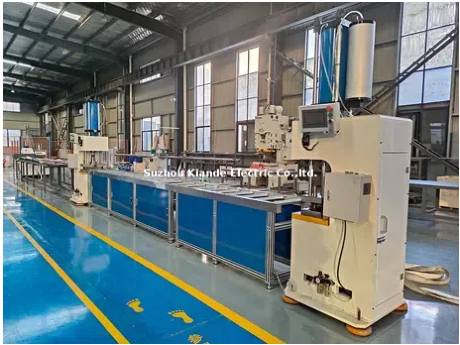
Optimizing your workflow with equipment specially designed for busbar production means more than just upgrading your machines—it means transforming your production line into a streamlined, high-performance system. From cutting and punching to bending, finishing, and insulation, every stage can be enhanced with better precision, faster turnaround, and reduced waste. At Suzhou Kiande Electric Co., Ltd., we’re committed to providing the tools and technology that modern manufacturers need to compete in a demanding global market.
Contact us today to evaluate your current production setup and learn how our specialized solutions can unlock greater value at every step of your busbar manufacturing process.

