
Views: 0 Author: Site Editor Publish Time: 2025-08-19 Origin: Site


In today’s power distribution landscape, the demand for more compact, efficient, and customized solutions is driving changes in how busbars are produced. Traditional manufacturing tools are no longer sufficient to meet industry requirements for speed, precision, and reliability. This is where equipment specially designed for busbar production becomes essential. At Suzhou Kiande Electric Co., Ltd., we understand that your production line is only as strong as the equipment that powers it. Our commitment is to deliver innovative solutions that reduce costs, improve quality, and maximize productivity. In this article, we’ll explore what sets our specialized machines apart and how they can help modern manufacturers meet growing market expectations.
Producing busbars is no longer just about cutting metal bars and drilling holes. As electrical systems become more complex and space-constrained, the requirements for busbar manufacturing become increasingly demanding.
Busbars are critical components in electrical systems that must endure high currents over long periods. These high loads lead to continuous thermal expansion and contraction, which can stress the material and create fatigue-related failures. As a result, busbars need to be produced with high structural integrity and without microscopic flaws. Specialized machines ensure consistent material handling and precise shaping to reduce these risks.
Today’s busbars must fit within densely packed enclosures while supporting complex electrical configurations. This requires holes and shapes to be placed with exact accuracy—something that’s very difficult to achieve consistently with manual or non-specialized machinery. Our equipment ensures that every cut, punch, and bend meets the design specifications down to the millimeter, avoiding costly rework or misfits during installation.
Another challenge is the variability of order volumes. Some customers require small batches of highly customized busbars, while others need mass production at high speed. Manually switching between different job configurations can be time-consuming and error-prone. With our intelligent production systems, switching from one job to another is quick and seamless, enabling manufacturers to handle both small and large batches with ease.
Generic metalworking machines simply can’t meet the unique requirements of busbar manufacturing. Equipment specially designed for busbar production includes functionality and precision tailored specifically for this application.
Rather than relying on separate machines for cutting, punching, and bending, our solutions combine all these functions into one seamless, automated workflow. This integration reduces the number of manual handling steps, shortens production time, and minimizes alignment errors. Operators can control the entire process from a single interface, improving coordination and throughput.
CNC (Computer Numerical Control) automation is a defining feature of specialized busbar machines. Once programmed, the equipment can execute complex shapes and hole patterns with repeatable precision. Programs can be saved, reused, and modified instantly, supporting a lean production approach and faster response to customer needs. Compared to manual setups, CNC drastically improves efficiency while reducing human dependency.
Many leading companies, including those using Kiande systems, have reported increased productivity and reduced defect rates after transitioning to CNC-controlled busbar equipment. For instance, advanced systems like our CNC busbar processing line deliver real-time adjustments, automatic tool changes, and fast cycle times—all of which translate into measurable performance gains. Our technology is on par with globally recognized solutions from top-tier brands like EHRT and Payapress, but tailored for your unique production goals.
Precision, consistency, and speed are essential in modern manufacturing, and CNC control is what makes these possible in busbar production.
With CNC technology, tolerances as tight as ±0.1 mm can be achieved regularly. This level of precision is vital for busbars used in critical infrastructure and electrical panels, where any deviation could lead to performance issues or component failure.
By automating critical processes, CNC control minimizes the risk of mistakes that are common in manual production, such as misaligned holes or incorrect angles. Less reliance on operator skill also means less time and money spent on training and supervision.
CNC systems can be integrated with sensors that monitor force, alignment, and material quality in real time. These insights help detect problems early and maintain consistent production quality. Over time, this results in fewer defects and less waste, boosting both efficiency and profitability.
Although all parts of the production cycle are important, some processes gain particular value from being performed on machines specially designed for busbar production.
Whether using mechanical shears or laser cutters, the cutting stage must be executed with clean edges and consistent lengths. Our equipment ensures high-speed cutting with minimal material deformation, reducing the need for post-processing.
Busbar holes must be perfectly aligned to ensure proper installation of bolts and electrical connectors. Specialized machines ensure exact hole placement and consistent spacing, even across large batches, preserving structural strength while maintaining functional alignment.
More compact electrical designs often require busbars to be bent in multiple directions with exact radii. Our machines use programmable bending heads that apply precise force and angles depending on the material type and geometry needed, ensuring each bend is accurate and crack-free.
Investment in specialized equipment is an investment in the future of your production capability. And the return on that investment becomes evident quickly.
Integrated automation reduces the number of labor hours required per unit, enabling smaller teams to handle larger production volumes. This alone can result in major cost savings over time.
Our customers report significant improvements in production speed and accuracy, leading to fewer rejections and less wasted material. This improves the overall yield of each production run, directly impacting profitability.
With the ability to switch programs and adjust tool settings quickly, manufacturers can fulfill custom or short-run orders without lengthy changeovers. This flexibility opens the door to new business opportunities that would otherwise be too costly to pursue.
Selecting the right machine involves evaluating your specific production needs and matching them with the right capabilities.
Copper and aluminum have different bending and punching characteristics, and your machine should be optimized for the material you use most. Additionally, production volume will determine whether a fully automatic or semi-automatic system is more cost-effective.
Key features include automatic insulation stripping, barcode printing, hole shape customization, tool quick-change systems, and software compatibility with design files. Kiande offers modular machines that can be configured according to your specific production goals.
We always recommend scheduling a live demo with your actual materials and design files. This lets you see the performance firsthand and understand how the machine will integrate with your current production process.
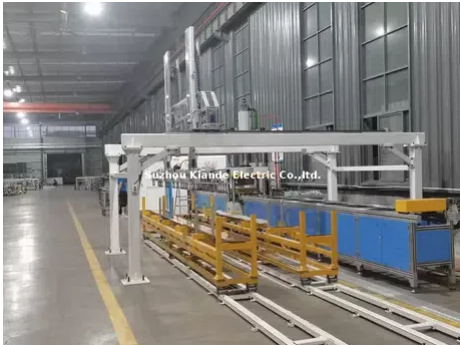
In a competitive manufacturing environment, having equipment that’s specially designed for busbar production is more than a luxury—it’s a necessity. At Suzhou Kiande Electric Co., Ltd., we provide comprehensive solutions that combine automation, precision, and flexibility to help your business thrive. Whether you’re expanding production or upgrading outdated systems, our machines are built to deliver superior performance and long-term value.
Contact us today to learn more about our CNC busbar solutions, request a demo, or speak with one of our technical experts. Let Kiande be your partner in advancing your production line.

