
Views: 0 Author: Site Editor Publish Time: 2025-11-04 Origin: Site


Busbars are critical to electrical distribution systems, ensuring smooth power flow. But how are these essential components manufactured? One key player is the automatic busbar riveting machine, which streamlines the riveting process, ensuring both speed and precision.
In this article, we will explore the purpose of an automatic busbar riveting machine, its operation, advantages, and applications. We'll also discuss the challenges industries face in adopting this advanced technology.
An automatic busbar riveting machine is designed to fasten busbars with rivets, creating secure joints between components of a power distribution system. The machine automates the process of inserting rivets into busbars, reducing the need for manual labor while increasing precision and efficiency in the production process.
Riveting machines come in different types depending on their function and power source:
● Pneumatic riveting machines: Utilize compressed air to drive rivets.
● Hydraulic riveting machines: Use hydraulic pressure for heavy-duty applications.
● Automatic riveting machines: Automate the entire process, from rivet insertion to securing.
For busbar production, the automatic busbar riveting machine ensures that rivets are inserted quickly and securely with minimal human intervention.
The main components of an automatic busbar riveting machine include:
● Feeding system: Automatically feeds rivets into the machine.
● Rivet setting tool: Inserts and deforms the rivet to create a strong joint.
● Control system: Allows for precise automation, adjusting settings like rivet force, speed, and pressure.
These components work together to create efficient and high-quality riveted connections between busbars.
The machine plays a critical role in the production of busbars used in electrical systems. By automating the riveting process, it ensures the consistent production of high-quality busbars that meet industry standards for electrical conductivity and safety.
1. Material Placement: The busbar is placed under the riveting head, often with the help of robotic arms.
2. Feeding Rivets: The automatic feeder system loads rivets into position, aligning them with pre-drilled holes in the busbar.
3. Rivet Insertion: The riveting head descends and inserts the rivet into the hole.
4. Rivet Securing: The machine deforms the rivet to form a secure joint, using either pneumatic, hydraulic, or mechanical force.
This seamless process ensures that each rivet is inserted with consistent force, maintaining joint integrity.
The automation in these machines allows for precise control over various parameters, such as the pressure applied during riveting and the speed of the process. This results in uniform and high-quality joints, reducing human error and enhancing production speed.
Modern automatic riveting machines are equipped with advanced material handling systems that accurately position busbars. These systems ensure that the busbars remain stationary during riveting, preventing misalignment and ensuring precise rivet insertion.
Once the rivet is inserted, the machine applies the necessary pressure to deform the rivet’s tail, securing the two busbar components together. This ensures a solid, durable joint that can withstand the electrical load without fail.
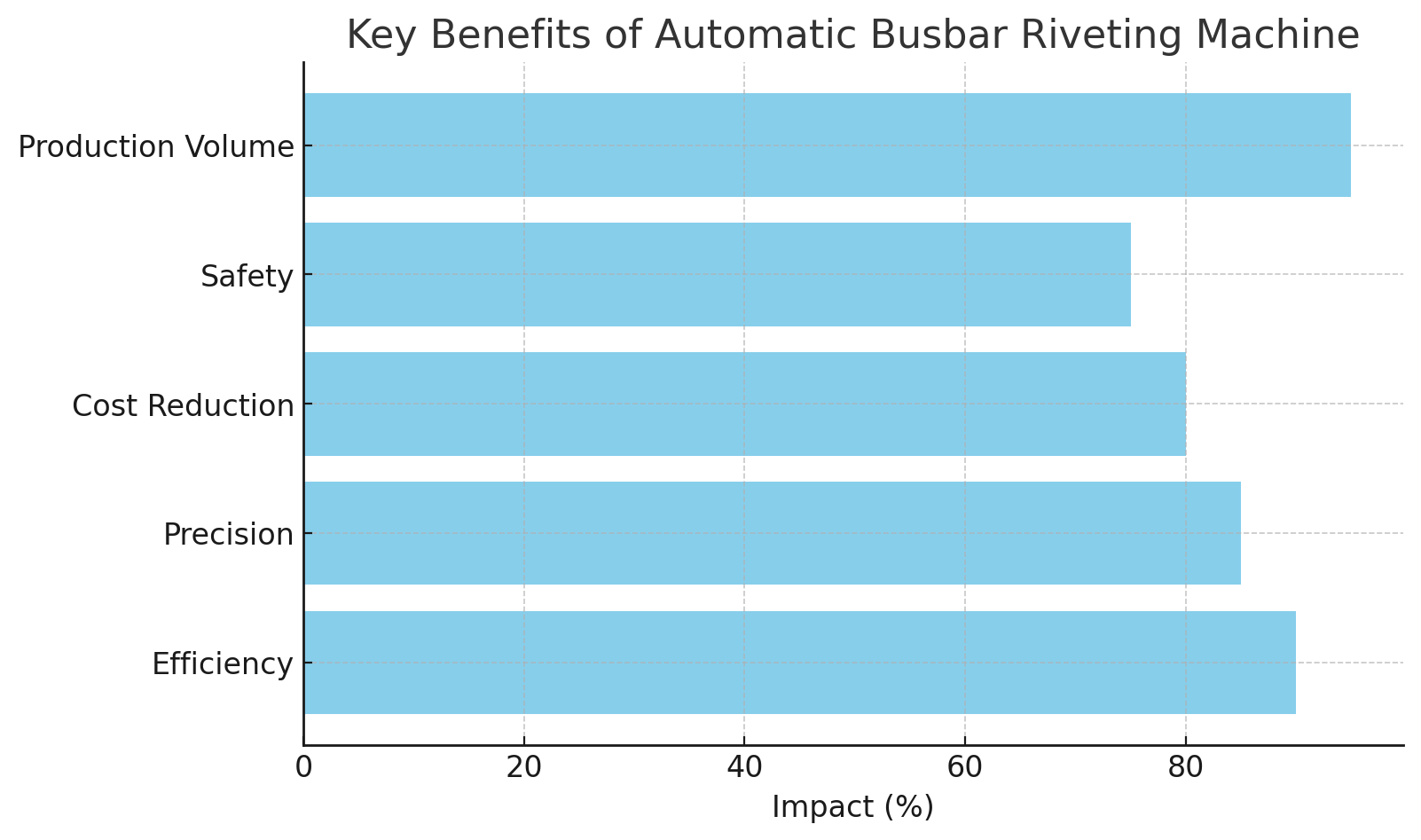
Automation significantly speeds up the production process. The automatic busbar riveting machine can operate continuously, handling high volumes of rivets with minimal downtime, leading to faster production cycles.
The machine ensures that each rivet is placed in exactly the same location, with the same pressure. This consistency is critical for producing busbars that meet strict electrical and safety standards.
By reducing labor costs and increasing the speed of production, these machines help businesses save on operational expenses. Automated systems also reduce waste caused by human error, further lowering costs.
With minimal human interaction, the risks associated with manual riveting are significantly reduced. Operators experience less fatigue, and the machines often feature safety mechanisms to prevent accidents.
An automatic busbar riveting machine can handle large-scale production with little intervention, ensuring that manufacturers can meet the growing demand for high-quality busbars in a competitive market.
The automatic busbar riveting machine is indispensable in the electrical industry, particularly for the mass production of busbars used in power distribution systems. These machines ensure that the rivets used in busbar production are securely fastened, offering long-lasting and safe electrical connections.
In industries like automotive and aerospace, where precise, strong connections are essential, riveting machines are used to assemble components with high mechanical strength. For example, in aircraft assembly, rivets must withstand vibrations and high stress, making an automatic riveting machine crucial for ensuring durable connections.
Industries involved in heavy machinery and construction benefit from automatic riveting machines due to their ability to handle large and complex materials, providing strong joints for safety-critical components.
Modern automatic busbar riveting machines can be customized to meet specific industry requirements. This includes adjusting rivet sizes, force settings, and even the type of rivet used, allowing manufacturers to produce rivets that are optimized for their unique applications.
Setting up the machine to handle different sizes and types of busbars can be complex. Manufacturers must ensure that the machine is correctly configured for each specific product to avoid errors and inconsistencies in production.
Not all materials are compatible with rivets, and some require specific settings for proper joint formation. For example, materials with different thicknesses or hardness levels may need to be adjusted to ensure a secure rivet joint.
Like any automated system, automatic busbar riveting machines require regular maintenance to ensure they remain operational and effective. Neglecting maintenance can lead to machine failure, costly repairs, and production downtime.
The upfront cost of purchasing an automatic busbar riveting machine can be significant. However, businesses often find that the return on investment justifies the expense due to increased efficiency and cost savings over time.
As robotics and AI technology advance, the capabilities of automatic riveting machines will continue to improve. Future models may incorporate smarter systems that can adapt to various production requirements in real-time.
Integrating IoT technology into riveting machines will allow for real-time monitoring and control of the manufacturing process. Data collected from these systems can help optimize production efficiency and identify potential issues before they cause downtime.
Manufacturers are increasingly focusing on creating energy-efficient machines that consume less power while maintaining high production levels. Sustainability is becoming a priority in manufacturing, and automatic riveting machines will likely see more eco-friendly innovations.
The demand for customized solutions is increasing, and automatic riveting machines are expected to become even more versatile. Future models will be capable of handling a wider range of materials, rivet sizes, and production configurations, further expanding their utility.
Automatic busbar riveting machines are vital in modern manufacturing, enhancing efficiency, precision, and safety. They speed up production and lower costs, ensuring high-quality results. Industries such as electrical, automotive, and aerospace benefit from these machines. Investing in an automatic busbar riveting machine helps businesses stay competitive. For manufacturers, upgrading to this technology improves efficiency and product quality, ensuring reliable performance in power distribution systems. KIANDE offers reliable solutions to help businesses optimize their manufacturing processes.
A: An automatic busbar riveting machine automates the riveting process, ensuring precise, fast, and reliable assembly of busbars in electrical systems.
A: The machine feeds rivets automatically, positions materials, and inserts rivets precisely to create secure connections, increasing production speed and quality.
A: The main advantages include enhanced efficiency, consistency, precision, reduced labor costs, and higher production volumes, making it ideal for large-scale manufacturing.
A: By automating the riveting process, it reduces human error, speeds up production, and ensures consistent results, leading to a more efficient manufacturing workflow.
A: These machines are commonly used in the electrical, automotive, aerospace, and heavy industries, where precise and high-volume riveting is required.

