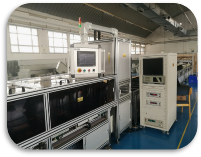
The Digital Automatic Busbar Inspection Machine for HV Withstanding Testing is composed of three parts: the feeding positioning station, the inspection station, and the discharge station. When operators interact with this industrial equipment, they immediately notice the solid, cold-rolled steel construction of the feeding module, designed to handle heavy electrical components without vibration. The inspection station emits a faint, reassuring hum during the high-voltage cycles, signaling that the internal transformers are actively verifying insulation integrity. Finally, the discharge station operates with a crisp, pneumatic sound, smoothly releasing the verified components down the line. This physical workflow transforms a traditionally labor-intensive process into a highly controlled, predictable operation.
System Overview: Digital Automatic Busbar Inspection Machine
Engineered specifically for busbar trunking system inspection, this advanced apparatus performs high-voltage withstanding tests and integrates modern digital technology with automated control to guarantee the electrical safety of busbar products. Facility managers and production line integrators face constant pressure to maintain absolute electrical safety while increasing daily output. This machine addresses that exact challenge by replacing manual, error-prone testing steps with a synchronized, data-driven methodology. The tactile feedback of the heavy-duty control switches and the glare-free, high-contrast HMI touchscreen provide operators with immediate confidence in the system's status. By bridging the gap between rigorous electrical safety verification and modern manufacturing demands, the equipment establishes a reliable foundation for scaling up production without compromising on stringent quality assurance protocols.
Core Functions & Capabilities
Comprehensive Testing Scope & Safety Systems
– Withstanding test: AC 5 000 V, 0-100 mA
– Insulation test: DC 500-1 000 V, 0-2 000 MΩ
– Earth-resistance test: AC 30 A test current
Conducting an AC 5 000 V withstanding test requires absolute environmental control. To ensure operator well-being, the system is equipped with industrial-grade safety light curtains, strict emergency shutdown protocols, and an automatic grounding mechanism. If any personnel breach the active testing zone, the high-voltage output is instantly neutralized, providing a completely secure atmosphere for line workers handling the daily throughput.
Technical Specifications & Automated Workflow
– Fast-test time: 1 s-20s/phase to phase
– Machine footprint: 1500 × 1800 × 1450 mm
– Built-in industrial PC control system
Beyond the core specifications, the machine integrates a fully automated workflow and material handling system. By combining the automatic feeding, precise mechanical positioning, and the discharge station, it effectively eliminates the physical bottlenecks associated with manual material transfer. When paired with the rapid 1 s-20s test cycle, this automated progression significantly elevates the overall throughput of the production line, allowing facilities to meet aggressive delivery schedules.
Digital Features & Smart Connectivity
– Automatic data logging: all test records stored automatically
– Data export: USB port for easy report transfer or internet transfer
– Built-in IPC: high stability, simple HMI
Embracing Industry 4.0 standards, the built-in IPC facilitates smart connectivity and MES integration. Production supervisors can utilize barcode scanning to automatically load the correct testing programs, preventing human input errors. The seamless connection to factory ERP/MES systems ensures that every piece of data is tracked in real-time, creating a foolproof management loop that meticulously documents the electrical integrity of every single unit passing through the station.
Applicable Products
Compact Busbar Trunking Systems
Compact busbar trunking system. The equipment features exceptional product adaptability and quick changeover capabilities. It is engineered with smart fixture recognition and self-adaptive clamping mechanisms. This means that when switching between different specifications or dimensions of densely packed busbar trunking systems, the machine automatically adjusts its physical grip. Operators are spared from tedious manual recalibrations, allowing the line to transition to new product runs in a fraction of the usual time.
Low-Voltage Busbar Production Lines
Low-voltage busbar production lines. In a continuous manufacturing environment, the physical integration of this testing machine provides a definitive quality gate. The heavy steel rollers and precise alignment guides ensure that long, cumbersome low-voltage busbars are fed into the testing chamber without scratching the exterior casing or bending the internal copper conductors, preserving the physical integrity of the materials throughout the inspection process.
QC Laboratories
QC laboratories. For controlled laboratory settings, the machine offers a quiet, highly analytical testing environment. The enclosed testing chamber minimizes external electromagnetic interference, allowing quality control engineers to capture the most accurate data possible. The smooth, powder-coated exterior of the machine is easy to clean and maintain, fitting perfectly into the pristine layout of a modern industrial laboratory focused on continuous improvement.
Technical Advantages
Test Accuracy & Structural Durability
– High-precision voltage & current measurement
– Real-time waveform monitoring
To maintain this level of test accuracy over years of service, the machine is constructed with structural durability designed for continuous operation. Utilizing an industrial-grade heavy-duty frame and an advanced thermal management system, the equipment dissipates the heat generated during constant high-voltage cycles. This ensures that the internal measurement components experience zero degradation in precision, even when subjected to 24/7 high-intensity operational demands.
Ease of Use & Intelligent Diagnostics
– One-button test sequence, select the testing device automatically.
– 1-second quick-test function
Complementing the one-button test sequence is a sophisticated intelligent diagnostics and maintenance system. The machine continuously monitors its own real-time health, tracking the actuation cycles of pneumatic valves and the calibration status of voltage sensors. If a potential anomaly is detected, the HMI displays visual troubleshooting guides and early warnings, drastically reducing the risk of unexpected downtime and keeping maintenance overhead to an absolute minimum.
Quality Control & Traceability
– Full test traceability
– Automatic test-report generation
– Compliant with industry standards
The automated generation of test reports removes the ambiguity from quality control. Every waveform anomaly, no matter how brief, is captured and logged. This level of granular traceability empowers facility managers to present indisputable proof of product safety to their clients, reinforcing trust and validating the rigorous standards upheld on the factory floor.
Typical Applications
End-of-Line Testing Before Shipment
End-of-line testing before shipment. By placing this automated testing apparatus at the final stage of the production line, manufacturers create an impenetrable barrier against defective products leaving the facility. The immediate pass/fail feedback, indicated by bright LED status lights and an audible confirmation tone, allows packaging teams to proceed with absolute certainty that the enclosed busbar is electrically sound.
Quality Assurance to Meet Safety Standards
Quality assurance to meet safety standards. Navigating the complex landscape of global electrical regulations requires equipment that leaves no room for interpretation. This machine provides the empirical data necessary to satisfy strict third-party audits, ensuring that every manufactured batch aligns perfectly with the documented safety thresholds required for commercial and industrial installations.
R&D Validation of New Designs
R&D validation of new designs. When engineering teams develop new busbar architectures, they rely on the precise waveform monitoring of this machine to observe how prototype insulation materials behave under extreme stress. The detailed electrical feedback helps refine material choices and structural designs before committing to mass production.
Periodic Field Inspection & Maintenance
Periodic field inspection & maintenance. Beyond the factory floor, the underlying technology and data management principles of this system can be applied to establish baselines for field maintenance. By comparing historical factory data with field performance, service teams can predict the lifecycle of the busbar trunking systems and schedule preventative maintenance effectively.
Standards Compliance
Satisfies Busbar Withstanding-Test Standards
Satisfies busbar withstanding-test standards. Compliance is not just a checkbox; it is the foundation of electrical infrastructure. This machine is precisely calibrated to apply the exact voltage and current profiles dictated by international busbar testing protocols, ensuring that the physical insulation and phase-to-phase spacing are thoroughly validated against established engineering benchmarks.
Meets General Electrical-Safety Test Codes
Meets general electrical-safety test codes. The equipment’s internal architecture is designed to reflect the most rigorous electrical safety codes available. From the isolation of its own power supply to the shielded cables connecting the testing probes, every physical component is engineered to prevent false readings and protect the surrounding factory infrastructure from stray electrical currents.
Supports Multiple Test-Standard Presets
Supports multiple test-standard presets. Because manufacturing facilities often produce components for various global markets, the machine’s software includes a diverse library of pre-configured testing standards. A simple tap on the capacitive touchscreen allows the operator to switch the entire testing profile to match the specific regulatory requirements of the destination country, streamlining international order fulfillment.
Economic Benefits
Higher Throughput via Automation
Higher throughput: automation cuts manual labour. The integration of automated feeding, positioning, and discharging physically removes the slowest elements of the testing process. By minimizing human handling, the production line maintains a continuous, rhythmic flow. This reduction in manual labor not only accelerates daily output but also allows facility managers to reallocate skilled workers to more complex, value-added tasks across the plant.
Lower Quality Risk & Enhanced Reliability
Lower quality risk: comprehensive testing ensures product reliability. Every undetected electrical fault represents a significant financial liability. By subjecting 100% of the production volume to rigorous, automated high-voltage verification, the risk of catastrophic field failures is virtually eliminated. This proactive approach to quality control drastically reduces the costs associated with product recalls, warranty claims, and on-site troubleshooting.
Simplified Data Management & Traceability
Simplified data management: digital storage enables easy traceability & analysis. The days of filing paper reports are obsolete. With all test records automatically logged and synchronized with the facility's central database, procurement and quality teams can instantly retrieve the historical performance of any specific serial number. This digital transparency simplifies audits and provides invaluable data for long-term process optimization.
Enhanced Brand Image & Technical Strength
Enhanced brand image: advanced test equipment demonstrates technical strength. When prospective clients or third-party inspectors tour the manufacturing floor, the presence of this highly organized, automated testing station speaks volumes. The sleek industrial design, the glowing indicator lights, and the organized flow of materials visually communicate a deep commitment to excellence, positioning the manufacturer as a highly capable and trustworthy partner in the electrical infrastructure sector.


