CNC vs. Manual Busbar Machines: Which Fits Your Part Mix and Volume?
Home » News » CNC vs. Manual Busbar Machines: Which Fits Your Part Mix and Volume?

CNC vs. Manual Busbar Machines: Which Fits Your Part Mix and Volume?

Views: 0     Author: Site Editor     Publish Time: 2026-11-21      Origin: Site

facebook sharing button
twitter sharing button
line sharing button
wechat sharing button
linkedin sharing button
pinterest sharing button
whatsapp sharing button
kakao sharing button
snapchat sharing button
telegram sharing button
sharethis sharing button

Choose the busbar machine by the part data you reuse, not by its label. Manual stand-alone processing suits one-off bars and irregular families where an operator positions each bar; CNC or automatic processing earns its place where the same hole patterns and bend sets come back often enough to store, recall and repeat. Everything else — volume, cost, maintenance and accuracy — has to be measured on your own parts, tooling and material.

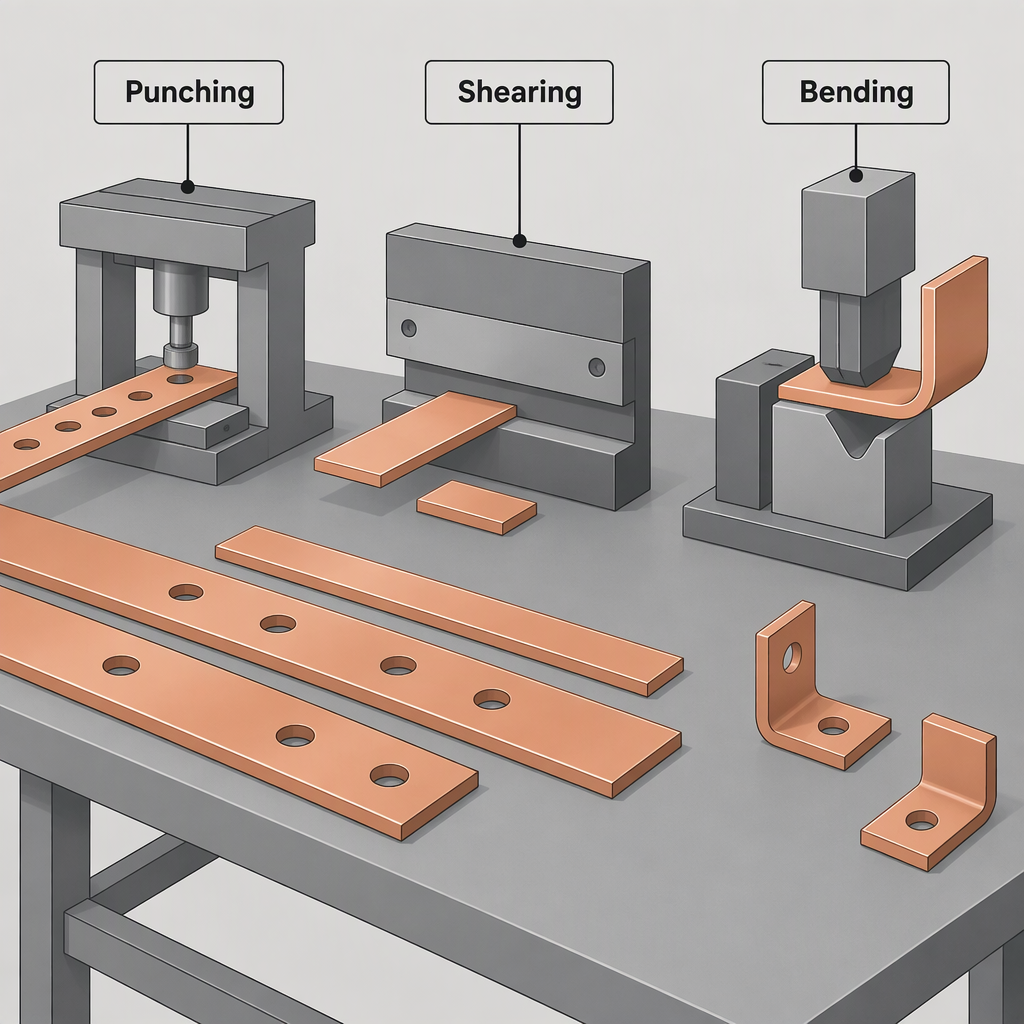
Busbar bench with copper bars positioned at punching, shearing and bending

What changes when you compare a CNC busbar machine with a manual one?

A manual, stand-alone set-up leaves positioning and sequence to the operator at three separate stations: punching, shearing and bending of copper or aluminium bars. A CNC or automatic machine keeps that part information in the control and repeats it: Suzhou Kiande Electric Co., Ltd. describes its automatic busbar machine as integrating automatic feeding, shearing, bending and stamping, with PLC-controlled modes intended to reduce manual intervention. The hazard profile stays the same: both types expose operators to struck-by, drawing-in, shearing, cutting and crushing hazards, so both need the same class of safeguarding and the same residual-risk information from the supplier.

Manual / stand-alone processing

Positioning
Operator places the bar against stops or a gauge at each station.
Part data
Lives in drawings, templates and operator judgement; nothing is stored for recall.
Repeatability
Depends on operator skill, stop condition and tooling wear.
Changeover
Tools and stops reset by hand; short batches stay practical.
Fits when
Few repeats, many one-off bars, mixed families.
Watch
Fatigue, guarding at each station, and variation between operators and shifts.

CNC / automatic processing

Positioning
Feeding is control-driven; the operator loads and starts the cycle.
Part data
Stored per part and recalled, so programming effort is spread across repeats.
Repeatability
Comes from the control, the drives and fixture condition rather than hand placement.
Changeover
Mostly a program recall plus a tooling and fixture check.
Fits when
Repeating hole patterns and bend sets within defined families.
Watch
Program-change competence, guarded access, and maintenance access.

Which part mix fits CNC, and which fits manual busbar processing?

Sort your work by repetition. A mix dominated by one-off bars, prototype panels and irregular families keeps a stand-alone machine competitive, because nothing needs to be stored and nothing has to be reprogrammed. A mix where the same hole patterns and bend sets return across batches is where a machine that integrates feeding, shearing, bending and stamping under stored control starts to pay back. Compare families by their real alloy designation rather than the word "copper": the Copper Development Association standards and specifications overview explains how UNS designations and European numbers such as CuZn37, also written CW508L, are formed, which is what lets a reordered family be set up or programmed the same way twice.

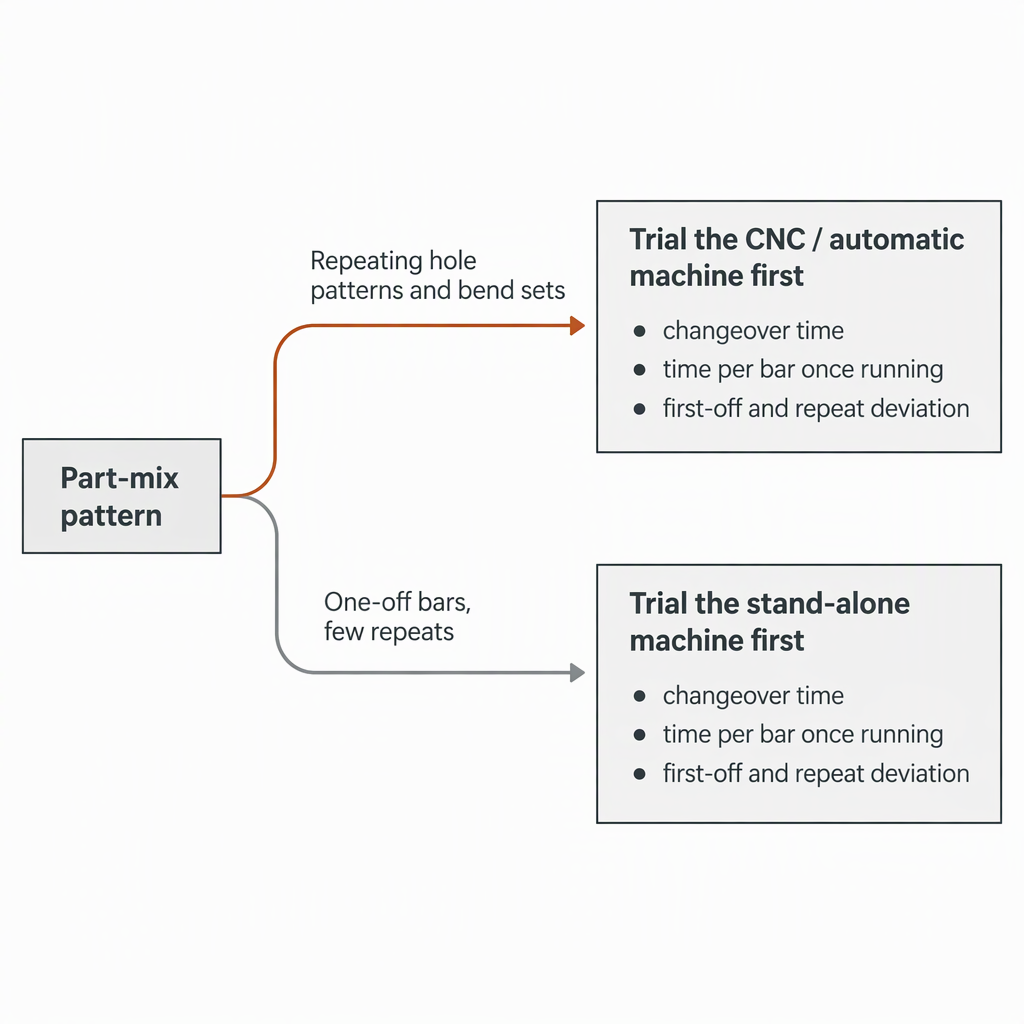
Decision path from part-mix pattern to which busbar machine to trial first and the values to record on each branch
Part-mix scenarios: which option to trial first
Part-mix pattern How the work is done today Trial first Value to record
Mostly one-off bars, few repeats Three stations, operator-set stops Manual / stand-alone Minutes per bar, positioning included
Small repeating families, frequent design changes Manual work with templates Both, side by side Changeover minutes per family
Repeating hole patterns and bend sets Manual repositioning for every bar CNC / automatic Time per bar once running
Long runs of one bar type Any method CNC / automatic First-off and repeat deviation
Mixed copper and aluminium families Shared tooling Whichever handles both safely Tooling change time per material

How do volume and changeover frequency change the answer?

Volume alone does not decide. What decides is the ratio between the time spent setting up, recalling or programming a part and the time spent producing good parts. If a shift contains more changeovers than long runs, stored part data has little to amortise against, however many bars leave the plant each month; if one set-up serves hundreds of bars, that same stored data removes repeated manual positioning from every one of them.

The same dimensions, compared for both options
Dimension Manual / stand-alone CNC / automatic
Setup before the first good part Stops, gauges and tools set by hand at each station Program recall plus a tooling and fixture check
Time per bar once running Operator positions and triggers every operation Control sequences feeding, shearing and bending
Batch size that makes sense Small batches stay economical Larger repeating batches recover the data-building effort
Where labour stays In the cycle, at every bar In loading, monitoring and first-off checks
Engineering change New template or stop setting New or edited program, made by a competent person and recorded
Documentation to keep Maintenance and inspection records Maintenance, inspection and control-program records

Where do accuracy and repeatability come from on copper and aluminium busbar?

From three things you can inspect on site: machine and tooling condition, how the bar is held during each operation, and the material actually delivered. A busbar system is made up of bar conductors, exposed or enclosed, with one or more joints to achieve length and configuration and one or more take-off points, and the Copper Development Association busbar reference publishes ampacity and mechanical property data for Copper No. 110 at nominally 99% IACS for temperature rises of 30, 50 and 65 degrees C, recommends designing to a 30 degree C rise or less, and states that rises above 65 degrees C are not recommended. That guidance governs the conductor, not the machine: it fixes no hole-to-hole or bend-angle tolerance for either processing option, so a tolerance figure only becomes meaningful when it is measured on your own bars, tooling and fixtures.

Fit the material before you argue about accuracy

Designation is the part of material control both options depend on. UNS designations and European numbers such as CuZn37, also written CW508L, identify the alloy you bought and reorder, but they do not state temper, straightness or springback for the bar as delivered.

Conductor design data covers current-carrying capacity and temperature rise. It does not cover machine accuracy, tooling life, cycle time or supplier performance.

Ask each supplier to demonstrate repeatability on your own material, at your bar thickness and width, with the tooling they would deliver, and record the values instead of accepting a catalogue figure.

What belongs in the cost comparison, and what must you measure yourself?

Compare cost lines on identical operating conditions: same bar designations, same hole patterns, same bend sets, same shift pattern. Maintenance is a statutory cost line for either option, because work equipment has to be maintained in an efficient state, in efficient order and in good repair by competent persons, with a maintenance log kept current, so that labour belongs in the comparison and not only the purchase price.

  • Machine and tooling scope for your hole and bend range, quoted on the same bar sizes.
  • Installation: foundation, services, levelling, and the stable installation machinery requires.
  • Part-data build-up: programming for a stored-control machine, or templates and stops for a stand-alone one.
  • Maintenance labour, spare parts, and the time needed to keep the maintenance log current.
  • Inspection regime, including records kept until the next inspection.
  • Guarding, interlock verification and operator protective equipment.
  • Measured setup and changeover time per part family, from your own trial.
  • Measured time per bar once running, loading and unloading included.
  • Counted first-off and changeover scrap.
  • Training hours until an operator runs unaided and an engineer owns the part programs.
  • Floor space, energy, and the work in progress that batch size forces you to hold.

How do maintenance and safety duties differ between the two options?

The duty is the same class of duty for both options; the work differs. The Provision and Use of Work Equipment Regulations 1998 govern work equipment in Great Britain and cover inspection, maintenance of work equipment, training and competence, and mobile work equipment, so a manual stand-alone machine and a PLC-controlled automatic machine sit inside the same framework.

  1. Before any manual access for clearing, cleaning or adjustment, switch the machine off and disconnect it from its power supply, including stored energy such as pneumatic or hydraulic pressure and any suspended load, then follow the machine manual's permitted access procedure before reaching in.
  2. Plan each task from the manufacturer's instructions, use competent persons, and record the work in the maintenance log.
  3. On a PLC-controlled machine, changes to programmable electronic system programs must be made by a competent person and recorded.
  4. Apply guarding in order: fixed guards first, then interlocks and trip devices, then jigs, holders and push sticks, and only then information, training and protective equipment.
  5. Inspect after installation and before first use, at risk-based intervals where deterioration could create danger, and after exceptional circumstances; keep the records until the next inspection and use a quick visual check before each shift.
  6. Refit guards and verify interlocks and stops before the machine returns to production.

The HSE guidance on maintenance of work equipment and its introduction to machinery safety set out these duties and the safeguarding hierarchy. Requirements differ between countries, so confirm what applies where the machine will be installed.

What should you test on both machines before deciding?

Run the same part family on both options and write down numbers, because no catalogue figure tells you what your bars, tooling and operators will achieve. Inspection belongs in the protocol too: work equipment must be inspected after installation and before first use, at suitable intervals where deterioration could create danger, and after exceptional circumstances, with records kept until the next inspection, as set out in the HSE guidance on inspection of work equipment.

Trial protocol: what to record and why it decides the purchase
Record How to obtain it Why it decides
Changeover time per part family Time the change from the last good part of type A to the first good part of type B Turns the setup-versus-run question into arithmetic
Time per bar once running Time 20 consecutive bars, loading included Shows where labour actually sits in the cycle
First-off and repeat deviation Measure the same feature on every bar of the run Separates machine capability from a lucky first part
Changeover scrap Count bars discarded from setup to first good part Creates a real material and time cost line
Surface and burr condition Inspect hole edges and bend marks on both materials Affects downstream joint preparation
Guard and interlock behaviour Verify that each guard stops the cycle as designed Confirms the machine can be operated as supplied
Operator independence time Record training hours until unaided running Adds to the real cost of either option

What is the final selection checklist?

Commit only when your own trial data shows where your parts sit between changeover time and run time, and when both options have been quoted on the same bar sizes, hole patterns and bend sets. Stored, integrated processing pays back through repeated part data; stand-alone processing pays back through flexibility on one-off work.

  • Part families listed with their real alloy designations, bar sizes and bend sets.
  • Changeover and run times measured on both options rather than quoted.
  • First-off and repeat deviations recorded on your own material.
  • Cost lines agreed, including maintenance, inspection, training and scrap.
  • Guarding, interlocks and program-change control confirmed during the demonstration.
  • Maintenance and inspection plans written before the machine is installed.
  • Operator and engineer competence planned, with records kept.

Decision recap

  • Manual processing fits one-off bars and irregular families; CNC fits repeating hole patterns and bend sets.
  • Volume matters only through the setup-to-run ratio you measure.
  • Accuracy follows condition, fixturing and the material as delivered.
  • Maintenance, inspection, competence and safeguarding duties apply to both options.

Frequently asked questions

These are the questions buyers raise once the comparison is on the table, answered on the same operating-condition basis used above.

Can one busbar machine perform punching, shearing and bending?

Yes. Integrated machines exist that combine the operations: Suzhou Kiande Electric Co., Ltd. describes its automatic busbar machine as integrating automatic feeding, shearing, bending and stamping with PLC-controlled modes intended to reduce manual intervention. Whether to buy one integrated machine or keep separate stations is still a part-mix question, because integration saves handling where parts repeat while separate stations keep more freedom for one-off work.

Do we need in-house programming and control competence for a PLC-controlled machine?

Yes, on the control side. Changes to the programs of a programmable electronic system must be made by a competent person and recorded, so at least one person should own the part programs, the backups and the change records, with their training documented. Mechanical maintenance follows the same principle, because maintenance has to be carried out safely by competent persons.

Is CNC processing always more productive than manual processing?

No. Stored part data only pays back where it is reused. If your work is dominated by one-off bars and irregular families, the effort of building and maintaining part data can outweigh the handling it saves, and a stand-alone machine keeps more options open. The balance shifts as soon as a set of hole patterns and bend sets starts repeating across batches.

How do alloy designations affect a fair comparison?

They define what you are cutting, punching and bending. Wrought copper and copper alloys carry UNS designations from C10000 to C79999 and cast alloys from C80000 to C99999, developed by ASTM International and SAE International, while the European Numbering System developed by CEN gives names such as CuZn37, also written CW508L. Comparing quotations on a stable designation keeps reordered families comparable; "copper bar" does not.

Does the machine type change our maintenance and log duties?

No. Work equipment must be maintained in an efficient state, in efficient order and in good repair, and where a maintenance log exists it has to be kept up to date, with the work done safely by competent persons. What changes is the content: a PLC-controlled machine adds program and control checks, while a stand-alone machine concentrates the work on stops, tooling and mechanical condition.

When must work equipment be inspected?

Inspection is required where incorrect installation, deterioration or other circumstances could create significant risk: after installation and before first use, at suitable intervals where deterioration could create danger, and after exceptional circumstances. Frequency follows your risk assessment, which should take the manufacturer's recommendations into account; keep records at least until the next inspection, and use a quick visual check before use in between.

What training should operators and maintenance staff have?

The regulations covering work equipment in Great Britain include training and competence among their subject areas, and maintenance must be carried out safely by competent persons. In practice, plan documented training for normal operation, changeover, program changes and the specific isolation procedure of each machine, and keep those records with the maintenance log so they can be produced at inspection.

CONTACT INFOR

Phone

+86-18115550561

QUICK LINKS

PRODUCT CATEGORY

CONTACT US
Copyright  2024 Suzhou Kiande Electric Co.,Ltd. All rights reserved. Sitemap | Privacy Policy