
Views: 0 Author: Site Editor Publish Time: 2026-07-01 Origin: Site


Precise formulas help makers know the real capacity and output efficiency of any Busbar Production Line. Accurate math helps factories work better. Industry data shows this: production goes up by 45%. Material waste goes down by 23%. This happens when measurement and control improve.
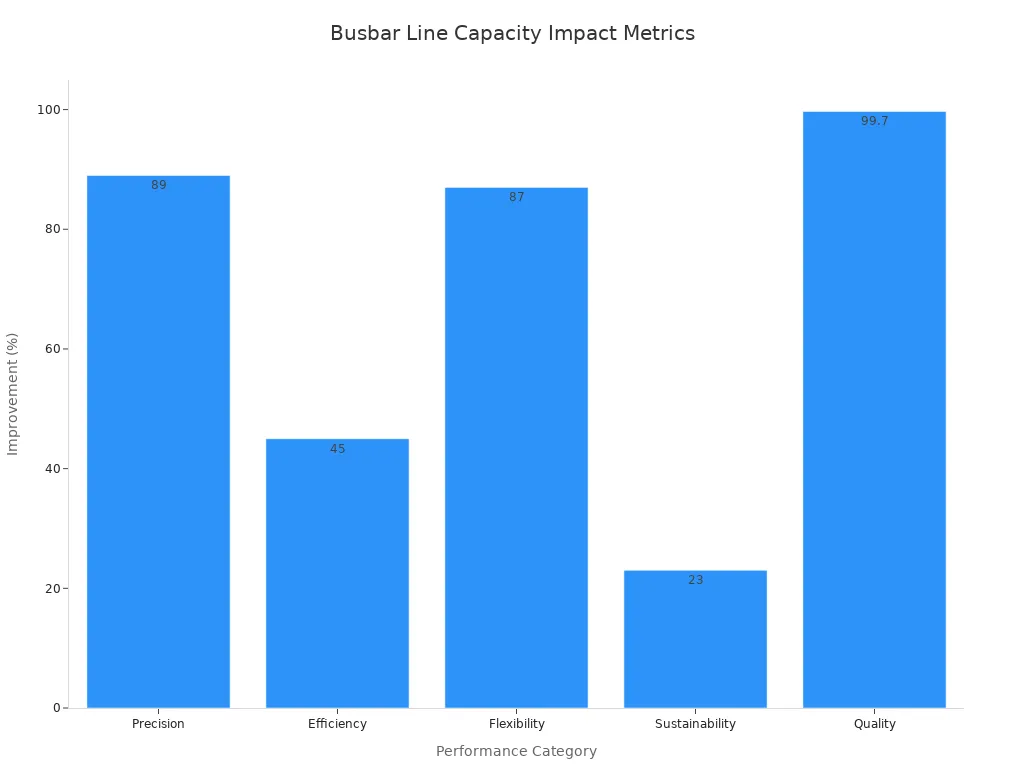
Suzhou Kiande’s skill shows how advanced systems can make busbar manufacturing better. Every plant can get better results by using these proven ways.
Knowing how much a production line can make helps factories plan well and meet what customers need.
Important things like the kind of material, the size of the cross-section, and the place where work happens change busbar capacity a lot.
Using machines and connecting systems makes work faster, lowers mistakes, and helps make more busbars.
Checking data often and doing careful math stops expensive errors in busbar design and making.
Using smart ideas, like the ones from Suzhou Kiande, makes busbars more reliable and better in quality.
Production line capacity tells us how much a factory can make in a certain time. In busbar manufacturing, it shows the most busbars or the longest length made each hour or shift. This number helps managers plan work and use resources well. It also helps them finish orders on time. High capacity means factories can fill big orders and give steady power to customers. When companies know their capacity, they can stop slowdowns and make each step more reliable.
Many things change how much a busbar production line can make. The material, like copper or aluminum, changes how much current the busbar can hold. The cross-sectional area shows how much current can go through without getting too hot. Temperature and air flow also matter. The table below lists the main things that affect capacity:
Factor | Description |
|---|---|
Type of Material | Copper and aluminum let current flow differently, so they carry different amounts. |
Cross-Sectional Area | Bigger cross-sections let more current pass because they have less resistance and cool better. |
Ambient Temperature | Hotter air lowers how much current busbars can carry. |
Ventilation | Good air flow helps busbars cool down and work better. |
Mounting Orientation | How busbars are placed changes how much current they can carry. |
Number of Busbars in a Stack | Stacking busbars close makes more heat, which can lower capacity. |
Engineers must think about all these things when they do busbar size calculation. If they miss any, the busbar could get too hot, break down, or stop working right.
Groups like the International Electrotechnical Commission (IEC) give formulas to find out how much current busbars can carry. The formula depends on what the busbar is made of and its size. The table below shows some common formulas:
Material | |
|---|---|
Copper | Iccc = 1.2 × busbar width × busbar thickness |
Silver Steel | Iccc = 1.6 × busbar width × busbar thickness |
Aluminum | Iccc = 0.8 × busbar width × busbar thickness |
Iron | Iccc = 0.6 × busbar width × busbar thickness |
Galvanized Steel | Iccc = 0.6 × busbar width × busbar thickness |
DC Circuit | Iccc = P (kW) × 1000 / V (V) × (1 + S.F / 100) |
1 Phase AC Circuit | Iccc = S (kVA) × 1000 / V (V) × (1 + S.F / 100) |
3 Phase AC Circuit | Iccc = S (kVA) × 1000 / 1.73 × Vll (V) × (1 + S.F / 100) |
Iccc = S (kVA) × 1000 / 3 × Vln (V) × (1 + S.F / 100) |
Engineers use these formulas to find the most current a busbar can safely carry. This helps keep power flowing and stops the busbar from getting too hot.
Suzhou Kiande’s Busduct Production Line is a good example of using these formulas. Let’s say a company needs copper busbars that are 100 mm wide and 10 mm thick. The formula for copper is:
Iccc = 1.2 × busbar width × busbar thickness
Iccc = 1.2 × 100 × 10
Iccc = 1,200 Amperes
So, each busbar can safely carry up to 1,200 amperes. The production line can make many busbars each hour, based on how much automation it has. Suzhou Kiande’s system uses barcode scanning and ERP integration to set things up automatically. This makes sure every busbar meets the right current carrying capacity and works well.
By following these steps, factories can make their busbar production line better, increase output, and give customers reliable products for power systems.
Output efficiency tells us how well a busbar production line changes raw materials into finished busbars. It shows the real output compared to the highest possible output. Managers use this number to see how much the line makes versus its full ability. High efficiency means the line works well and gives steady power. It also means the machines work right. Important signs of output efficiency are steady power, good heat control, and how much work the machine does. These signs help factories keep busbars reliable and control the current in each one.
Automation and system integration help make output efficiency better. Machines like the Suzhou Kiande Busbar Machine do cutting, punching, and bending all at once. This means less manual work and faster production. The table below shows how different methods compare:
Processing Method | Average Time Per Busbar | Daily Output |
|---|---|---|
Manual + Separate Machines | 15–20 mins | 30–40 pcs |
Hydraulic Busbar Machine | 7–10 mins | 60–80 pcs |
CNC Busbar Machine | 3–5 mins | 120–160 pcs |
Automation lowers mistakes and keeps the current moving well. System integration, like doing bending and punching together, stops the need for moving parts by hand. This makes the process more exact and stable. When factories use these systems, they get better output efficiency and more reliable busbars. They also avoid problems like cracking and bending, which can hurt current and capacity.
Engineers use a simple formula to find output efficiency:
Output Efficiency (%) = (Actual Output / Maximum Possible Output) × 100
For example, if a busbar line can make 160 busbars a day but only makes 120, the formula is:
Output Efficiency (%) = (120 / 160) × 100 = 75%
This means the line works at 75% efficiency. Managers use this number to find ways to make the line better. They can change machine settings, fix heat control, or add more automation to help current flow and make more busbars.
Suzhou Kiande has smart solutions that help factories get better output efficiency. Their Busbar Machine does many steps in one, so workers do less and output goes up. The Busduct Production Line uses barcode scanning and ERP integration to set things up by itself. This makes sure every busbar can carry the right current and stays reliable. The system’s modular design makes upgrades and changes easy. Factories using Suzhou Kiande’s solutions get better heat control, steady power, and higher efficiency. These things help companies give good products for power and keep current and capacity under control.
Tip: Automated systems from Suzhou Kiande help factories make steady output, have fewer mistakes, and keep current flowing well. Managers can trust these solutions to make every busbar line more reliable and efficient.
Engineers first collect important data before busbar size calculation. They look at how the busbar handles heat. They check what the busbar is made of. They also see how the busbar is mounted. Thermal performance tells how well the busbar deals with heat. Material properties show how much current the busbar can carry. They also show how long the busbar will last. Mounting configuration affects how the busbar cools. This changes capacity and reliability. Getting this information helps engineers make good calculations. It also helps them avoid problems in power distribution.
Many companies use advanced machines and formulas to improve their busbar production line. For example:
A big manufacturer had delays with old machines.
They needed machines that cut, punch, and bend aluminum and copper bars.
Suzhou Kiande gave them custom machines for their line.
These machines made work more accurate and stable.
The upgrades made production faster, improved quality, and lowered defects.
Using the right formulas and modern machines helps companies increase capacity and efficiency. It also keeps current flow steady.
Undersizing a busbar is a common and expensive mistake in power design. If the size is wrong, the busbar can get too hot. It can cause trips or even faults that shut down a panel.
To stop these mistakes, engineers use machines that connect to software. They import 3D CAD files. Automated systems and CNC models with angle sensors help every bend and cut stay precise. These steps stop manual errors and make busbars more reliable.
Make sure the line can grow for future needs.
Use monitoring platforms for dashboards, reports, and alerts.
Check the environment for humidity and dust.
Keep high quality in making, insulating, and testing busbars.
Use smart busbars to lower downtime and watch signals.
Evidence Type | Description |
|---|---|
Manufacturing Methods | New ways of making busbars help efficiency and product performance. |
Material Innovations | Better coatings and plating help current flow and reliability. |
Strategic Sourcing | Flexible sourcing lowers costs and boosts capacity. |
These strategies help factories get higher capacity, better efficiency, and strong reliability in every busbar production line.
Accurate calculation lets factories give steady power for distribution. Advanced automation, like Suzhou Kiande’s solutions, helps factories make more busbars and better quality. Industry leaders get faster results and shorter wait times when they upgrade their systems.
Automation makes work faster and more exact.
CNC machines do hard jobs with great accuracy.
Top makers have many busbar sizes for different uses.
Checking often and asking experts keeps the line working well.
Engineers figure out busbar production line capacity to see how many busbars a factory can make in a certain time. This helps managers plan jobs, finish on time, and give customers steady power.
Automation cuts down on mistakes people make. It keeps every step the same. Machines from Suzhou Kiande help make sure each busbar is made well and meets tough quality rules.
Current carrying capacity tells how much electric current a busbar can safely hold. This number helps engineers pick the right size and material. It stops overheating and keeps things safe and working right.
Good material, careful machines, and regular checks all help with reliability. Automated systems also lower mistakes and keep the work going smoothly.
Suzhou Kiande’s machines and lines help factories make good busbars. These busbars meet industry rules and what customers need for steady power.

