
Views: 0 Author: Site Editor Publish Time: 2025-11-25 Origin: Site


In the age of Industry 4.0, smart factories are transforming manufacturing with automation and data integration. One key innovation is the Compact Busbar Automatic Inspection Machine, crucial for ensuring the quality of busbars, which are essential components in electrical systems like switchgear and transformers. These machines automate testing processes—such as withstand voltage, insulation resistance, and grounding resistance—ensuring higher accuracy and efficiency compared to traditional manual methods.
By integrating seamlessly into smart factory environments, compact busbar inspection machines speed up production, reduce errors, and enable real-time quality control. Their advanced control technologies enhance testing precision and stability, making them an essential part of modern, automated manufacturing systems. As automation continues to evolve, these machines are set to play a central role in the future of smart factories.
Busbars are essential components in electrical distribution systems, typically made from copper or aluminum, that distribute electrical power across various parts of an electrical network. They connect equipment such as switchgear, transformers, and busducts, ensuring efficient and safe transmission of electricity. Given their importance, busbars must be carefully manufactured and rigorously tested to meet safety and performance standards.
Busbar manufacturing involves processes like cutting, punching, bending, and sometimes coating to meet specific electrical system requirements. Any defects in these processes can lead to inefficiencies or failures in the electrical system. As a result, reliable testing and inspection methods are crucial to ensuring that busbars meet all necessary standards.
A compact automatic busbar inspection machine is a specialized device designed to automatically test busbars and busduct systems. It conducts tests such as withstand voltage, insulation resistance, and grounding resistance to ensure the busbars are safe and reliable. These machines improve speed, accuracy, and consistency while reducing human error and labor costs compared to manual inspection methods.
The term "compact" refers to the smaller, more flexible design of these machines. Compared to traditional large inspection systems, compact machines occupy less space and are ideal for flexible production lines or small-batch manufacturing. They offer the same high performance but with added benefits of efficiency and ease of integration into existing setups, making them perfect for environments where space and production flexibility are crucial.
Automated inspection equipment, such as the Compact Busbar Automatic Inspection Machine, is vital for enhancing efficiency and quality in smart manufacturing. These machines accelerate inspection speed, allowing busbars to be tested quickly without sacrificing accuracy. By eliminating human error, they ensure consistent quality across production. Additionally, automation reduces labor costs and minimizes defects, enabling manufacturers to meet high standards while optimizing production throughput.
The demand for automated busbar inspection machines is growing rapidly. In 2022, fully automated inspection equipment held a significant share of the market. This trend reflects the need for higher precision, faster production cycles, and more complex electrical systems. As industries increasingly embrace automated production environments, the adoption of compact busbar inspection machines continues to rise.
The busbar manufacturing process includes cutting, punching, bending, followed by assembly and inspection. The inspection step is crucial for quality control before busbars are approved for shipment. Automated inspection ensures every busbar is tested thoroughly, preventing defects from reaching customers and maintaining high-quality standards.
Fast Switching for Small-Batch, Multi-Product Production
Compact inspection machines offer quick setup and changeover, making them ideal for small-batch or multi-product production lines. This flexibility reduces downtime and boosts production efficiency.
Integration with MES/ERP Systems
These machines integrate easily with upstream processing equipment and Manufacturing Execution Systems (MES) or Enterprise Resource Planning (ERP) systems, ensuring smooth data flow across the entire production process. This integration helps optimize workflow and improves supply chain management.
Real-Time Data Collection and Analysis
Automated inspection machines gather real-time data on manufacturing efficiency, yield rates, and quality trends. This data supports better decision-making and continuous improvement, helping manufacturers address issues proactively and maintain consistent product quality.
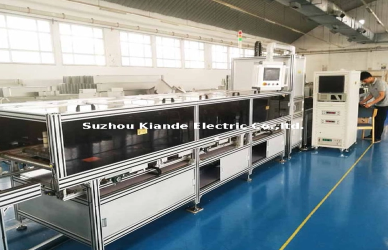
These machines offer essential tests to ensure busbar reliability and safety:
Withstand voltage testing: Verifies the busbar can handle high-voltage conditions.
Insulation resistance testing: Ensures the insulation prevents electrical leakage.
Grounding resistance testing: Checks the grounding for safety.
For example, Kiande models support AC 5000V, DC 500–1000V, and grounding resistance up to 30A, covering various testing needs.
The machines are designed for automation and data management:
Automatic material feeding: Reduces manual handling and errors.
Part identification via barcode: Ensures correct tracking of busbars.
Automatic test report generation: Streamlines data recording.
USB/network data export: Facilitates easy data transfer.
Integration with MES systems: Connects seamlessly with Manufacturing Execution Systems (MES) for real-time production monitoring.
The compact design offers flexibility in production environments:
Small footprint: For example, dimensions like 1500×1800×1450 mm, ideal for limited space.
Adaptability: Supports various busbar lengths and types, including single-layer and multi-layer.
These machines ensure high-quality standards:
100% inspection: Every busbar is tested, preventing defects.
Automatic rejection for defective products: Alerts manufacturers to remove faulty items.
Data storage for analysis: Helps track quality trends and drive process improvements.
Automating inspection brings significant economic advantages:
Reduced manual inspection costs: Automation cuts labor costs.
Lower rework and waste: Early defect detection reduces waste and rework.
Increased yield rates: Higher test accuracy leads to better product yield.
Faster shipment cycles: Quicker inspection improves production speed.
Digital manufacturing entry point: The inspection data contributes to digital factory operations.
These machines integrate smoothly with smart factory systems:
Production optimization: Inspection data refines production processes.
Predictive maintenance: Data helps identify maintenance needs early.
Manufacturing resource planning (MRP): Contributes to more accurate material planning.
Supply chain feedback: Real-time data helps adjust production and optimize inventory.
When selecting a Compact Busbar Automatic Inspection Machine, consider busbar specifications (current rating, length, and layer count), production speed, and the types of inspection required (e.g., straight bars, elbows, or busducts). Customizing the machine to these factors ensures optimal performance for specific manufacturing needs.
Ensure the inspection machine integrates smoothly with existing production lines and supports MES/ERP systems for real-time tracking. Barcode identification and automatic report generation streamline part tracking and data analysis, improving efficiency and traceability across the production process.
Evaluate the initial investment against potential savings in labor, rework, and improved yield rates. A thorough ROI analysis should be conducted to assess long-term benefits. Additionally, the machine should support future upgrades for new busbar specifications and IoT/smart monitoring capabilities, ensuring scalability and long-term value.
A1: These machines are typically used for inspecting straight busbars and sections of busduct systems. They support busbar lengths ranging from 1.2–6 meters and current ratings from 630A to 2500A (single-layer). For elbow-shaped or custom busbar sections, additional manual inspection or machine customization may be needed.
A2: Yes, it can significantly reduce or even replace manual inspection steps. For example, Kiande's machine can perform withstand voltage, insulation, and grounding tests in about 1–2 minutes per piece, ensuring accuracy and consistency. It also generates automatic reports and stores data for traceability.
A3: The inspection machine can integrate with existing systems through barcode recognition, part identification, and data export capabilities. The machine supports PLC control or industrial PC control and can communicate with MES/ERP systems for real-time data collection and manufacturing analysis.
A4: The main benefits include:
Reduced labor costs and fewer human errors in inspection.
Faster inspection times, improving overall production throughput.
Higher yield rates and lower rework/waste, reducing quality risks.
Enabling full traceability and data reporting for manufacturing process optimization.
Supporting the digital transformation of smart factories with real-time data and integration capabilities.
The Compact Busbar Automatic Inspection Machine plays a crucial role in modernizing busbar manufacturing, providing enhanced efficiency, precision, and flexibility. By carefully selecting and customizing the machine to fit specific busbar specifications, production speed, and inspection types, manufacturers can ensure optimal performance tailored to their needs. Integration with existing production lines and robust data connectivity with MES/ERP systems streamlines the workflow, ensuring seamless tracking, reporting, and real-time data analysis.
Beyond improving inspection accuracy and speed, busbar machine offers significant economic benefits, such as reducing manual labor costs, minimizing rework, and increasing product yield, ultimately improving ROI. Furthermore, its adaptability for future upgrades, including support for new busbar specifications and IoT/smart monitoring capabilities, ensures it can evolve with industry trends and continue to deliver long-term value. As a result, the compact busbar inspection machine is an essential investment for any smart factory looking to enhance production efficiency, maintain high-quality standards, and stay competitive in the rapidly advancing automation landscape.

