
Views: 0 Author: Site Editor Publish Time: 2025-11-03 Origin: Site


Busbars are essential for the efficient distribution of electricity in various systems. But how are these critical components made? The answer lies in the busbar assembly line.
In this article, we will explore how a busbar assembly line works, the key components involved, and how automation enhances production efficiency. You'll discover how these systems ensure high-quality, cost-effective busbars for diverse electrical applications.
A busbar assembly line is a specialized manufacturing system that assembles busbars—metal strips or rods made of copper or aluminum—into functional units used in electrical systems. These busbars are then connected to electrical components such as transformers, circuit breakers, and feeders to distribute power efficiently.
The assembly line streamlines the entire process of shaping, insulating, and assembling busbars, ensuring that each component is securely fastened, tested, and ready for installation.
1. Copper Busbars: Known for their high electrical conductivity, copper busbars are ideal for handling high currents.
2. Aluminum Busbars: Lighter and less expensive than copper, aluminum busbars are often used in applications where weight and cost are critical factors.
3. Flexible Busbars: These are made from braided copper or aluminum and are used in spaces requiring flexibility.
The busbar assembly line ensures that busbars are precisely manufactured to meet the rigorous demands of power distribution systems. These systems rely on busbars to ensure continuous power flow while minimizing energy loss and maintaining safety.
The assembly line begins with the selection of raw materials—either copper or aluminum. The material must be of high purity to ensure the busbar's performance and durability. These materials are then cut and shaped according to the required dimensions.
After preparation, the materials undergo cutting, bending, and shaping processes to form the busbars. This ensures they meet the exact size specifications required for the electrical systems.
Busbars are assembled with components like insulators, casings, and connectors. The assembly stations combine these components using automated or manual processes, ensuring each part is securely attached and aligned.
Riveting is used to secure the busbars within their housing. Rivets provide a strong, permanent connection between the busbars and other components, ensuring stability and preventing loosening over time.
Once the busbars are fully assembled, they undergo extensive testing to ensure they meet electrical and safety standards. Tests typically include current capacity, voltage resistance, and mechanical strength to ensure the busbar can perform under normal and extreme conditions.
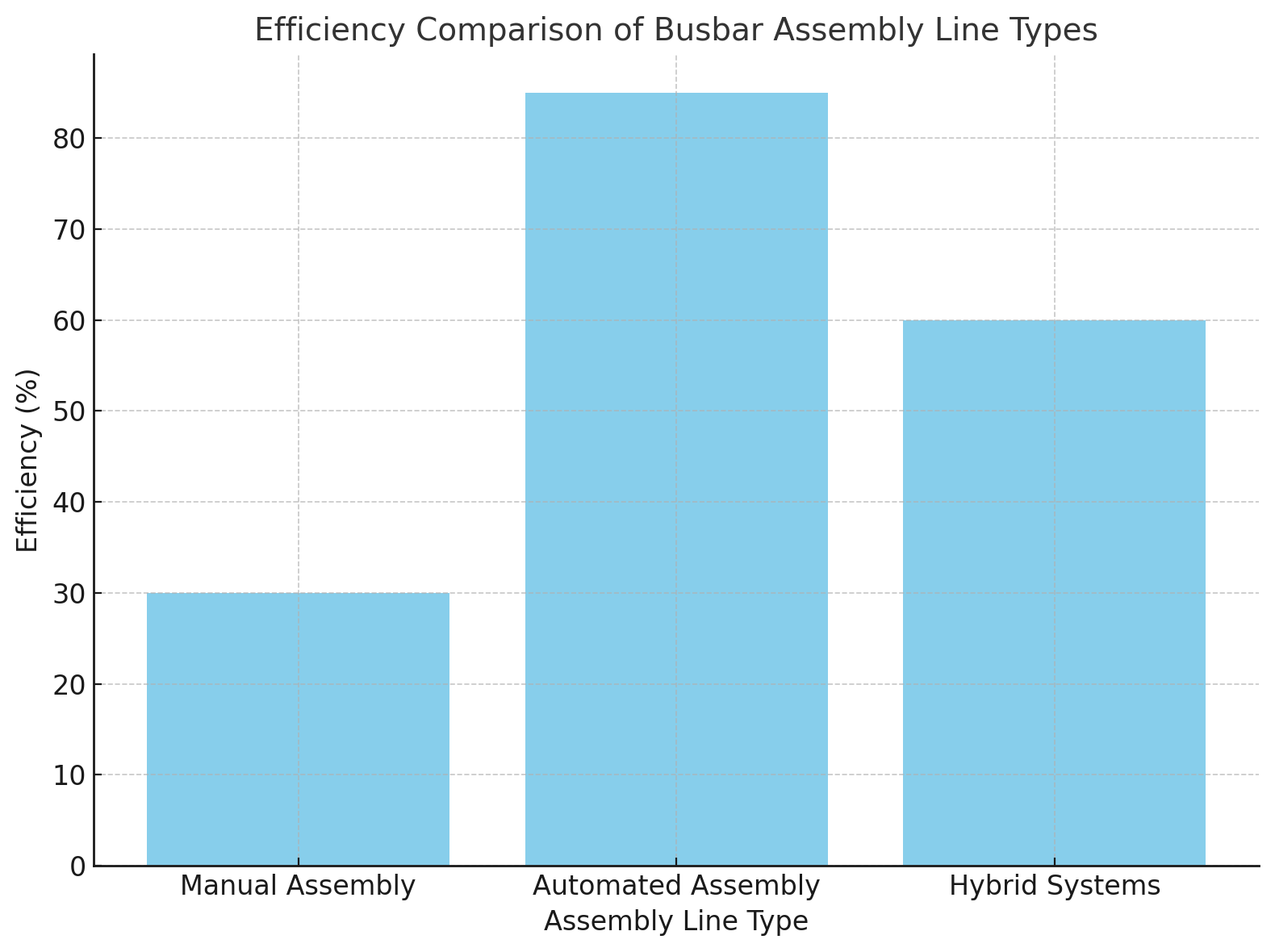
In a manual assembly line, human workers are responsible for assembling busbars. This method is labor-intensive but allows for customization and flexibility in production. However, it is slower compared to automated systems and may be prone to human error.
An automated busbar assembly line uses machines and robotics to streamline production. These systems can perform tasks such as cutting, shaping, riveting, and testing at much higher speeds with greater precision, significantly reducing errors and increasing throughput.
Hybrid systems combine both manual and automated processes. Workers may handle some tasks, while automation takes care of repetitive or high-precision tasks. This approach offers flexibility while maintaining high efficiency.
Many busbar assembly lines are designed to accommodate custom specifications, such as voltage ratings, amperage, and installation requirements. This flexibility allows manufacturers to produce a wide variety of busbars, from heavy-duty industrial busbars to lighter systems for commercial buildings.
The preparation stage involves selecting raw materials, such as copper or aluminum, and preparing them for further processing. The materials are cleaned, inspected, and cut into initial sizes before moving to the shaping stage.
The assembly process involves cutting the raw material to size, bending it as needed, and assembling the various components such as connectors, insulators, and the casing. These components are fastened together securely through riveting or welding.
Riveting and insulation are essential steps. Rivets are used to hold the busbars in place within their enclosures. Insulation materials are applied to prevent electrical faults and overheating. Insulated busbars are often used in densely populated or high-current applications.
Once the busbars are assembled and insulated, they undergo a series of electrical tests to ensure they meet industry standards. This includes checking for resistance, current handling capability, and physical integrity. Only products that pass these tests are sent out for distribution.
Automated systems significantly speed up the busbar assembly process, allowing manufacturers to produce larger volumes in less time. This increases productivity and helps meet the growing demand for busbar systems.
By automating repetitive tasks, manufacturers can reduce labor costs and improve profitability. Automation also reduces the chance of errors, which can result in costly rework or product failure.
Automated systems ensure consistent production quality. With precise control over each stage of production, automated systems reduce variability and improve the final product’s reliability.
Automation enables faster production times, which means businesses can respond more quickly to market demands, keeping up with the increasing need for busbar systems in industrial and commercial applications.
Different applications may require custom-designed busbars, which means the assembly line must be flexible enough to handle a range of sizes, materials, and configurations. This adds complexity to the design and implementation of the assembly line.
Managing raw materials efficiently is critical. Busbars are typically made from copper and aluminum, both of which require careful handling to prevent damage and ensure consistent quality.
While automated systems are efficient, they require regular maintenance to prevent production delays. Downtime for repairs can impact overall production efficiency.
Integrating a new busbar assembly line with existing production infrastructure can be challenging, especially when upgrading to more automated systems. Compatibility between new machinery and older equipment must be carefully planned.
The future of busbar assembly lines lies in increased automation. Robotics and AI technologies are becoming more prevalent, offering even higher speeds, precision, and flexibility in the production process.
Integration of IoT and smart sensors will allow manufacturers to monitor each step of the assembly line in real-time, optimizing performance and addressing issues before they arise.
Sustainability will continue to be a driving factor in the design of busbar assembly lines. Manufacturers will focus on reducing energy consumption, waste, and emissions during production.
As the demand for specialized busbar products increases, busbar assembly lines will become more customizable, allowing for on-demand production tailored to specific customer needs.
Busbar assembly lines play a crucial role in producing reliable busbars for power distribution. These lines incorporate advanced technologies to streamline production, reduce costs, and enhance product quality. By investing in modern systems, businesses can meet the growing demand for efficient power solutions. As automation, smart manufacturing, and sustainability shape the future, companies like KIANDE are leading the way in providing flexible and high-quality busbar assembly line solutions.
A: A busbar assembly line is a production system designed to efficiently assemble busbars, used in electrical distribution systems. It integrates automated or semi-automated processes to streamline manufacturing.
A: The busbar assembly line enhances efficiency by automating tasks like cutting, shaping, and assembling, which speeds up production and ensures consistent quality.
A: Key components include raw material preparation, cutting, shaping, assembly stations, riveting systems, and quality control processes.
A: Automation in a busbar assembly line reduces human error, speeds up production, and ensures higher consistency and quality in the final products.
A: By automating tasks and minimizing labor costs, a busbar assembly line reduces overall production expenses and increases profitability.
A: Busbar assembly lines produce various busbars, including copper, aluminum, and flexible types, tailored to meet different power distribution requirements.

