
Views: 0 Author: Site Editor Publish Time: 2026-06-27 Origin: Site


What if the biggest bottleneck in your busbar production line is not the lack of labor or the cost of raw materials, but the production process itself? Many electrical manufacturers still rely on separate machines for cutting, punching, and bending, believing this traditional workflow is enough to support growing production demands, but in reality, this method often causes slower cycle times, higher labor dependency, increased material waste, and greater chances of dimensional errors. As the electrical industry continues to expand rapidly in sectors such as switchgear manufacturing, transformer assembly, renewable energy systems, and EV charging infrastructure, manufacturers are under increasing pressure to improve productivity, maintain higher precision, and reduce production costs at the same time.
The challenge is clear: busbar fabrication is one of the most critical stages in electrical manufacturing because busbars serve as the core conductive pathway inside electrical systems, and any mistake during fabrication can directly affect assembly quality, conductivity efficiency, and long-term operational safety. When production volume increases, these small inefficiencies become much larger problems, leading to delayed deliveries and higher overall manufacturing costs.
In this article, we will explore what a 3 in 1 busbar machine is, how it works, why it has become an increasingly important piece of equipment for modern manufacturers, and how it compares to traditional separate busbar processing systems. By the end of this guide, you will have a clear understanding of whether a 3 in 1 busbar machine is the right solution for your production needs.
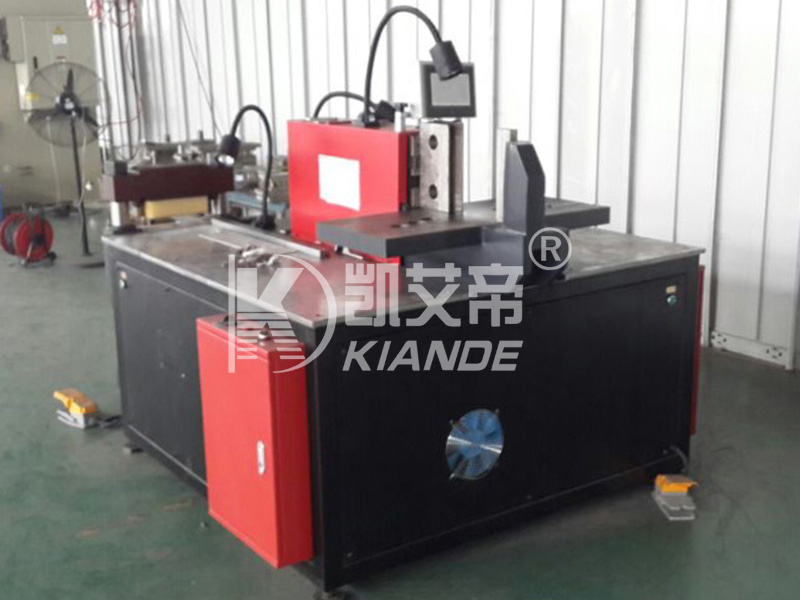
A 3 in 1 busbar machine is an integrated industrial fabrication machine designed to perform three essential busbar processing operations within one compact system: cutting, punching, and bending. Instead of requiring separate workstations and multiple operators to complete each step individually, a 3 in 1 busbar machine allows manufacturers to process busbars more efficiently through one connected workflow, significantly improving speed and precision.
The term “3 in 1” refers specifically to these three critical fabrication functions, which are essential for producing finished busbars used in electrical equipment. Since copper and aluminum busbars often need precise lengths, exact hole positions, and accurate bending angles, combining these operations into one machine reduces repeated positioning errors and saves valuable production time.
A 3 in 1 busbar machine is widely used in industries where electrical conductivity and structural precision are critical, including switchgear production, electrical panel assembly, transformer manufacturing, industrial control systems, power distribution cabinets, solar inverter systems, and EV charging stations. As electrical systems become more advanced and compact, the demand for integrated fabrication solutions continues to grow.
Busbars are not simply pieces of metal; they are the backbone of electrical current transmission inside many industrial systems. Unlike traditional wiring systems, busbars offer higher conductivity, lower resistance, and more efficient current distribution, making them essential in modern power systems.
In switchgear cabinets and electrical panels, busbars connect major electrical components such as breakers, isolators, relays, and transformers. Because these components must fit together with very high precision, busbars must be fabricated accurately.
Poor fabrication can cause several serious issues, including incorrect alignment during assembly, unstable electrical contact, increased resistance, excessive heat generation, and reduced equipment lifespan. For high-voltage systems, even small dimensional errors can create major safety risks.
This is why the 3 in 1 busbar machine has become such an important investment for manufacturers, because it directly improves fabrication accuracy and ensures consistent quality.
The value of a 3 in 1 busbar machine comes from its integrated ability to complete the three most important fabrication operations.
The cutting function is responsible for cutting raw copper or aluminum busbars into precise lengths according to design specifications. Accurate cutting is the foundation of the entire fabrication process because any length deviation will affect hole placement and bending position.
Modern 3 in 1 busbar machine systems usually use hydraulic cutting systems, which offer smoother cutting surfaces and higher force output. Some advanced models also integrate CNC positioning systems to improve length accuracy further.
The typical cutting capacity can be summarized below:
Material | Thickness Range | Width Range |
Copper | 3–15 mm | 20–200 mm |
Aluminum | 3–20 mm | 20–200 mm |
Accurate cutting helps improve final assembly speed because each busbar matches the engineering design precisely.
After cutting, the punching function creates holes for bolting, mounting, and electrical connection points. These holes are essential because they allow the busbars to be securely connected to other components.
A 3 in 1 busbar machine can usually produce various hole types, including round holes, oval holes, slot holes, and customized special shapes depending on project requirements.
Punching accuracy is extremely important because incorrect hole positions can create alignment issues during installation, leading to uneven pressure and higher contact resistance. In high-current systems, this can cause dangerous heat buildup.
Modern punching systems improve both speed and repeatability, especially for batch production.
The bending function shapes the busbar according to the required installation layout. This is often the most complex part of fabrication because busbars must fit inside compact electrical cabinets where space is highly limited.
A 3 in 1 busbar machine can perform precise bends at various angles such as 30°, 45°, 90°, and 135°, allowing manufacturers to create custom shapes for different applications.
The quality of bending directly affects installation efficiency, space utilization, and electrical safety. Accurate bends reduce stress on connection points and improve overall system stability.
The working process of a 3 in 1 busbar machine follows a logical sequence that improves efficiency by integrating multiple operations into one workflow.
First, the operator selects the appropriate raw material based on project requirements, usually copper or aluminum, while checking thickness, width, and conductivity specifications. Once the material is prepared, it is positioned inside the machine using the alignment system to ensure accurate starting points for all operations.
The cutting process begins first, where the hydraulic or CNC cutting system cuts the busbar to the required length. After cutting is completed, the material moves directly to the punching station, where the machine creates connection holes according to programmed dimensions or manual settings.
Once punching is completed, the busbar enters the bending section, where hydraulic force applies controlled pressure through bending dies to form the required shape. After the final bending operation, the finished busbar is removed and inspected for length accuracy, hole position accuracy, bending angle precision, and surface quality.
This integrated workflow significantly reduces production time compared to separate machines.
Understanding the main components helps explain why a 3 in 1 busbar machine is so efficient.
The hydraulic system provides the power needed for cutting, punching, and bending. Its pressure stability directly affects processing quality.
This includes cutting blades, punching dies, and bending molds, which determine the final precision of each process.
Modern machines may use manual, semi-automatic, or CNC controls.
Control Type | Precision Level | Best For |
Manual | Medium | Small workshops |
Semi-Automatic | High | Medium factories |
CNC | Very High | Large-scale production |
The positioning system ensures that every operation starts at the correct location, improving repeatability.
A strong frame maintains stability under high hydraulic pressure.
One of the main reasons manufacturers invest in a 3 in 1 busbar machine is because it solves several production problems at once.
First, it improves production efficiency by combining three operations into one workflow, reducing total fabrication time by 40% to 60% compared with traditional methods. This means faster order completion and better production scheduling.
Second, it saves factory space because one machine replaces three separate systems. For small and medium-sized workshops, this is especially valuable because factory floor space directly affects operational flexibility.
Third, it reduces labor costs because fewer operators are needed. Instead of requiring separate workers for cutting, punching, and bending, one trained operator can handle the entire process.
Fourth, it improves precision because the integrated system reduces repeated repositioning errors. This means higher consistency and fewer rejected parts.
Fifth, it reduces material waste because cutting, punching, and bending are all performed with higher accuracy, improving raw material utilization.
Finally, it improves ROI because the combined savings in labor, time, and material quickly offset the initial investment.
Many manufacturers still compare traditional workflows with integrated systems before making a purchase decision.
Factor | Separate Machines | 3 in 1 Busbar Machine |
Production Speed | Slow | Fast |
Floor Space | Large | Compact |
Labor Requirement | High | Low |
Positioning Accuracy | Medium | High |
Material Waste | Higher | Lower |
Workflow Complexity | High | Low |
Long-term ROI | Medium | High |
While the initial investment for a 3 in 1 busbar machine may be slightly higher, the operational advantages usually create much stronger long-term returns.
A 3 in 1 busbar machine is suitable for various business sizes.
For small workshops, it provides an affordable all-in-one solution without requiring multiple separate machines. For medium-sized manufacturers, it improves efficiency and helps support growing order volumes. For large-scale electrical factories, it offers the consistency and speed needed for mass production.
OEM manufacturers also benefit greatly because custom busbar production requires high repeatability and precise dimensions.
Choosing the right machine depends on several factors including maximum busbar thickness, width capacity, daily production volume, required precision, automation level, and budget.
For low-volume production, hydraulic manual models may be enough. For medium-volume production, semi-automatic systems offer a good balance between cost and efficiency. For high-volume factories, CNC-integrated machines provide the highest productivity.
It is also important to choose a supplier with strong after-sales support, spare parts availability, and technical training.
A 3 in 1 busbar machine is one of the most practical and efficient solutions for modern busbar fabrication because it combines cutting, punching, and bending into one integrated workflow, improving productivity, reducing labor costs, saving factory space, and increasing precision. As electrical manufacturing continues evolving toward higher efficiency and greater production demands, relying on separate machines is becoming less competitive.
For manufacturers involved in switchgear production, transformer manufacturing, electrical panels, renewable energy systems, and EV charging infrastructure, investing in a 3 in 1 busbar machine is not simply a way to improve production—it is a strategic decision that can improve long-term profitability and market competitiveness.
A 3 in 1 busbar machine performs cutting, punching, and bending in one integrated system.
Yes, most modern machines are designed to process both copper and aluminum busbars.
For most manufacturers, yes, because it improves workflow efficiency, reduces labor, and increases precision.
It is widely used in switchgear, transformer, electrical panel, renewable energy, and EV charging industries.
You should consider busbar size, production volume, automation needs, and long-term expansion plans.

