
Views: 0 Author: Site Editor Publish Time: 2025-10-28 Origin: Site


Did you know that a Sandwich busway can improve both power distribution efficiency and reduce installation costs? In industries like commercial and industrial buildings, Sandwich busways are becoming essential.
In this article, we will explore the key components of a Sandwich busway assembly line. You'll learn about the various elements that contribute to a high-quality and efficient production process.
Busbars are the primary conductors in a Sandwich busway system. Made of high-conductivity copper or aluminum, these bars carry electricity across the system. They are designed to handle high electrical loads and are stacked inside the protective housing to ensure safety and functionality.
The insulating system in a Sandwich busway prevents electrical faults by separating the busbars. These insulations are often made of air, epoxy, or mylar, which are effective in isolating the conductors and ensuring the busway operates safely.
The housing or enclosure of a Sandwich busway is a crucial component that provides physical protection for the busbars and insulation. Typically made from aluminum or steel, the enclosures protect against environmental damage, and ensure the system's safety and durability in various applications.
Fittings such as elbows, tees, and connectors are essential to the functionality of the busway system. They ensure that the busway is routed correctly, connecting components and enabling proper power distribution across different sections of the system.
Component | Description |
Busbars | The primary conductors that carry electricity. Made of copper or aluminum. |
Insulating Systems | Components like air, epoxy, and mylar that prevent electrical faults. |
Enclosures | Protective housing made of aluminum or steel that contains the busbars. |
Fittings | Elbows, tees, and connectors used to route the busway in the system. |
The preparation stage includes cutting the busbars to the required lengths and shaping them for assembly. It also involves preparing the insulating materials and components for installation. This stage ensures that all materials are ready for the subsequent assembly and riveting processes.
At this stage, the various components of the Sandwich busway are combined manually or with automated machinery. Assembly stations are strategically set up for handling different types of busway systems, ensuring a streamlined process that minimizes delays and errors.
Rivets are used to secure the busbars within the housing. Automated riveting systems are often employed to speed up the process and ensure that the busbars are firmly secured. This is a critical part of the assembly line, as it guarantees the busway’s structural integrity.
Once the busbars are positioned, insulation materials are applied to ensure that the system is electrically safe. The insulation also protects the busbars from potential environmental damage, such as corrosion or thermal wear, extending the system’s lifespan.
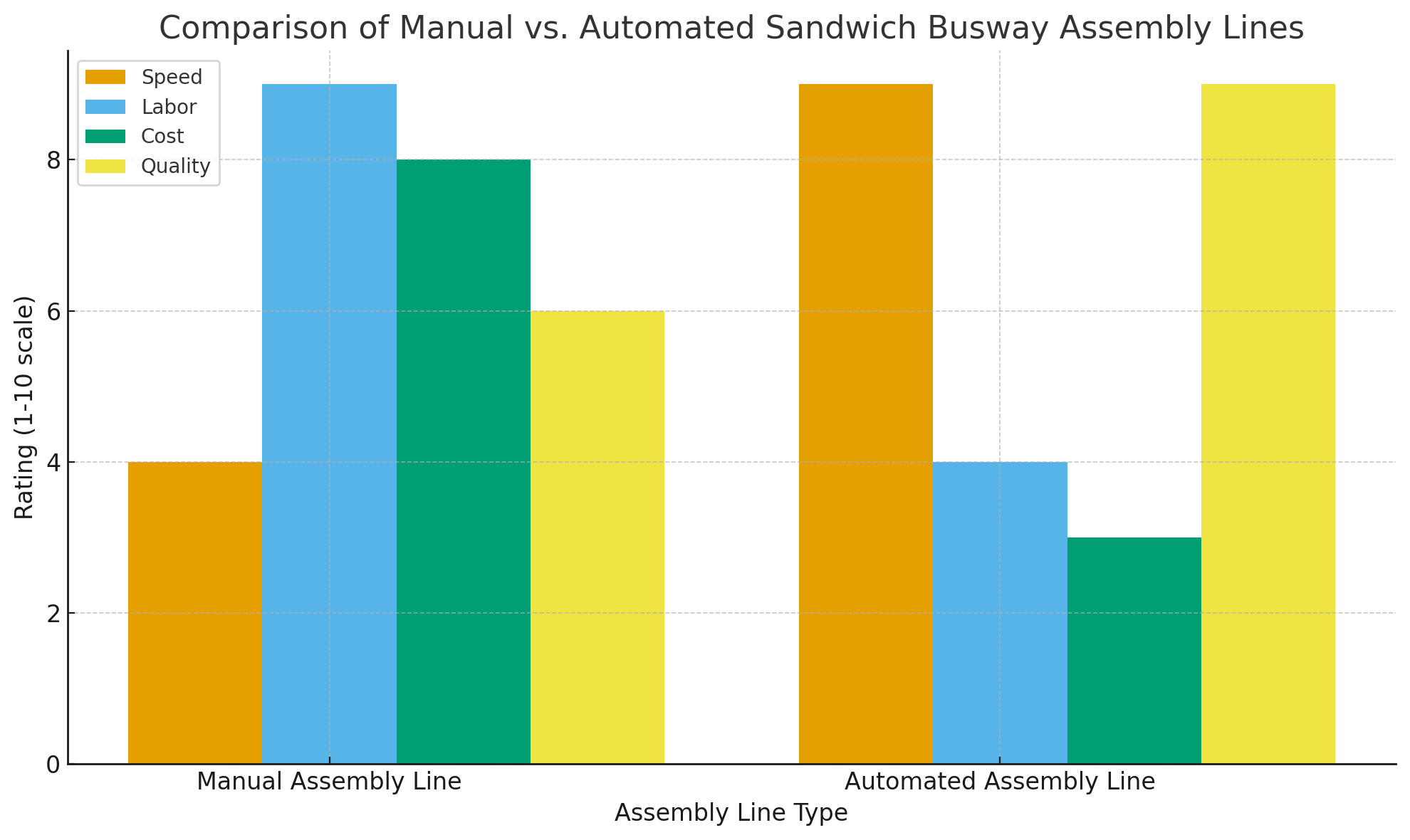
Manual assembly lines involve workers handling and assembling the components, often for smaller-scale production. Automated Sandwich busway assembly lines use robotic systems to perform tasks like cutting, riveting, and insulation application. Automated systems offer increased speed and consistency, making them ideal for high-volume production.
A Sandwich busway assembly line can be customized to produce different types of busways, such as those for high-voltage or low-voltage applications. Customization is crucial for meeting specific requirements related to power, voltage, and current ratings, ensuring the system performs optimally for each installation.
Different busway designs, such as compact or flame-retardant busways, can affect how the assembly line operates. The flexibility of the assembly line ensures that the manufacturing process can adapt to these varied design needs, providing businesses with tailored solutions for specific applications.
Automated Sandwich busway assembly lines significantly improve production speed. The ability to quickly assemble, rivet, and insulate busways reduces lead times, allowing companies to meet market demand more efficiently. This is especially important for industries like data centers, where time-sensitive installations are common.
The efficiency of automated systems helps to lower labor costs and reduce material wastage. By optimizing the manufacturing process, Sandwich busway assembly lines can significantly lower the overall production costs, making them a cost-effective solution for businesses.
Automated systems not only increase production speed but also improve energy efficiency. By reducing the energy consumption during manufacturing and using less material than traditional cable systems, Sandwich busway assembly lines offer an eco-friendly alternative to conventional electrical distribution methods.
Quality control is essential in ensuring that all components meet safety and performance standards. During production, each unit undergoes inspection, including visual checks, electrical tests, and safety assessments, to guarantee that the final product is free of defects and operates as intended.
After assembly, Sandwich busway systems are subjected to voltage, current, and insulation tests. These tests confirm that the product can handle its rated load and is safe for installation in electrical systems. Failure to pass these tests results in immediate rework or rejection.
To ensure compliance with industry regulations, Sandwich busway systems must meet various certifications, including NEMA, UL, and IEC standards. Meeting these standards guarantees that the busway system will be safe, efficient, and legally compliant for use in various industries.
As technology advances, Sandwich busway assembly lines are becoming increasingly automated. Robotics and AI technologies are expected to play a larger role, enhancing production speed, precision, and safety while reducing human error.
Integrating smart technologies like IoT into the assembly process will allow manufacturers to monitor production in real-time. These advancements will improve operational efficiency and allow for predictive maintenance, ensuring longer operational lifespans for busway systems.
The growing emphasis on sustainability in manufacturing processes is driving innovation in the Sandwich busway industry. Manufacturers are adopting eco-friendly materials and processes, reducing the environmental impact of production while increasing system efficiency.
The components of a Sandwich busway assembly line—busbars, insulating systems, enclosures, and fittings—are essential for creating an efficient and reliable electrical distribution system. An optimized assembly line ensures faster production, cost savings, and higher-quality results, especially with automated systems.
Looking ahead, technological advancements will enhance the efficiency and customization of these assembly lines. Businesses should consider investing in automated systems to improve production and reduce costs, ensuring they meet growing demand for cost-effective electrical solutions. KIANDE’s Sandwich busway assembly line equipment offers these advantages, delivering reliable and high-quality products for a wide range of industries.
A: The key components of a Sandwich busway assembly line include busbars, insulating systems, enclosures, and fittings. These ensure the system's efficiency and reliability.
A: An automated Sandwich busway assembly line enhances production speed, reduces labor costs, and ensures consistent, high-quality output.
A: Automated systems streamline the assembly process, saving time and reducing errors while improving product quality and consistency.
A: Investing in a Sandwich busway assembly line helps businesses meet demand efficiently, reduces long-term costs, and improves reliability in electrical distribution systems.
A: Sandwich busway assembly lines can be customized to accommodate different voltage, current requirements, and specific busway types, ensuring flexibility in design.

