
Views: 0 Author: Site Editor Publish Time: 2026-06-27 Origin: Site


Catastrophic electrical failures often trace back to manufacturing defects. Arc flashes or thermal runaways can result from micro-cracks in insulation. Poor joint integrity poses severe risks to entire electrical networks. In high-stakes power distribution, relying on manual sample testing is no longer sufficient. Strict international standards demand verifiable quality. IEC and UL regulations expect consistent execution every single time.
A dedicated Busbar Inspection Machine bridges the gap between raw manufacturing and field deployment. It automates critical checks to guarantee compliance across production runs. This technology eliminates human error entirely. Manufacturers rely on it to deliver audit-ready data seamlessly, ensuring safe field performance.
Error Elimination: Automated inspection removes the subjectivity and fatigue associated with manual visual and electrical checks.
Comprehensive Testing: Modern machines integrate hipot testing, insulation testing, and contact resistance checks into a single seamless workflow.
Regulatory Compliance: Automated data logging ensures every piece of busduct or busbar meets strict IEC 61439-6 and UL 857 standards before it leaves the facility.
Risk Mitigation: Transparent ROI comes not just from labor savings, but from the prevention of product recalls, field failures, and liability claims.
Traditional manufacturing environments face immense pressure to accelerate production. Manual visual checks routinely miss microscopic plating defects. Early-stage oxidation often goes unnoticed by the naked eye. Human operators simply cannot measure minute dimensional deviations consistently over an eight-hour shift. When manufacturers rely solely on manual busbar quality control, they accept a higher risk of field failure.
Setup times for manual testing create severe labor and throughput bottlenecks. Operators must physically connect and disconnect probes for every test phase. High-volume environments suffer compounding delays when testing stops production flow. Furthermore, inconsistent documentation plagues standard compliance audits. Paper forms or basic Excel checklists lack automated timestamps. This makes reliable traceability nearly impossible. Tracking trend analysis during strict quality audits becomes a guessing game.
Success criteria for automation require repeatability and speed. Systems must provide objective pass or fail parameters immediately. They also need automated data archiving to ensure robust compliance. Modern manufacturing demands continuous, digital verification.
Evaluation Metric | Manual Inspection Process | Automated Inspection System |
|---|---|---|
Defect Detection | Subject to human fatigue; microscopic flaws often missed. | Objective optical sensors detect minute dimensional deviations. |
Throughput Speed | Slow; requires manual probe setup and manual data entry. | High; seamless transition between multiple testing parameters. |
Data Traceability | Prone to transcription errors; lacks digital timestamps. | Cloud-connected; provides irrefutable timestamps and instant logs. |
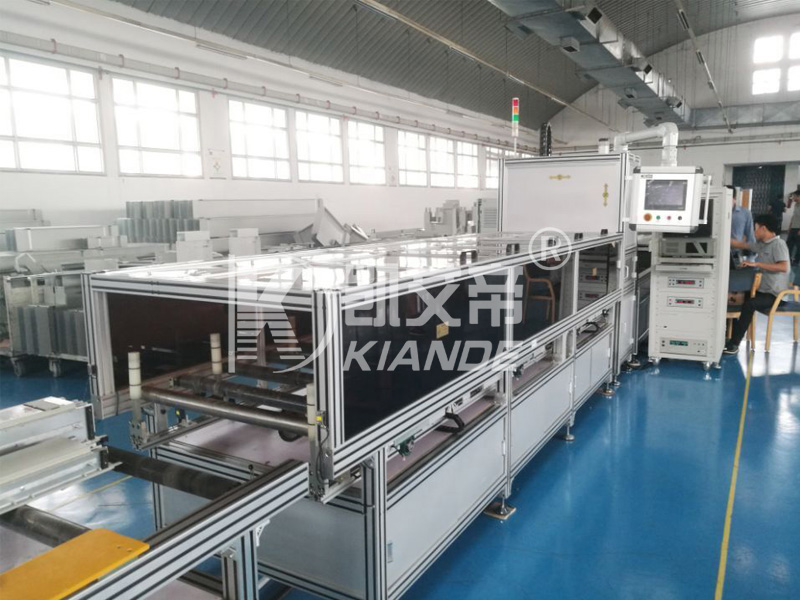
Integrating comprehensive electrical testing directly into the production line is critical. A modern testing unit executes several essential evaluations concurrently. It transforms a disjointed process into a unified quality gate.
First, hipot testing (dielectric withstand) applies high voltage to the conductor. It verifies insulation can withstand peak overvoltage without breaking down. This step actively prevents fatal shorts in the field. It pushes the component slightly beyond operational limits to confirm structural integrity.
Second, insulation testing and partial discharge (PD) checks identify localized weaknesses. They reveal micro-cracks or hidden voids in the insulation material. Left unchecked, these flaws inevitably lead to surface tracking. Material degrades steadily over time if voids remain undiscovered.
Third, electrical continuity and micro-ohm testing measure contact resistance at joints. Field experience shows a stark reality regarding connection integrity. Even a 30% drop in proper connection torque increases joint temperature by 80-100°C under load. This rapid heat accumulation easily triggers thermal runaway.
Finally, automated dimensional and visual checks utilize high-resolution optical sensors. They verify hole tolerances, surface flatness, and plating thickness. Accurate physical dimensions guarantee secure mechanical assembly once deployed in the field.
Test Category | Primary Function | Safety Outcome / Risk Mitigated |
|---|---|---|
Hipot Testing | Applies severe overvoltage stress | Prevents sudden dielectric breakdown and fatal shorts. |
Insulation & PD | Checks resistance and internal voids | Stops long-term material degradation and surface tracking. |
Micro-Ohm Testing | Verifies joint contact resistance | Averts excessive heating and subsequent thermal runaway. |
Optical Scanning | Measures physical tolerances | Ensures proper field assembly without structural stress. |
Global standards dictate strict verification rules for electrical components. Automated testing aligns directly with IEC 61439-6 requirements. These rules govern low-voltage busbar trunking systems worldwide. In North America, UL 857 sets the absolute benchmark for power distribution safety. Machines ensure precise adherence to these critical safety frameworks daily.
ISO 9001 compliance relies heavily on consistent traceability. Automated logging captures every test metric instantly. Systems record applied voltage, measured resistance, and ambient environmental humidity. This immediate data capture provides an irrefutable digital paper trail. QA audits become straightforward and highly reliable when operators simply export digital logs.
Furthermore, RoHS compliance requires stringent environmental integrity. RoHS primarily functions as a material standard restricting hazardous substances. However, modern inspection machines help verify component purity visually or through integrated material checks. They ensure environmentally compliant components never mix inadvertently with non-compliant batches during assembly.
Choosing the right equipment requires clear operational criteria. Buyers must first decide between inline integration and standalone setups. Inline systems provide continuous busduct inspection for massive production runs. They sit directly on the conveyor line. Conversely, standalone testing stations suit custom fabrication perfectly. They handle variable batch environments without disrupting primary workflows.
Next, evaluate software data architecture carefully. Modern operations demand seamless ERP integration. Determine whether the machine outputs isolated, siloed data on a local drive. Ideally, it should connect via API or IoT directly into enterprise CMMS systems. Real-time quality monitoring depends heavily on this network connectivity.
Finally, prioritize intrinsic machine safety features. The equipment itself must protect operators from high-voltage hazards. Always look for these essential hardware safeguards before purchasing:
Interlocking physical guards: Mechanical barriers halt all operations immediately when opened by an operator.
Light curtains: Infrared barriers detect human proximity and cut power before contact occurs.
Overload protection sensors: Internal monitors prevent electrical damage if testing currents exceed safe thresholds.
Accessible emergency stops: Prominent kill switches located on all operational sides of the machinery.
Transitioning to automated systems involves specific implementation realities. Understanding these operational factors ensures a smooth rollout process. Facilities must prepare for changes beyond simply plugging in new hardware.
First, acknowledge the initial Capital Expenditure (CapEx). Enterprise-grade automated testers require significant upfront investment. However, facilities typically offset this expense rapidly. Reduced labor requirements accelerate the financial return. Achieving zero-defect downstream rates also prevents costly product recalls later.
Second, plan for rigorous calibration and maintenance. Precision sensors, internal hipot testers, and micro-ohm meters need strict periodic calibration. They maintain accuracy only through consistent upkeep. It is never a simple set-and-forget scenario. You must budget time for annual certifications.
Third, anticipate system integration friction during deployment. Linking proprietary machine software with legacy factory management systems often creates compatibility hurdles. Prepare internal IT teams for data translation tasks. They must map testing outputs to existing quality control dashboards accurately.
Lastly, prioritize operator upskilling comprehensively. Staff must transition from performing manual tests to managing advanced CNC machinery. They need dedicated training. Operators must learn to troubleshoot equipment, resolve sensor faults, and interpret complex data outputs confidently.
A busbar inspection machine represents much more than a speed upgrade for manufacturers. It acts as a critical safeguard enforcing strict industry compliance. It actively protects brand reputation by preventing catastrophic electrical failures in the field. Digital traceability replaces unreliable paper trails entirely.
For facilities scaling production or entering heavily regulated markets, upgrading is vital. Moving to automated electrical testing signifies a necessary operational maturity step. It shifts quality control from subjective guessing to objective certainty.
Audit your current manual QA pass and fail rates today. Identify where bottlenecks and false passes occur. Consult with an equipment integration specialist to map out a pilot automated testing line for your facility.
A: Insulation testing (IR) measures total resistance to current leakage. It usually outputs results in Megohms to identify generalized material weakness. Conversely, hipot testing applies a deliberate, extreme overvoltage to the busbar. It ensures the insulation will not physically break down or arc under sudden electrical stress.
A: Yes. Modern multi-axis machines and programmable logic controllers (PLCs) handle high variability. They allow operators to set custom testing parameters and spatial coordinates. This flexibility easily accommodates varying busbar geometries and custom bends used in specialized distribution panels.
A: Automated systems remove the operator from direct contact with high-voltage testing environments. By utilizing interlocked safety guards and infrared light curtains, machines isolate the testing zone. This virtually eliminates the risk of accidental shock during routine QA procedures.

